Artwork Search
Arts in Southeast Asia Database
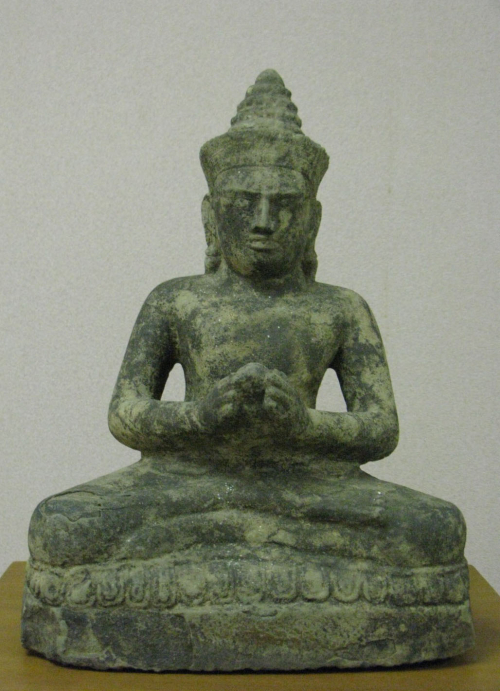

SculpturePhra Phaisachayaguru
The sculpture is sitting on a base in a meditation position, decorated with lotus petal pattern. It is wearing a crown with a visor and layers of tiaras and round shape earrings on the ears. The upper part of the body is bare and both hands are holding a pot of water in a stomach position.
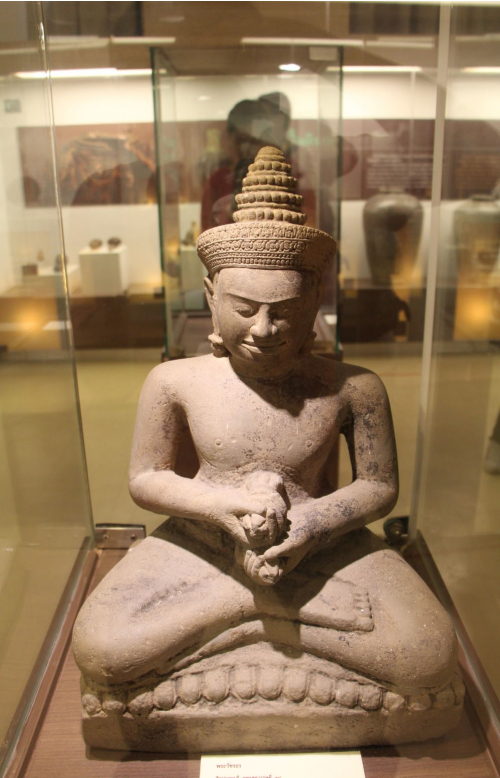
SculpturePhra Phaisachayaguru
The sculpture is sitting on a base in a meditation position, decorated with lotus petal pattern. The face is in a square shape. The eyebrows are sharp and nearly straight and the eyes are widely open. The mouth is protruding. It is wearing a crown with a visor and layers of tiaras and round shape earrings on the ears. The upper part of the body is bare and both hands are holding bolts in front of the stomach.
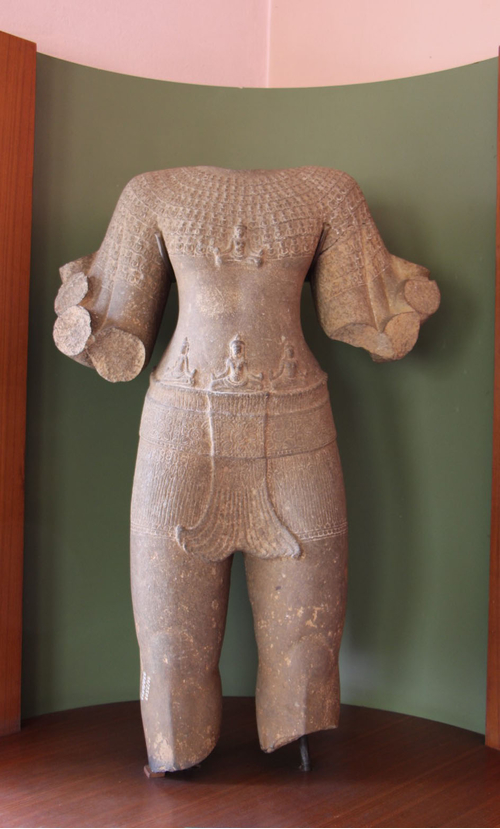
SculptureThe radiant Avalokiteshvara Bodhisattva
The radiant Avalokiteshvara Bodhisattva is in a standing position but with missing limbs as in the head, hands, shins, and feet. The chest, shoulders and upper arms of the body are decorated with many rows of Buddha images that looks like armor.There is a large image of a person in the middle of the chest and the waist and this might refer to Prachya Paramita. The image wears shorts with roughly engraved pattern. Its lower body from the thigh to the feet is in disproportion according to the sculpture in Bayon style.
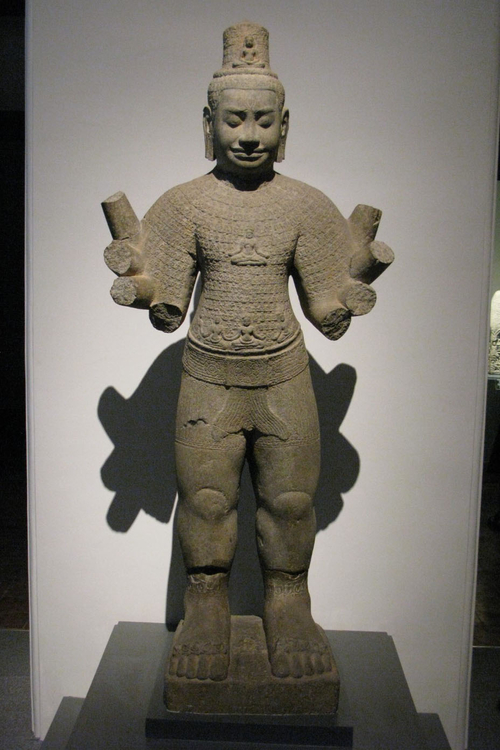
SculptureThe radiant Avalokiteshvara Bodhisattva
The radiant Avalokiteshvara Bodhisattva is standing on a square base. Its condition is complete except for the 8 hands that are missing. The sculpture has a square face, closed eyes, with the corners of the mouth lifted slightly as in Khmer Arts, Bayon style. The hair is put up in a cylinder shape and the hair is decorated with the image of Amitabha Buddha and many other Buddha images. The upper part of the body is decorated with rows of Buddha images that looks like armor. There is a large image of a person in the middle of the chest and the waist and they might refer to Prachya Paramita. All 8 hands are missing. The image wears shorts with roughly engraved pattern. His lower body from the thigh to the feet is in disproportion. Every toe has on a ring.
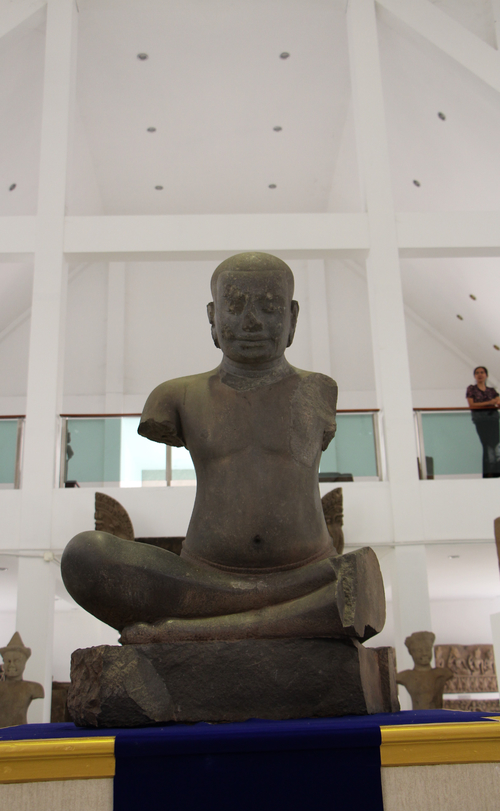
SculptureKing Jayavarman VII
Both arms and the left knee of the sculpture of King Jayavarman VII are missing. The sculpture has a plump body, square face, closed eyes with the corners of the mouth lifted slightly; its long hair is put up in a bun shape. The upper part of the body is bare and the lower part is clothed in shorts. The sculpture is sitting in a cross-legged position. The arms are missing so it is unknown as to which gestures the sculpture is making. However, some suggested that it is positioned to pay salutation by putting the palm together; because if the arms are on the laps or in a meditating position, there will certainly be a handprint on the lap.
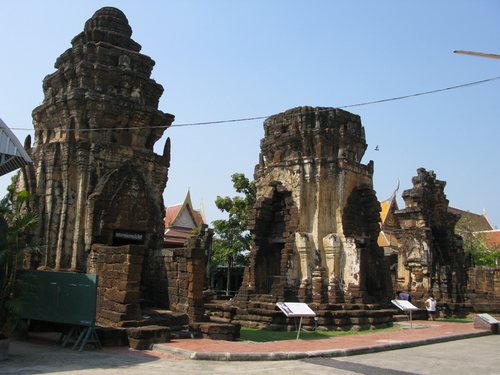
ArchitecturePrasat Kumpanglang
Prasat Kumpanglang is surrounded by a square laterite wall. It is facing east. Inside the laterite wall is the location of four laterite prasats in Khmer Arts. The 3 prasats in the front were arranged in a north-south line. The principle prasat is taller than the other two. This is similar to Prang Sam Yod in Lopburi.The fourth prasat is located behind the principle prasat on the east side. Stucco patterns appear on this prasat. In the front there is a gopura or an entrance. Inside the laterite wall on the eastern area appears a pond. Important artifacts that were found here are the radiant Avalokiteshvara Bodhisattva, the body part of the 4- arm Avalokiteshvara Bodhisattva, the body part of a Buddha image Sheltered by a Naga, and the head of Prachya Paramita. The use of laterite as the main material for the construction and the layout of the diagram displays the motto of the Buddhistic Triad. The northern prasat is Prachya Paramita, the central prasat is the Buddha image Sheltered by a Naga, and the southern prasat is Avalokiteshvara; the arrrangement of the idols like this is found in Mahayana Buddhism during the 18th century B.E. in the reign of King Jayavarman VII; therefore, the age of the site can be determined to be contemporary with King Jayavarman VII. The Preah Khan Inscription of Cambodia mentioned Mueang “Srichaiya Watcharapura” (Mueang Phetchaburi) that it was one of the six ancient Mueangs in the Central Region where one of 23 Pra Chaiya Buddha Mahanat had been sent from Mueang Phra Nakhon Luang to be enshrined in Mueang Phetchaburi. When compared to the ancient ruins, it can be confirmed that this Prasat Kumpanglang is the prasat mentioned in the inscription. Prasat Preah Khan is a prasat that is contemporary with King Jayavarman VII as well.
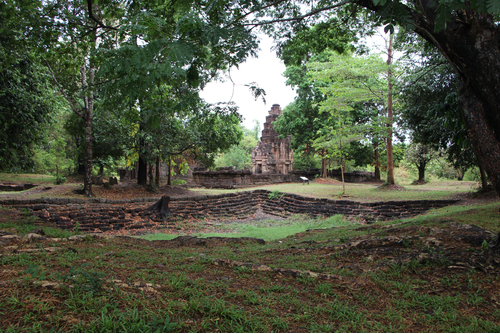
ArchitecturePrasat Ta Muan Tot
Prasat Ta Muan Tot is a chapel “Arogayasala”. It was built to treat diseases during the reign of King Jayavarman VII during the 18th century B.E. The architectural elements of the Arogayasala are the same everywhere. There will be one principle prasat made of laterite and sandstone. It is a square diagram with recessed corners. The top part was carved with sandstone in the lotus petals pattern. There is only one entrance and exit, the other 3 sides are false doors. The entrance was made as a long room with a porch in the front. The roof was made of sandstone and laterite. There is a Banalai in a rectangular diagram built from sandstone and laterite on the east of the principle prasat. There is one entrance and exit. The eastern area is surrounded by an inner wall and under a laterite arch door that is divided into 3 booths. A stone inscription, built around the 18th century B.E., inscribed in Khmer letters, Sanskrit language was found around the booths and it is currently at Wachirayan Book Hall, Bangkok. The inscription mentioned Phra Phaisachayaguru, the Bodhisattva who granted people a healty life. It also stated that King Jayavarman VII donated materials and equipment and arranged staff to stay in the hospital as well. The north-eastern side of the prasat appears a pond.
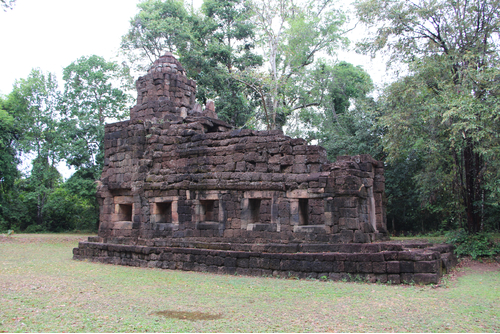
ArchitecturePrasat Ta Muen
The diagram of Prasat Ta Muen is a characteristic of an archaeological site called "Dharamshala or a traveler's lodge" which King Jayavarman VII, around the 18th century, had ordered to build along the important routes throughout the kingdom. The place is a single prasat constructed with laterite and sandstone. The diagram is a square with recessed corners. The front of the prasat is a long room built of laterite. There is a door connected to the prasat on the west. This long room has one wall cut into a row of windows. Other walls were made of false windows. There is one entrance and exit on the east with a sandstone lintel carved into a Buddha image sitting cross-legged in a meditating position.