Artwork Search
Arts in Southeast Asia Database


SculptureThe Buddha Image on Vanaspati
The Lord Buddha stands on a vehicle and surrounded by two people, one on each side. Both hands depict the giving sermon attitude and there is a hole on the leg. The vehicle is a large half-body human with wings. The vehicle wears a tube-shaped crown and holds lotus in each side of the hands. Some scholars called this type of vehicle Phra Arunathip or the sun. Above each lotus is a standing human. Despite being damaged, it can still be seen that one human holds a whip. It is therefore assumed that these people are Indra and Brahman.
SculptureThe Twin Miracles Sculpture
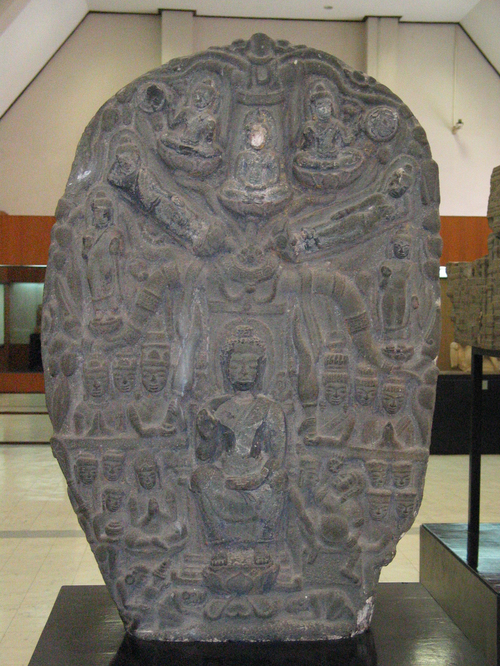
This rock-craved sculpture depicts the twin miracles scene at Sawasti to fight the non-believers. The Lord Buddha sits on a throne with dropping leg and the right hand is in the giving sermon attitude.Both sides are surrounded with people. On each side, there is a horizontal line dividing people into two groups. This might mean that under the straight line is the earth and over the straight line is heaven. Therefore, the group of people under the line on the right of the Lord Buddha might be King Pasenthikosol and his followers, whereas people on the other side might be the defeated non-believers. The group of people above the line might be people on the heaven. On the right, it might be Indra and other gods, whereas on the left might be Brahman. On the branches of the tree, there are 7 Lord Buddha in different postures.
SculptureConnecting block
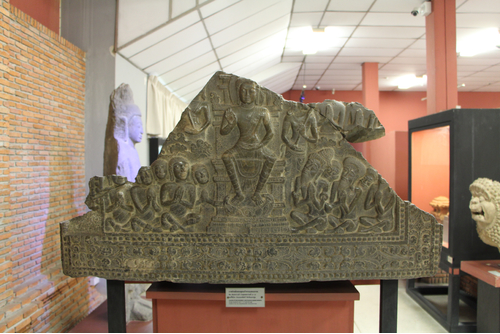
The connecting block is utterly ruined. Made of stone, the connecting block is a square hunk of stone with a through hole in the middle and serves to connect the Dharmacakra to the pillar. The four sides of the block depict the First Sermon and are in s state of disrepair. Only one side gives details adequate for studying. The Buddha is seated in the European style on the throne, his right hand is showing preaching gesture, and his left hand is placed on the lap. Five Brahmins sitting below on the left hand side of the Buddha might possibly represent the Five Disciples before Buddhist ordination; while, on the right side, five Buddhist monks are sitting there, convincingly considered as the Five Disciples after entering monkhood. The figures right behind the Five Disciples on both sides could be deities and the Brahma devas.

SculptureHead of Buddha Image
The head of Buddha Image has a round face, broad forehead with connected eyebrows. The Buddha also has protuberant eyes looking down towards the floor; a huge nose; protruding lips; short and tight ringlet curls; and a Uṣṇīṣa shown as a cranial protuberance. There is a hole in the Uṣṇīṣa which possibly used to be decorated with an aureole made of gemstone or might be the space for enshrining Śarīra or relics of the Buddha.
SculptureDharmachakra
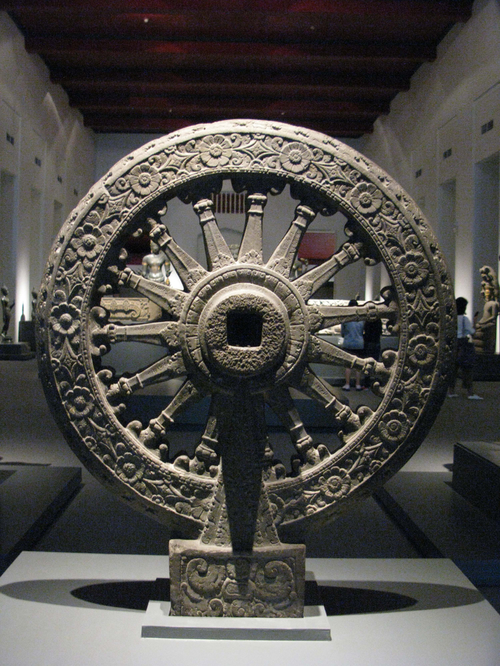
The Dharmacakra consists of 3 significant parts, that is, a hub in the middle, spokes the spaces between which were cut through and make it look thin, and the outer part of the Wheel which is a felloe was carved with round flower and lozenge patterns. The rim of the felloe was engraved with a decorative flame motif. The triangular lower part of the Wheel serves to bear its load and connects to a square base. Many parts of the Wheel bear Pali inscriptions using Pallava script which describe the Buddhist Doctrine, namely excerpts from Dhammacakkapavattana Sutta.
SculptureDharmachakra
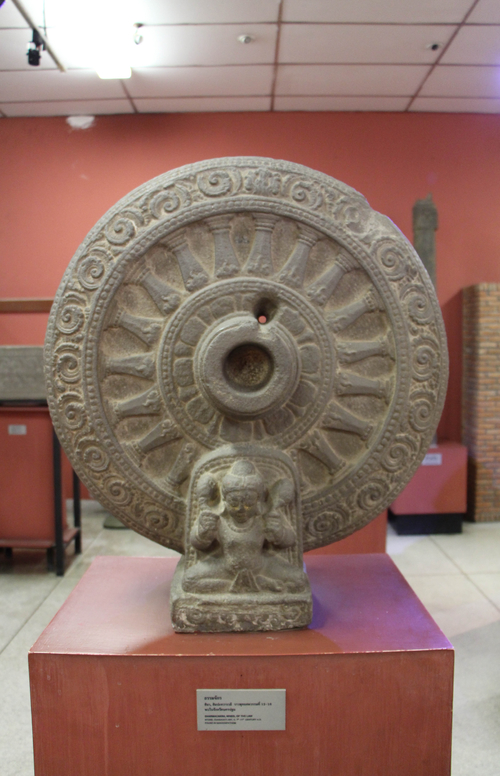
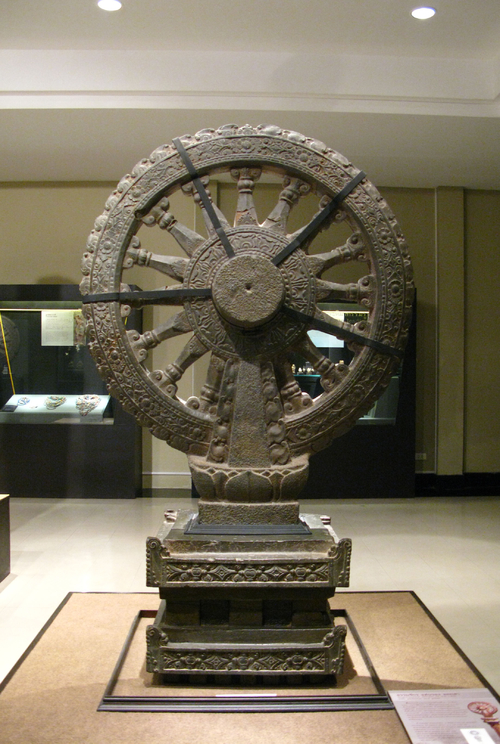
The Dharmacakra includes 3 main parts, namely a hub above which there is a through hole; spokes the spaces between which weren’t cut through and make the wheel look thick; and a felloe ornamented with a Kankhot or alternating lozenge motif. The lower part of the Wheel depicts an individual sitting cross-legged with a lotus in each hand which may represent Surya.
SculptureDharmachakra
This emsemble of Dharmacakra is complete, as it includes 3 parts, namely an octagonal pillar, a square socle, and a Wheel of Law. The square socle helps hold the wheel firmly on the pillar.The round wheel of law consists of 3 main components as follows: a hub, spokes, and a felloe. The spaces between spokes were cut through, and they make the Wheel look thin. The outer part of the Wheel is the felloe carved with a pattern of round flowers and rhombi. The rim of the felloe was carved with a Thai motif called Kanok which resembles flames. The triangular bottom part of the wheel serves to bear its load, and the socle below decorated with a pattern of lotus petals comes with a tenon joint which fits a mortise hole underneath the wheel. In the lower part, the square connecting block is ornamented with a pattern of round flowers and rhombi; and the four corners of the socle depict a Makara motif. The block was cut through as a mortise hole which serves to fix the wheel to the Dharmacakrastambha or the pillar. The lowest part of the octagonal pillar is a square base carved with a Hamsa motif; and on top of it, the bottom of the pillar resembles lotus petals. The top of the pillar was engraved with a pattern of flower garlands and flower tassels. The upmost part of the pillar is a top tenon for insertion into a mortise beneath the square socle.
SculptureThe attitude of subduing Mara
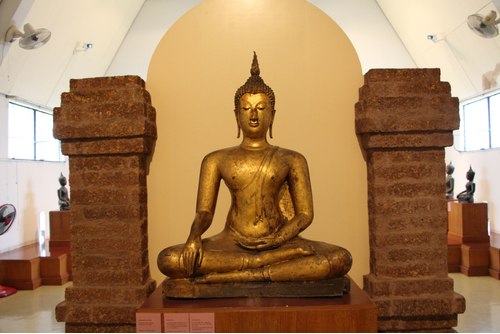
The image is seated in a basic cross-legged gesture on the plain base while the hands are doing the attitude of subduing Mara. The significant features that classify the image under the General Group are the oval face, the curved eyebrows, the low gazing eyes, the aquiline nose, the well-proportioned lips, the big hair curls like a whorl, high swelling Usanisa, the flame-liked halo, wearing cross-body robe with no crease, and the long small outer robe reaching the navel which the edge is folded known as the centipede fangs. There is the name of its creator and the desire in building it.