Artwork Search
Arts in Southeast Asia Database
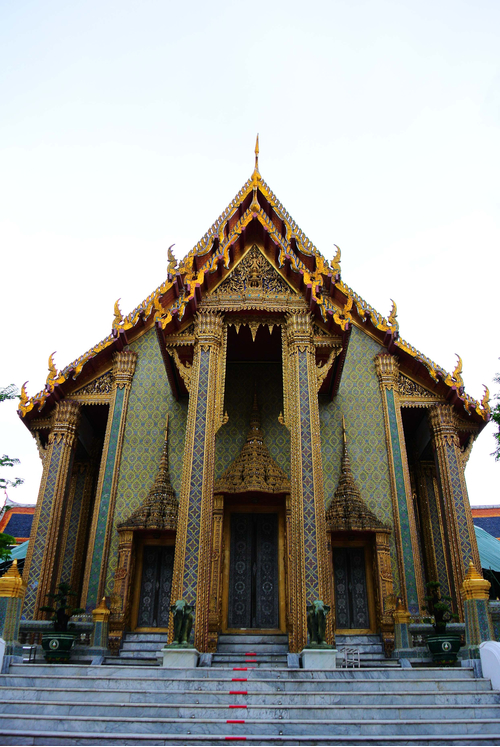

ArchitectureWat Ratbophit Sathitmahasimaram
The Ubosot is in Thai traditional style. The masonry building has wooden roof with ceramics tiles. The wall is furnished with five-colored glazed porcelain tiles and deity motifs. The roof structure was built from wood and roofing with ceramics tile and decorated with Thai traditional ornament. The main pediment illustrates a seven headed elephant carrying a pedestal tray with a coronet flanked by tiered-umbrellas held by a lion and a Gajasimha (half elephant and lion). The second pediment depicts Narayana on GarudaGlided and stucco door and window pediments are in a traditional Thai roof form with decoration. The interior door panels are adorned with lacquer and glided lotus bud or Phum Khao Bin motifs; while the exterior of each door panel illustrates five different first class Royal Decorations, namely the Ancient and Auspicious Order of the Nine Gems, the Most Illustrious Order of the Royal House of Chakri, Knight Grand Cordon (Special Class) of the Most Illustrious Order of Chula Chom Klao, Knight Grand Cross (First Class) of the Most Exalted Order of the White Elephant, and Knight Grand Cross (First Class) of the Most Noble Order of the Crown of Thailand. The interior of the Ubosot was decorated in Neo-Gothic style of the western art, and the Ubosot also enshrines the principal Buddha Image named Phra Phuttha Angkhirot.The bell-shaped Chedi with round ground plan features a bell-shaped Gharbhaya supported by a multi-tiered flower garland moulding with a five-coloured-glazed porcelain decoration similar to that of the Ubosot’s interior wall. The Chedi is in a galleried-enclosure with a colored-glazed porcelain tiled roof. Round pillars supporting the gallery are made of marble and come with lotus capitals. The Vihāra is a traditional Thai building which is similar to the Ubosot but has some different features, that is, the Vihāra is smaller than the Ubosot. Its wooden window and door panels are not pearl-inlaid, but they are carved in Royal Decoration patterns, lacquered, gilded and painted.
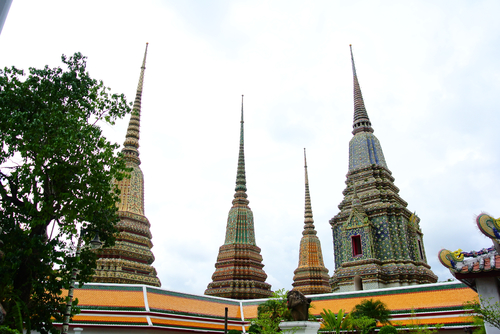
ArchitecturePhra Maha Chedi Si Ratchakan
Phra Maha Chedi Sisanphetchadayan, Phra Maha Chedi Dilokthammakaroknitan and Phra Maha Chedi Munibatborikhan are all Chedi Songkhrueang of redented Chedi on a redented tiered pedestal which achieved its popularity during the reign of King Rama 3 with some distinctive artistic traits of those of the late Ayutthaya period as follows: the lower architectural elements include multi-tiered pedestals with lion-legged corners (Than Singha or lion bases) and Bua Khlum or lotus petal mouldings. The Gharbhaya (hemispherical domes) in shape of a bell with four-redented corners, and superimposed lotus petal mouldings, conical spires, single bead mouldings, and upmost conical spires. All of the architectural elements are adorned with glazed porcelain and pottery with different patterns. Phra Maha Chedi Sisanphetchadayan is ornamented with green glazed pottery, Phra Maha Chedi Dilokthammakaroknitan is decorated with white glazed porcelain, and Phra Maha Chedi Munibatborikhan is adorned with yellow glazed pottery. The Chedi erected by King Rama IV ทรงสร้าง a redented Chedi, decorated with deep blue glazed porcelain. This type of Chedi had been popular since the mid-Ayutthaya period onwards.
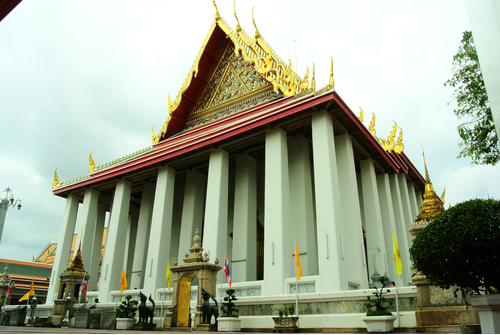
Architecturethe ordination hall of Wat Phrachetuphon Wimonmangkhararam
The Ubosot is a masonry building in traditional Thai style. Its pediment is decorated with traditional Thai roof finials, gilded and ornamented with glass mosaics. The building has square masonry supporting columns without lotus caapital. The boundary wall’s exterior framings surrounding the Ubosot are decorated with marble bas-relief sculptures depicting Ramayana or Rammakian. The doors’ exterior panels are decorated with pearl inlay depicting figures of character in Rammakian, while the interior panels are decorated with lacquer works depicting fans of rank for Phra Rachakhana, Phra Khru Sanyabat and Phra Khru Thananukrom belonging to the Gamavasi and the Arannavasi sections from both pronvinces and bangkok. The mural painting of the Ubosot is painted: the panels above the interior window casings depict Mahosadha pandit or Mahā Ummagga Jātaka, the walls between door and window casings display the stories of the top disciples, and the interior window panels are decorated with lacquered position seals of the monk leaders in the cities and in the provinces during the reign of King Rama III. The exterior window panels are carved in Kaeochingduang patterns or overlapping circles and lozenge flowers.
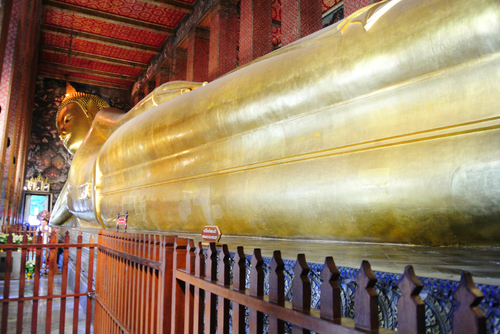
SculptureReclining Buddha
The Buddha lies on his right side or Sihasaiyat. His right hand supports his head supported by a square pillow ornamented with Chinese floral motifs. The Image shows Rattanakosin artistic characteristics, that is, a calm face, eyes looking down towards the floor, arched eyebrows, thin lips, long ears, small ringlet hair curls, an Uṣṇīṣa, and a flame-shaped aureole. Also, the Buddha wears a thin, plain monastic robe along his left arm while exposing his right shoulder. The Sanghati or uppergarment covers his left shoulder along to his navel, and the hem of the uppergarment falls in undulating folds. The ankle-length Antaravasaka lower garment has a front pleat-fold, and the strap of the belt is shown.Both feet of the Buddha is decorated with pearl-inlaid chakra and 108 auspicious illustration motifs. The 180 auspicious illustrations can be categorized as follows: 1. Symbols of fortune and abundance, i.e. Purna-ghata or water pots, twin fish, Swastika, gem garlands, and lotus. 2. Regalia of kings and Cakravartin; for instance, 7 Ratnas, royal regalia, thrones, royal vehicles, etc. 3. Symbols of Loka or spheres according to the Buddhist cosmology; for example, Mount Meru, the Cosmic Ocean, the 4 dvīpas, Kāñcanaparvata or the seven mountains surrounded Mount Meru, the Himavanta Forest, etc.
ArchitectureWat Phra Si Rattana Satsadaram
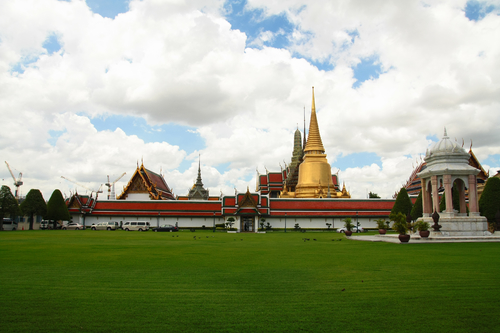
The Ubosot of Wat Phra Si Rattana Satsadaram is a masonry traditional building with wooden and glazed terra-cotta tiled roof. It has a roof composed of two superimposed tiers, and the pediments are decorated with a wooden gable bearing a gilded figure of Narayana on a Garuda decorated with glass mosaics. The roof is also adorned with traditional Thai roof finials, and the redented roof-supporting columns are gilded and decorated with glass mosaics. The capitals of the columns are decorated with pointed, superimposed lotus petals. Also, the roof eave is supported by brackets. The exterior wall of the Ubosot is gilded and decorated with a colored glass mosaics in lotus bud motifs.In the Ubosot, the Emerald Buddha is housed on a grand multi-tiered pedestal in front of which are several important Buddha Images, i.e. Phra Putthayotfachulalok, Phra Putthaloetla, Phra Samphutthaphanni, etc. Mural paintings displayed on the interior wall depict Tribhumi, Buddha’s life story, the royal parade, and the royal barge procession. Other significant buildings of the temple are as follows: in the north of the Ubosot, Phra Sriratana Chedi is erected on a tiered supporting base. The bell-shaped Chedi replicates the original Chedi at Wat Phrasisanphet in Ayutthaya Province. The Chedi is fully ornamented with golden tiles. Next to the Chedi, is Phra Mondop where Tipiṭaka or the Buddhist scriptures are kept. The building with a square plan has a multi-tiered conical roof with a spire on top. Its doors feature pearl-inlaid work. Dvarapala Yakṣa sculptures stand in front of the building, and the step entrance are flanked by figures of Nāgas with human’s face. In the same area, the Royal Pantheon, a four-porched building with a multi-tiered roof and a stupa on top, is situated. The four pediments are decorated with royal emblems of King Rama I to King Rama IV. The window panels are adorned with royal emblems of King Rama I to King Rama V. The Royal Pantheon houses statues of the previous kings of the Rattanakosin Era.
SculptureVotive tablet
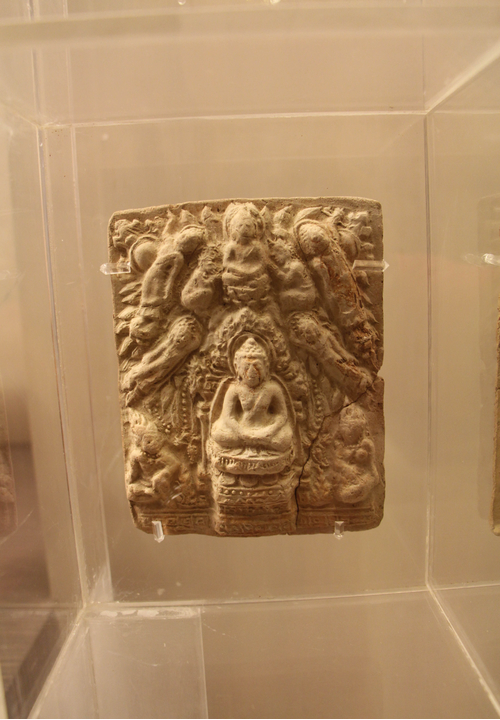
The Lord Buddha is seated in a meditation attitude on a throne. There is one person on each side. The person on the right might be a man and the person on the left might be a woman. At the top, there are five imaginary Lord Buddhas in different postures. There is a person paying respect to the Lord Buddha in the middle.
SculptureVotive Tablet
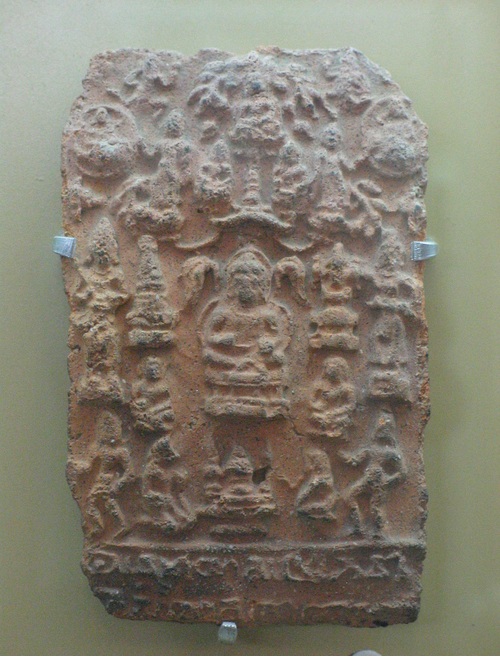
This votive tablet depicts the Lord Buddha life when he performed twin miracles to prevail the non-believers. The Lord Buddha is seated on a throne under the mango tree. There is a whip covering his head and on both sides. Next to this is a picture similar to stupa. Both sides are surrounded with a large number of people. These people might include humans and celestial humans. On the branches of the tree, there are 5 Lord Buddha in different postures. There are letters showing “Ye Dhamma” on the lowest part.
SculptureThe Buddha Image on Vanaspati
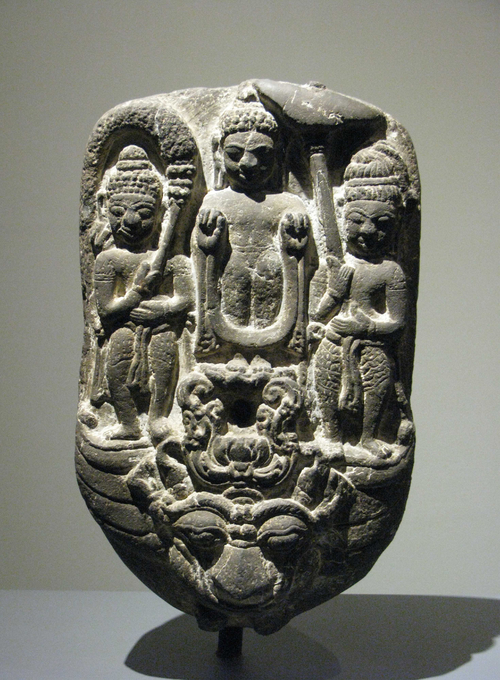
The Lord Buddha stands on a lotus on a vehicle. The Lord Buddha is surrounded by two people, one on each side. Both hands depict the giving sermon attitude and there is a hole on the leg. The vehicle is a mixed animal. It has wings, a beak, horns. Such animal is commonly called Vanaspati. One person on the sides holds a whip and the other holds an umbrella. It is therefore assumed that these people are Indra and Brahman.