Artwork Search
Arts in Southeast Asia Database
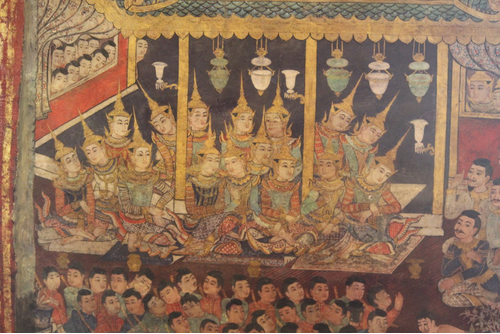

PaintingThe Moral Painting in Viharn Lai Kham
The mural painting at the Viharn Lai Kham has many parts, on the wall at the end of the viharn is a line of Buddhas in the past, the north wall is a picture of Suwan Hong, the south wall is a picture of Golden Conch, above the picture of Suwan Hong and Golden Conch is a Thep Chumnum. The image appears to be 3D and more realistic which is influenced by Rattanakosin art that influenced by Western and Burmese art such as the Payathat architecture form or various royal dressing and “Kak” picture that depicting the life of the people in greater amounts than murals in the central region.
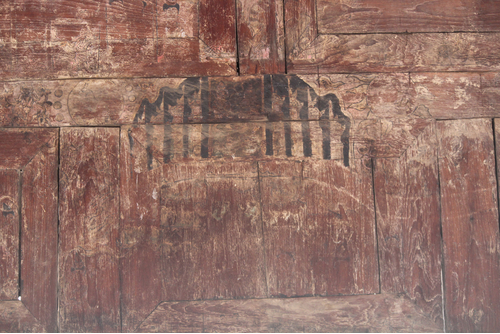
PaintingThe mural painting in Vihara Nam Tam
The style of painting in Nam Tam Vihara featured red, green, yellow, black and white, with the prominent people figures dressed in Burmese style, while the common villagers dressed in the folk Lanna and Burmese styles. The landscape paintings used the curve line to divide the picture. There are Lanna alphabet inscriptions on the story of Indra and Samavadee. There is a painting of Triphum story which is displayed as a pole in the middle of Indra's Prasat in heaven with the sun and the moon revolving around it.
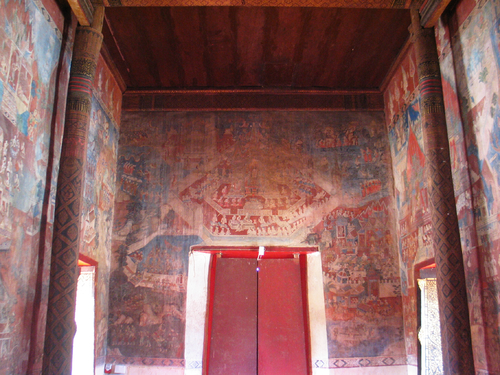
PaintingMural Painting Wat Thung Sri Meung
Mural paintings at this Phra Putthabhat hall were painted on the walls, the walls behind the doors and the columns. The paintings were painted in various stories including Vessanatara Jataka, Phra Malai and Buddha’s life. The walls behind the doors were painted with Pajittakumara Jataka, Julapata Jataka and Sin Chai. The columns were painted with Sin Chai stories, lotus bud and intertwined spray patterns. The painting techniques might have been influenced by the royal school of art in Bangkok. The techniques include patterns of the main characters, the palaces, and color status. However, there were also pictures of local folk life in the paintings.
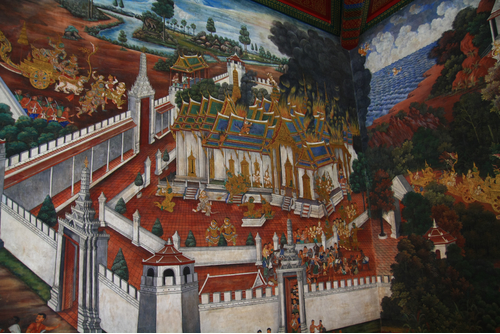
PaintingMural Paintings Depicting Ramayana
The mural paintings show a combination of traditional and modern painting techniques as follows: the traditional painting techniques are demonstrated through the main characters’ dresses are similar to those in the Masked dance drama, they are showing the same dance movements, and the characters’ adornments are gilded. The modern painting techniques include the use of horizon lines and perspective, imitation of real buildings such as palaces in the Grand Palace, and depiction of real landscapes. In addition, the paintings also show ways of life of people in the Thai Royal Court and ordinary Thai people and humor through the supporting characters. There are 178 painting panels in total; and each painting comes with verse of Ramayana poetry on the lower part of the panels, 224 verses in total.
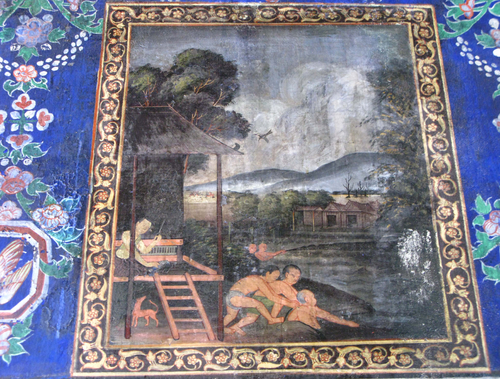
PaintingThe paintings of Chala Bhi Chati Tale
There is the Inscription at the bottom of the pillars read;“The Buddhist Proverbs of the tale of ‘Chala Bhi Chati are explained as follow;”1. Kanha Bhi Chatiya - The ones who were born black and follow black (dark), representing their harsh upbringing with low social status and poverty which makes them follow the dark side to the evil path. 2. Kanha Bhi Chatiya - The ones who were born black but follow the white (bright) path which means the merit way of life. 3. Kanha Bhi Chatiya - The ones who were born black but determined to reach nirvana, the color of their skins is meaningless. 4. Sukka Bhi Chatiya - The ones who were born white (bright) which means they were born to the high status and wealthiness but follow the dark to evil life. 5. Sukka Bhi Chatiya - The ones who were born white and follow white path. 6. Sukka Bhi Chatiya - The ones who born white and determined to reach nirvana, the color of their skins is meaningless.The paintings of the tale of ‘Chala Bhi Chati’ or six types of humans located in the lower frame of the 6 pairs of the inner principle pillars near the Principle Buddha Image in the following order; 1st pairs: The picture of Lord Buddha receive food offerings on the ivory white background. 2nd pairs: The picture of monks and priests on the white background. 3rd pairs: The picture of Upāsaka and Upāsikā (male and female attendants( wearing white attires on the yellow background. 4th pairs: The picture of the King, Royal family, Brahmins and Elites on the red background. 5th pairs: The picture of judiciaries (judges), Prison Officers, and Inmates on the green background. 6th pairs: The picture of the hunters or poachers on the indigo blue background. When compare with the verses from Tripitaka together with the composition of the paintings, it can be assumed that the paintings are classified to be the depiction of 3 groups of humans;1. The group of people who wish to attain or will attain nirvana - The picture of Lord Buddha and disciples on the first 2 pairs. This group included those who were born and wish to attain nirvana as mentioned in the proverbs. 2. The group of people that follow the white path - The picture of Upāsaka and Upāsikā and the picture of the King, Royal family, Brahmins and Elites reflecting those who behave properly and appropriately to their social status. It should included those who were born low but wish to follow the white path to become decent. 3. The group of people who follow dark path - The picture of judiciaries (judges), Prison Officers, and Inmates and the picture of the hunters or poachers reflecting those who follow the dark path regardless of their social status.
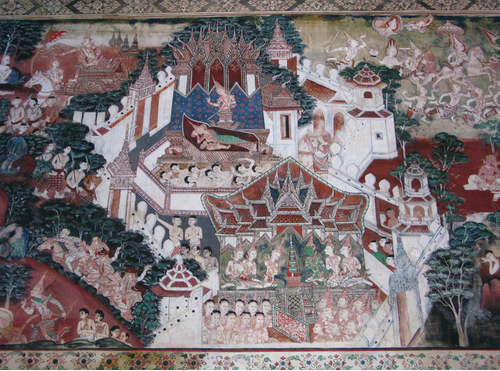
PaintingThe Wall Painting of Wat Kong Kha Ram
The Wall Painting of the Ubosot of Wat Kongkaram has the composition that similar to the artwork in Bangkok during the reign of King Nangklao. At the back of the Principle Buddha is the Buddhist Cosmology while the opposite side of the Buddha Image is the painting of the “Defying Mara” part of Lord Buddha’s life. The Wall between the 2 windows painted with the Mahanipata Jataka (Last 10 jataka). The area above the windows is the depiction of Lord Buddha’s life. The gates were painted with the pictures the Guardians subduing Maras. The characters from Buddhist Cosmology such as Bodhisattvas, God Indra, and other devas (angels) are depicted in the traditional Thai art positions. Other human characters like slodiers and villagers are depicted in the natural realistic positions. The pictures of the palace, forts and walls are depicted realistically using the grey line to separate some parts of the story but mostly used the bush, trees, and stones as the natural partition of the story.
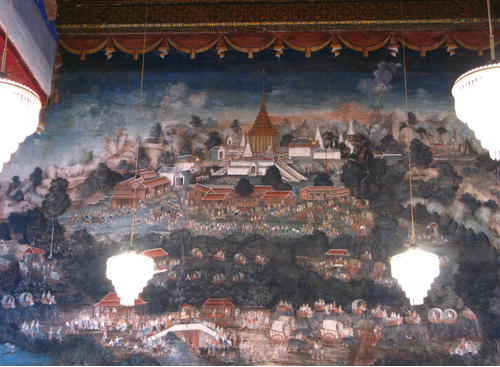
PaintingThe Wall Painting of The Pilgrimage to Phra Phutthabat, Saraburi
The powder color-painting depicted the Phra Phutthabat Mondop in the middle of the wall surrounding by other buildings and constructions in the temple. Under the Mondop is the depiction of people visiting the place by various methods such as by foot, by boat or by animal-drawn carriage. The people visiting Phra Phutthabat including both monks and villagers. The painting used the western-style technique of coloring with realistic shading and dimensions. Each parts used the bushes to separate them and to make the path for people to follow to the Mondop. The colors of the sky, clouds, and trees are realistic as in nature.