Artwork Search
Arts in Southeast Asia Database
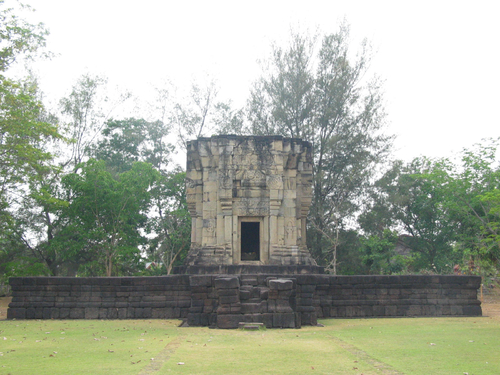

ArchitecturePrasat Ban Phlong
It is a small single prasat built from sandstone located on a large cross-shaped Phaitee laterite base. The fact that the laterite base has two wings which are much larger than the prasat itself can assume that that there might be a plan to build a surrounding prasats. However, those prasats are not in existence nowadays. It is unknown whether the prasats had never been completed or they were built with wood, so they had all been lost.This is an example of a small prasat with quite complete carvings. The main entrance is in the east while the other three are false doors. The prasat has beautiful engravings in Baphuon Arts both on the lintel and the gable. Therefore, the age of the prasat can be assumed to be around the late 16th century B.E to the early 17th century B.E. The peak of the prasat might be built with bricks but it was lost over time. The lintel of this prasat usually consists of a Kala face sticking out a triangular tongue to the front and spitting out a garland and this is a typical Baphuon style. Sometimes there is a bunch of flowers to separate the crescent lintel and sometimes there are none. This proves that the crescent and non-crescent lintels are popular in contemporary times.The gable is in Baphuon style. It is in a shape of a flower stalk facing downward. There is a Naga with a visor. Inside of the gable composed of flora patterns with a Kala face underneath. With the appearing visor, it may be possible that this prasat is in the late Baphuon period and its age may be slightly later than Prasat Khao Phra Viharn and Prasat Mueang Tum. Both the gable and the lintel of this prasat show images of Krishna in various episodes such as Krishna lifting the Kovanthana mountain and Krishna subdued Naga Kaliya. In addition, the images of Indra on the Erawan elephant also appeared in several areas.
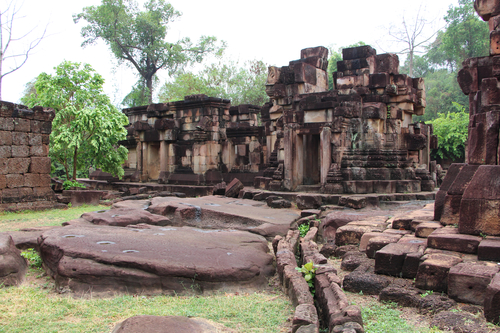
ArchitecturePrasat Ta Muen Thom
Prasat Tamuenthom are 3 large prasats built with sandstone and laterite. The group of prasats consists of a large principle prasat with recessed corners located in a square diagram. In a room at the center enshrines a Shiva lingam which is a symbol of Shiva, the supreme deity of Shaivism in Brahminism. This Shiva lingam is adorned from a natural sandstone. Later a prasat was built to cover it. It is assumed that this is a lingam that naturally appeared, called "Swayambhu lingam", which is the most important of Shaivism. There are 4 doors and the southern door is connected to the porch in the front or the Mondop. It is divided into 3 booths and the roof is made of sandstone. The base engraved a pattern of a standing idol. A sandstone lintel engraved a deity sitting in a knee-high position above the Kala face who is spitting out a bunch of garland was also found.There are 2 smaller prasats built of sandstone located behind the left and right sides of the principle prasat. The diagram is a square with receded corners. The entrance and exit is on the south and the other 3 sides were made of false doors.There are 2 laterite Bannalais. One is located in the south side of the principle prasat in a rectangular diagram. The other one is located in the south-west side in a square diagram.The principle prasat, the other 2 prasats and the 2 Banalais are surrounded by a crooked balcony. The gopura was built of sandstone in a square diagram. There is a 1.40 meter wide corridor with a gate on all four sides. The northern, eastern and western arches are similar while the arch on the southern side is the largest and it is the main arch, divided into 3 booths. The central booth is in a cross-shape diagram. There is a window with a stone balustrade attached. There was a discovery of a stone inscription inscribed with ancient Khmer and Sanskrit letters which were used in the late 16th century B.E. The detail in the inscription praises Shiva and also refers to the names of the slaves and the guardians of this religious place. A sandstone pier was also found in the south about 10 meters away from the balcony, and the pond was lined with laterite down to the bottom. It is located in northwestern side of the crooked balcony.
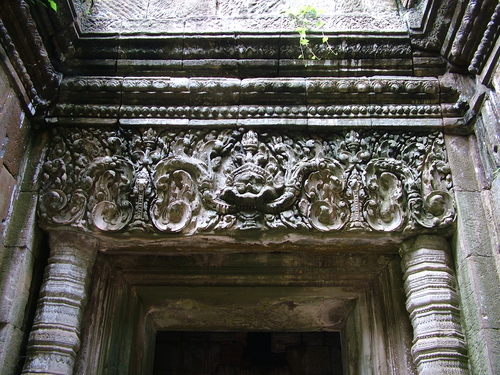

SculptureLintel
Lintels in Bapuan art have the garland that was inherited from the previous period. The middle of the garland drops down to the bottom. There is a Kala holding the garland and the ends of the garland curve out. Above the garland is the erecting leaves and under the garland is the falling leaves. Between the leaves, there are triangular leaves. However, there is quarter part of the garland that is originally decorated as “ an animal face biting the garland”. Initially , A French scholar believed that it was Klang art., but it was later found that the smae kind of lintel is found to be built in the sam period with Bapuan art. Therefore, it is classified as Bapuan art as well.

SculptureLintel carved of Umamaheswara
Lintels in Bapuan art have the garland that was inherited from the previous period. The middle of the garland drops down to the bottom. There is a Kala holding the garland and the ends of the garland curve out. Above the garland is the erecting leaves and under the garland is the falling leaves. Between the leaves, there are triangular leaves. Above the Kala, there is a Umamaheswara sculpture.