Artwork Search
Arts in Southeast Asia Database
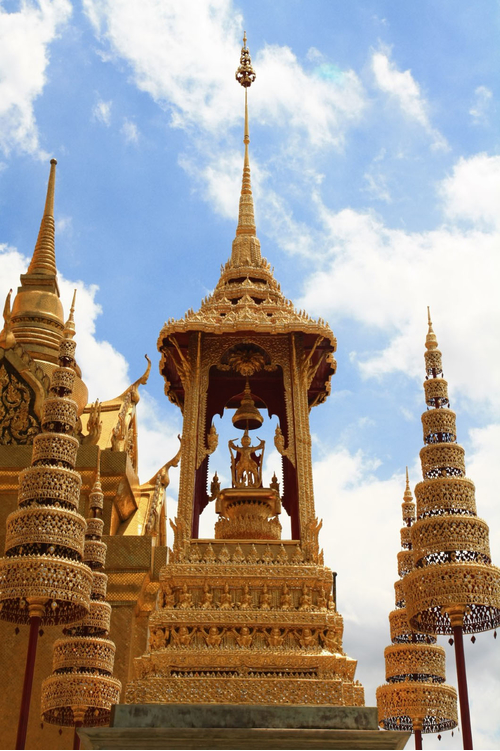

SculptureRoyal Emblems of the Thai Kings
Each pavilion is made of gilded metal decorated with glass. The open pavilions have redented columns on each corner which support the pointed roof. Each column of the pavilions’ are adorned with Thepphanom motifs or Devatas performing the Añjali Mudrā hand gesture, while the multi-tiered pedestals decorated with rows of gilded Thepphanom figurines.The northern pavilion houses the Royal Emblems of King Rama I-III as follows: the Royal emblem of King Rama I is a tiered crown without ear decoration; the Royal emblem of King Rama II is Garuda seizing Nāga; and the Royal emblem of King Rama III is a celestial palace. One of the pavilion in the south houses the Royal Emblems of King Rama IV which is a tiered crown with ear decorations and the other one enshrines King Rama V’s Royal Emblem, namely Phra Kiao or a coronet. The pavilion in the northeast houses 4 Royal emblems as follows: the Royal Emblem of King Rama VI is a Vajira or thunderbolt; the Royal Emblem of King Rama VII is 3 arrows named Phrasaengson Phrommat, Phrasaengson Pralaiwat, and Phrasaengson Akhaniwat. Above the arrow rack, the Emblem of the Royal House of Chakri is located under the Great Crown of Victory; the Royal Emblem of King Rama VIII is a deity seated on a lotus throne in Lalitasana pose; and The Royal Emblem of King Rama IX is the Atthathit Uthumphonratcha-at Royal Throne with an Unalom symbol enclosed by a Chakra and its rays of light. Nophapadon Maha Saweta Chatra or the White Nine-tiered Umbrella is over the throne. These Royal Emblems are housed in the pavilions located on a marble base decorated with bronze elephant sculptures which represent the Royal white elephants and auspicious elephants of each king.
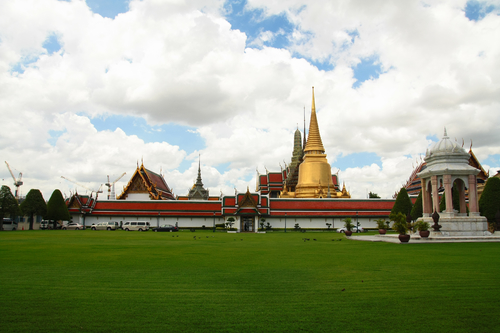
ArchitectureWat Phra Si Rattana Satsadaram
The Ubosot of Wat Phra Si Rattana Satsadaram is a masonry traditional building with wooden and glazed terra-cotta tiled roof. It has a roof composed of two superimposed tiers, and the pediments are decorated with a wooden gable bearing a gilded figure of Narayana on a Garuda decorated with glass mosaics. The roof is also adorned with traditional Thai roof finials, and the redented roof-supporting columns are gilded and decorated with glass mosaics. The capitals of the columns are decorated with pointed, superimposed lotus petals. Also, the roof eave is supported by brackets. The exterior wall of the Ubosot is gilded and decorated with a colored glass mosaics in lotus bud motifs.In the Ubosot, the Emerald Buddha is housed on a grand multi-tiered pedestal in front of which are several important Buddha Images, i.e. Phra Putthayotfachulalok, Phra Putthaloetla, Phra Samphutthaphanni, etc. Mural paintings displayed on the interior wall depict Tribhumi, Buddha’s life story, the royal parade, and the royal barge procession. Other significant buildings of the temple are as follows: in the north of the Ubosot, Phra Sriratana Chedi is erected on a tiered supporting base. The bell-shaped Chedi replicates the original Chedi at Wat Phrasisanphet in Ayutthaya Province. The Chedi is fully ornamented with golden tiles. Next to the Chedi, is Phra Mondop where Tipiṭaka or the Buddhist scriptures are kept. The building with a square plan has a multi-tiered conical roof with a spire on top. Its doors feature pearl-inlaid work. Dvarapala Yakṣa sculptures stand in front of the building, and the step entrance are flanked by figures of Nāgas with human’s face. In the same area, the Royal Pantheon, a four-porched building with a multi-tiered roof and a stupa on top, is situated. The four pediments are decorated with royal emblems of King Rama I to King Rama IV. The window panels are adorned with royal emblems of King Rama I to King Rama V. The Royal Pantheon houses statues of the previous kings of the Rattanakosin Era.
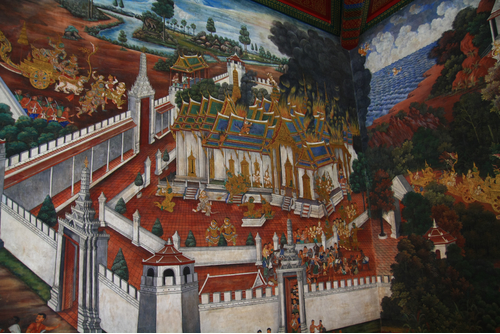
PaintingMural Paintings Depicting Ramayana
The mural paintings show a combination of traditional and modern painting techniques as follows: the traditional painting techniques are demonstrated through the main characters’ dresses are similar to those in the Masked dance drama, they are showing the same dance movements, and the characters’ adornments are gilded. The modern painting techniques include the use of horizon lines and perspective, imitation of real buildings such as palaces in the Grand Palace, and depiction of real landscapes. In addition, the paintings also show ways of life of people in the Thai Royal Court and ordinary Thai people and humor through the supporting characters. There are 178 painting panels in total; and each painting comes with verse of Ramayana poetry on the lower part of the panels, 224 verses in total.
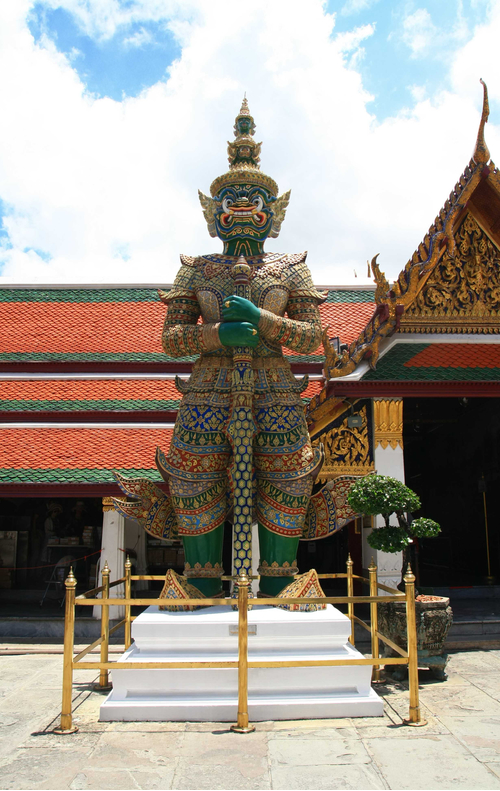
SculptureYakṣas at the Temple of the Emerald Buddha
The 12 sculptures are made of stucco with colorful glazed porcelain adornments according to Rammakian including different types of crowns, blouses, costumes, pointed sandals, etc. Their bodies were also painted according to the literary work.6 pairs of Yakṣas are as follows: 1.Suriyaphop – Intharachit 2.Mangkonkan – Wirunhok 3.Thotsakhichanthon – Thotsakhiriwan 4.Chakrawat – Atsakanmarasun 5.Thotsakan - Sahatsadecha Maiyarap - Wirunchambang
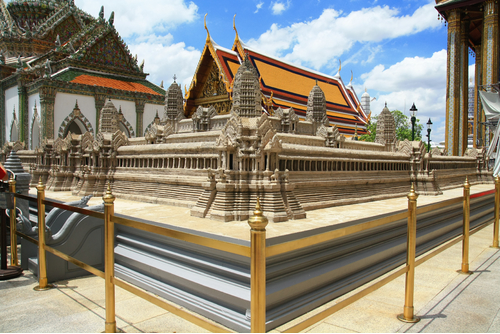
SculptureReplica of Angkor Wat
The replica of Angkor Wat was built in a square plan. The main tower, the highest building at the centre of the plan, was built on three descending levels in a cloistered enclosure order. Each cloister or gallery consists of columns and connecting roof. A gopura or entrance is in the middle of each side of the galleries, the 4 corners feature superimposed pediments. Since it is not an exact replication, the proportion and details of the replica are different from the original sanctuary: the tired roofs of the main tower and subordinate towers are those of pagodas in Thai arts.
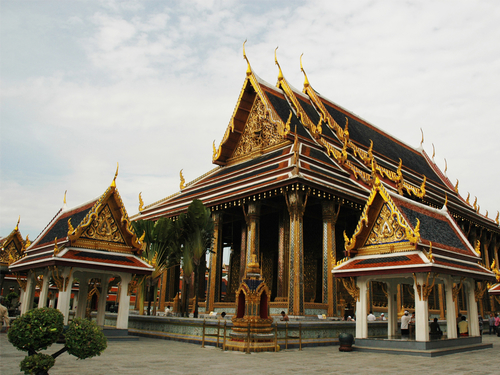
ArchitecturePhra Ubosot Wat Phra Sri Rattanasatsadaram
Phra Ubosot Wat Phra Sri Rattanasatsadaram is a traditional Thai brick-and-stucco architecture in rectangular plan with boundary and faces the east.The three-tiered wooden roof is decorated by blue roof tiles, with orange and yellow roof tiles at the edge line. The cornice is decorated with Chorfah, Bairaka, Naksadung and Hanghong. The floral-carved-wooden pediment is coated with gold lacquer and glass, whose centre displays Vishnu riding Garuda.The exterior wall is decorated with gold-lacquer-and-glass Phoom Khao Bindh pattern, while there are Garuda holding Naga sculptures around the pedestal. Three doorways can be found both in the front and the back, with three pairs of bronze lion figures at the front staircase. There are pillars in dodecagonal plan surrounding the ubosot in the veranda area. Its echinus is a lotus shape and brackets are supporting the eaves.
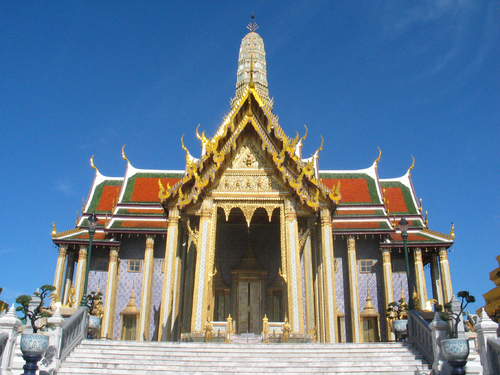
ArchitecturePrasat Phra Thep Bidorn
Prasat Phra Thep Bidorn is a four-portico building with Prang top. The front projecting portico is in the east. The wall is decorated by tiles in Phoom Khao Bindh pattern on blue background. The cornice is decorated with Chorfah, Bairaka, Naksadung and Hanghong. A prang is on the top of the building, which is made from plaster and decorated with coloured tiles. Its four pediments display the royal coats of arms. The northern portico’s pediment displays Unalom of King Rama I. The southern portico’s pediment displays Garuda holding Nagas of King Rama II. The western portico’s pediment displays Phra Viman of King Rama III and the eastern portico’s pediment displays Phra Makamongkut of King Rama IV. The windows and doorways has Mongkut tops which are coated with gold lacquer and glass, while the sided walls show the royal coats of arms of King Rama I – V.
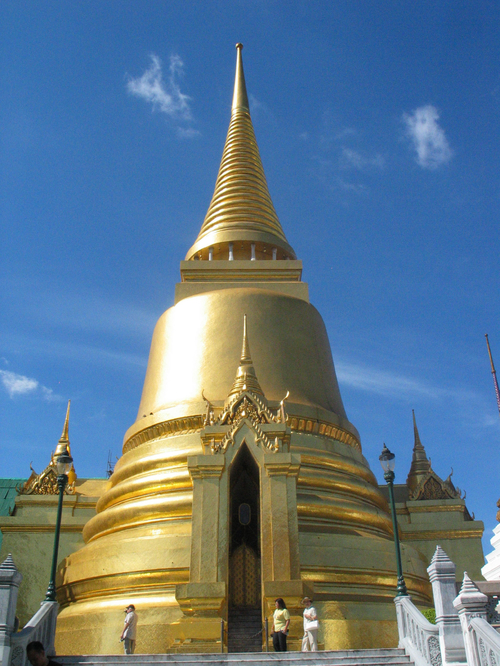
ArchitecturePhra Sri Rattanachedi
Phra Sri Rattanachedi is a bell-shaped stupa in circular plan. Its four niches which have doors leading to the inner chamber, where the relics are kept in the small golden stupa, have smaller bell-shaped stupa on the top. The stupa is on a set of pyramidal lotus-shaped pedestals with wires in round plan. Its Ballang is in square plan, surrounded by supporting pillars.