Artwork Search
Arts in Southeast Asia Database


SculptureGaruda being slaved by Serpents
Candi Kidal is the place where ashes of king Anusabadhi of Singasari dynasty were buried. He died in 1248 and because the death and the rituals had to always be sepeated by 12 years, this religious place was built in 1260. There are narratives showing Garuda stealing holy water to save his mother. The holy water is the water of eternity. This relates to “Tevaraja” principle in that it helps the dead gain eternity.
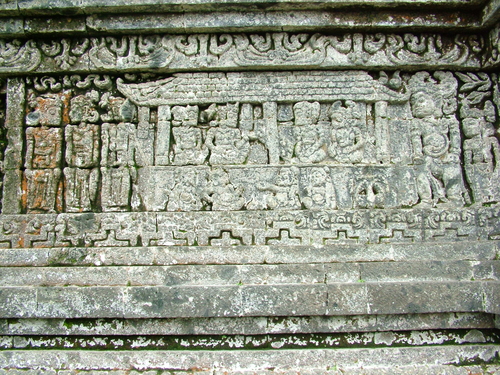
SculptureNarrative “Pandavas bit with Kauravas”
The narratrives in Eastern Java art usually depict human sculpture similar to Java shadow play. The sculpture only shows on side of the face and never face the audience directly. It wears local crown which is different from that in India. The space is filled with flower and cloud patterns. The building itself is of the local style. All of these localities show unique characteristics of “Eastern Java art”.
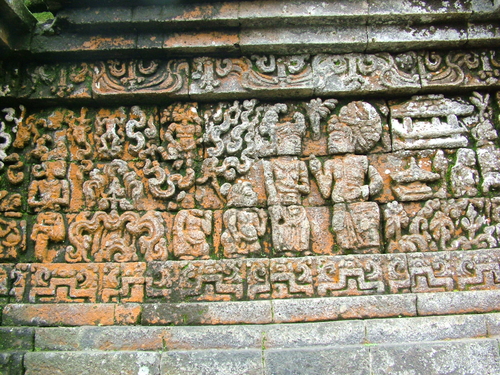
SculptureNarrative “The penance of Arjuna”
The narratrives in Eastern Java art usually depict human sculpture similar to Java shadow play. The sculpture only shows on side of the face and never face the audience directly. It wears local crown which is different from that in India. The space is filled with flower and cloud patterns. The building itself is of the local style. All of these localities show unique characteristics of “Eastern Java art”.
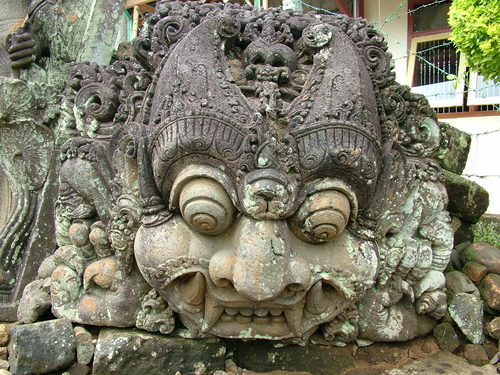
SculptureKala Face in East Javanese Style
Kala in Eastern Java art has a far more ferocious face than that in Central Java art. The eyes are round and protuding. The are fangs both on the upper and lower lips. There are horns and skull as well as hands showing threathening expressions “Indexing gesture”. The fact that kala has both upper and lower lips shows that the Indiam iconography of kala that does not have the lower lip had aleady disappeared.
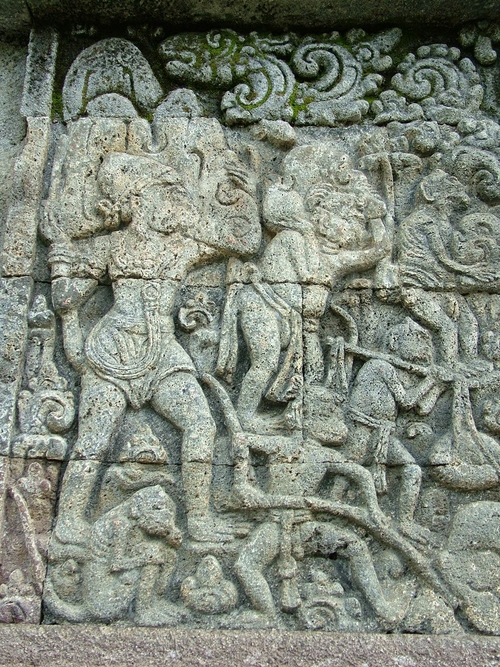
SculptureRamayana: the course-way constuction
The principle court is where the base of the main Candi is located. This level of base is related to Sumera Mount, which is the center of the universe and the residence of Shiva. However, the building was all ruined and may once be a crematory. It could alos be a multi-tiered building similar to those in bali art in the present. The first level of the base depicts scenes from Ramayana. These scenes are very similar to Java shadow play (Wayang).
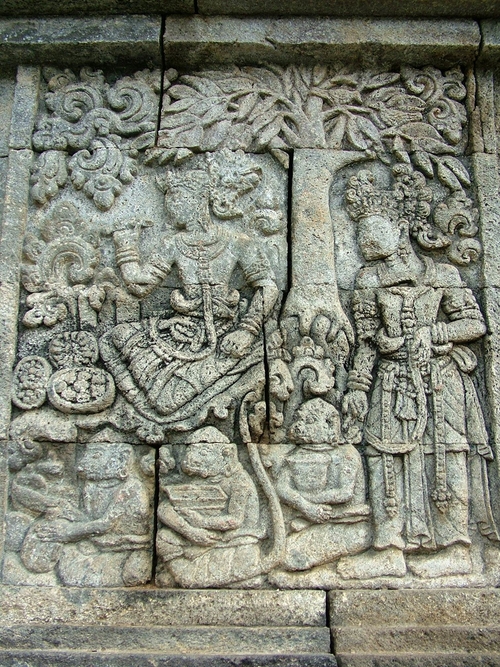
SculptureRamayana: Rama, Lakshmana and Monkeys
The principle court is where the base of the main Candi is located. This level of base is related to Sumera Mount, which is the center of the universe and the residence of Shiva. However, the building was all ruined and may once be a crematory. It could alos be a multi-tiered building similar to those in bali art in the present. The first level of the base depicts scenes from Ramayana. These scenes are very similar to Java shadow play (Wayang).
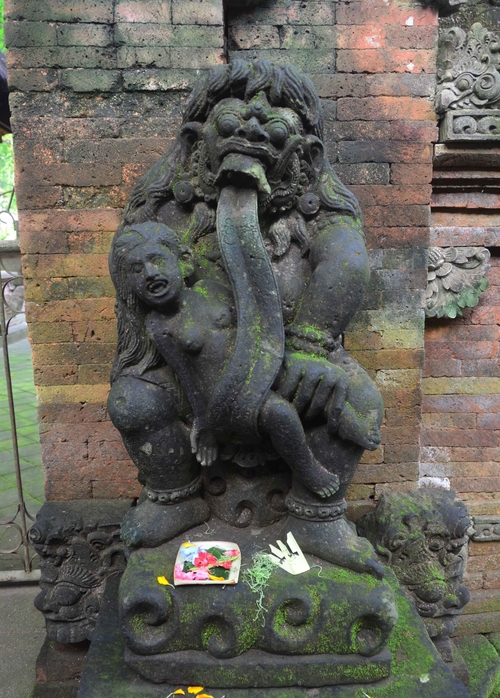
SculptureRangda
Pura Dalem is a temple built in dedication to the dead. It is one of the three Puras. Other Puras include Pura Desa, the temple of the village and Pura Puseh, a temple dediated to the ancentors who guard the village. Pura Dalem is often located in the south of the village, which is an inauspicious direction. This is different from Pura Desa which is in the center of the village and Pura Puseh, which is in the north of the village, an auspicious direction. Besides, Pura Dalem is dedicated to the dead. Pura Dalem is often located in a community forest, which is a forest dedicated to the dead. Such a forest is the habitat of monkeys in the present and is often called monkey forest . The most famous example is Pura Dalem of Ubud.
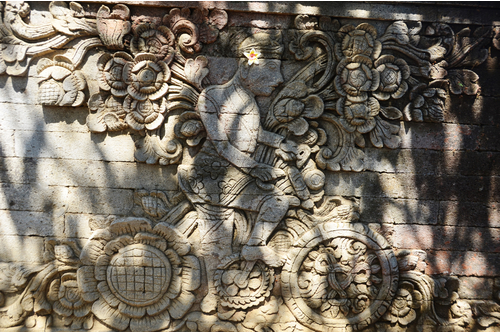
SculptureBalinese riding a bicycle
Grey stones are exclusively used in Bali art of Singaraja school, which is different from regular Bali art, which usually combines orange and grey sandstones to create patterns on the walls. Patterns in this school of art include flowers of western influence such as Acantas and sunflower. This shows that Pura in this school of art is not very old and might have been built when the Dutch had already ruled Bali. The patterns are usually larger than Bali art in general.