Artwork Search
Arts in Southeast Asia Database
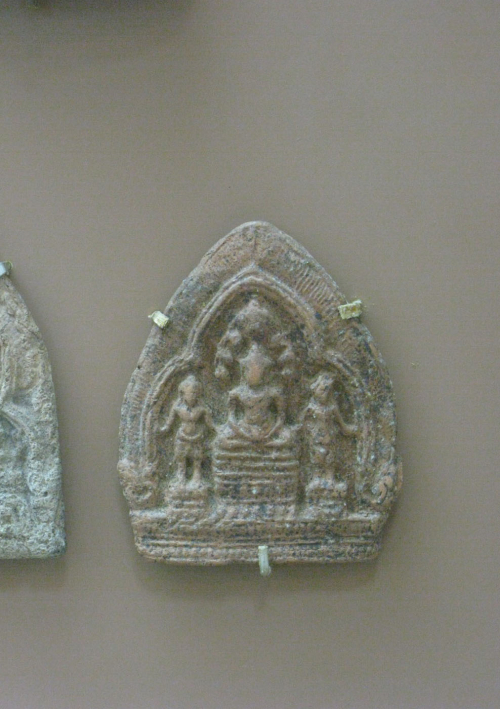

SculpturePottery votive tablet
It is a votive tablet that looks like a triangle shape. In the middle is a Buddha image Sheltered by a Naga. The right side is believed to be Avalokiteshvara Bodhisattva and the left side is Prachya Paramita. There is a curved frame surrounds the three sculptures and it is supported by a lotus base.
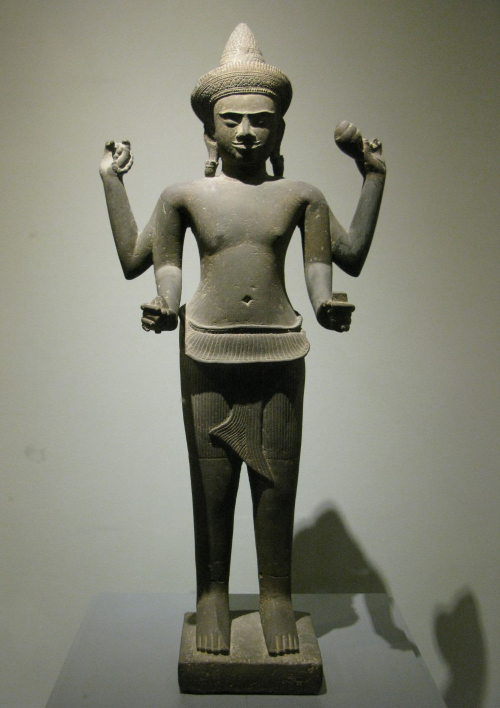
SculptureAvalokiteshvara Bodhisattva
The Avalokiteshvara Bodhisattva is standing on a square base. The face is square. The eyebrows are sharp and the eyes are widely open. The nose and the mouth are well balanced. The image wears pointed round shape earrings and there is a crown that is composed with a visor and a tiara in a cone shape that can be compared to idols in Nakon Wat style. At the center of the tiara appears a trace of an image that its detail was cracked out. The Buddha image on the tiara is a feature of Avalokiteshvara Bodhisattva, so it is believed that this is his sculpture. The image at the center of the tiara isAmitabha Buddha who gave life to Avalokiteshvara Bodhisattva. The upper part of the body is bare and the lower part is wearing shorts engraving straight lines and the hem under the stomach is curved. In the middle appears the hem in a shape of a fish tail. This is a style of sculptures in Nakorn Wat Arts. All 4 hands are holding onto an object that belongs to him. The lower right hand is holding a lotus flower. The upper right hand is holding beads, the lower left hand is holding a scripture, and the upper left hand is holding a conch shell.
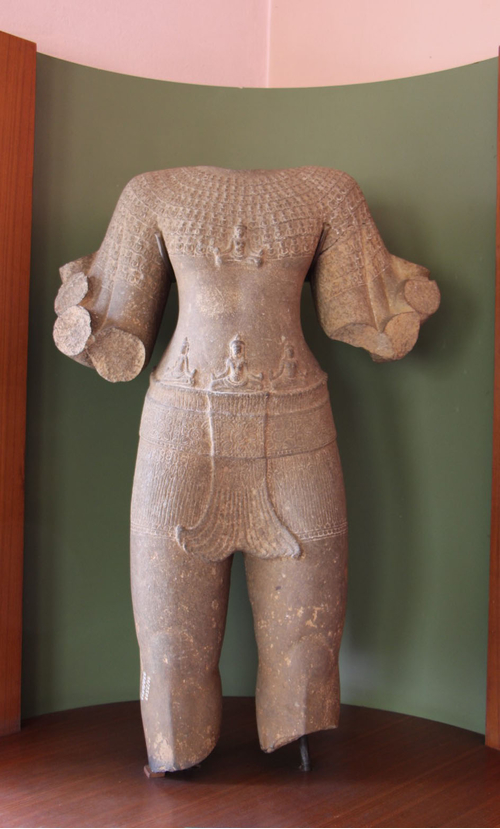
SculptureThe radiant Avalokiteshvara Bodhisattva
The radiant Avalokiteshvara Bodhisattva is in a standing position but with missing limbs as in the head, hands, shins, and feet. The chest, shoulders and upper arms of the body are decorated with many rows of Buddha images that looks like armor.There is a large image of a person in the middle of the chest and the waist and this might refer to Prachya Paramita. The image wears shorts with roughly engraved pattern. Its lower body from the thigh to the feet is in disproportion according to the sculpture in Bayon style.
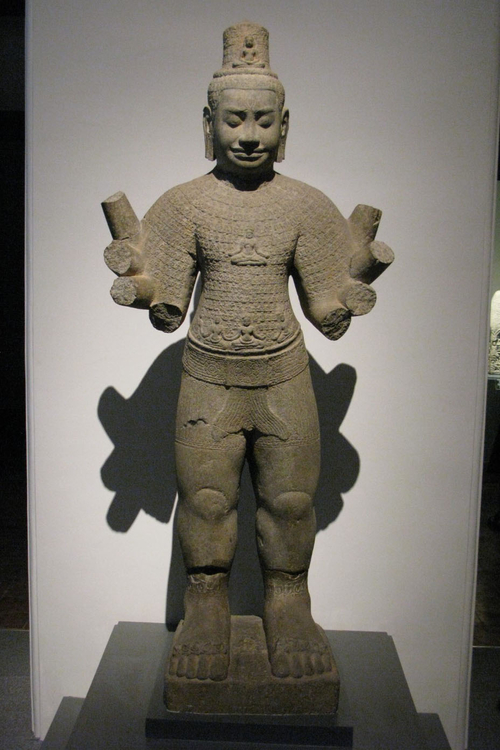
SculptureThe radiant Avalokiteshvara Bodhisattva
The radiant Avalokiteshvara Bodhisattva is standing on a square base. Its condition is complete except for the 8 hands that are missing. The sculpture has a square face, closed eyes, with the corners of the mouth lifted slightly as in Khmer Arts, Bayon style. The hair is put up in a cylinder shape and the hair is decorated with the image of Amitabha Buddha and many other Buddha images. The upper part of the body is decorated with rows of Buddha images that looks like armor. There is a large image of a person in the middle of the chest and the waist and they might refer to Prachya Paramita. All 8 hands are missing. The image wears shorts with roughly engraved pattern. His lower body from the thigh to the feet is in disproportion. Every toe has on a ring.
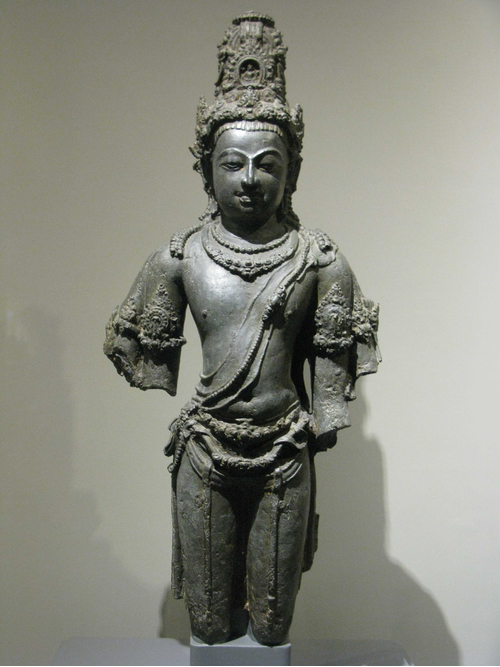
SculptureAvalokitesvara Bodhisattva
The Avalokitesvara Bodhisattva is in the standing posture with 8 arms but all the arms has only the upper part left. The lower body part from the knees down are gone.he face is plump and well-crafted. The eyelids are half closed. The head wears the triangle crown with jewelries. The hair bun is in the cylinder shape with the image of Amitabha Buddha. The hair is curvy and lies down to the shoulders left. The body wears many accessories such as the leather body bracelet with the chamois head on the left shoulder. This body bracelet is overlapped by a pearl body bracelet. Two necklaces, the top one is of pearls and the lower one is jewelries with flowers decorated. The jewels bracelet is also visible. Overall, this sculpture reflects the relationship between the Network of Mahayana Buddhist Kingdoms such as Pala Dynasty of India and Shailendra Dynasty of Java. However, the study by Assoc Prof Chet Tingsanchali points out the traits of the sculpture that do not exist in Java Art which means this sculpture might be crafted in Thailand.
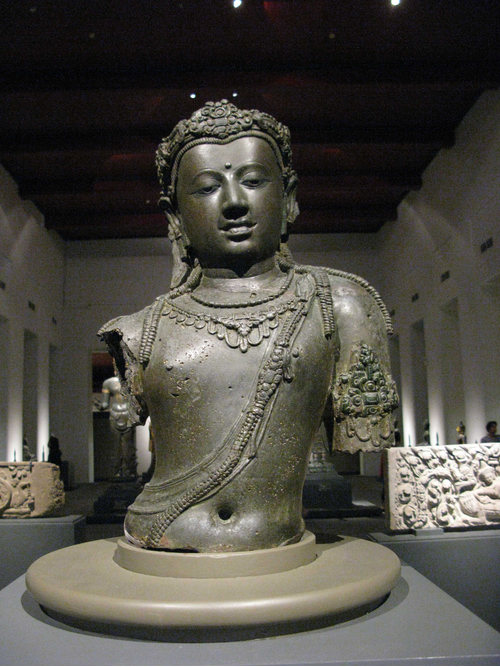
SculptureAvalokitesvara Bodhisattva
The sculpture is in the damaged condition. Only the head and upper body in ‘Tribhanga’ posture (standing body position or stance used in the traditional Indian sculpture, art and Indian classical dance forms) are left. The lower part of body is lost.The face is plump and well-crafted. The eyelids are half closed. The Unalome is visible at the forehead while head wears the triangle crown with jewelries. The hair bun on the top of the head is broken and lost, only the hair that is down to the shoulders left. The body wears many accessories such as the leather body bracelet with the chamois head on the left shoulder. This body bracelet is overlapped by a pearl body bracelet. Two necklaces, the top one is of pearls and the lower one is jewelries with flowers decorated. The jewels bracelet is also visible. Overall, this sculpture reflects the relationship between the Network of Mahayana Buddhist Kingdoms such as Pala Dynasty of India and Shailendra Dynasty of Java. However, the study by Assoc Prof Chet Tingsanchali points out the traits of the sculpture that do not exist in Java Art which means this sculpture might be crafted in Thailand.
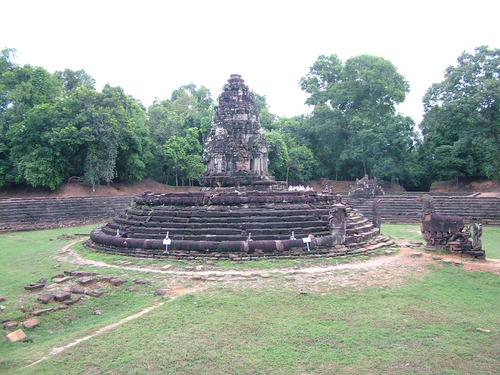

ArchitecturePrasat Neak Pean
Jayavarman VII had the reservoir entitled “Jayataḍāga” to be excavated in front of the complex of Rāajayaśrī (Prasat Preah Khan). In the middle of the lake there exists Prasat Neak Phan, the representation of the mythical Anottāta Lake, the holy lake in Buddhism.
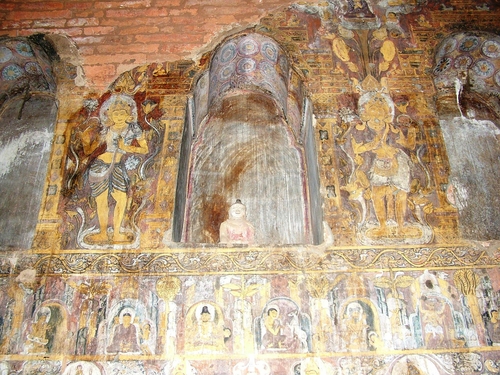

PaintingMural in Abeyadana
Pala artistic influence can be noticed from the red tone that occupies the painting. The niches for enshrining Buddha images that cloister at the wall of the temple are flanked by Mahayana Bodhisattvas. The dress and regalia of these figure are very similar to those of Pala sculpture, including the diadem with three pointed leafs, the S-shaped Yajnopavita and the folded lower garment.