Artwork Search
Arts in Southeast Asia Database
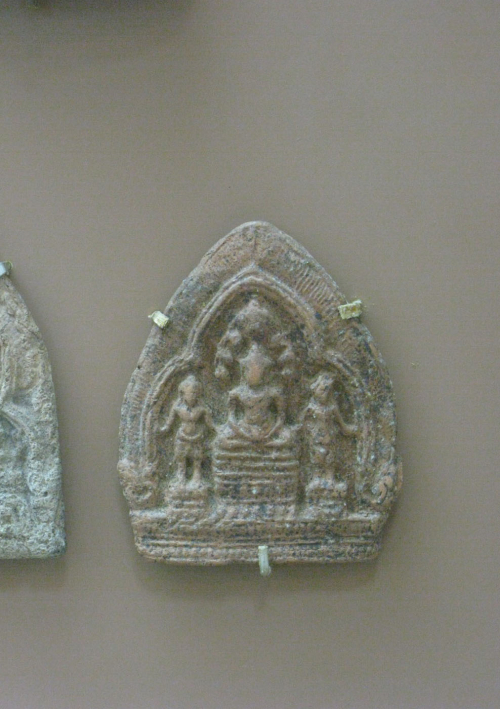

SculpturePottery votive tablet
It is a votive tablet that looks like a triangle shape. In the middle is a Buddha image Sheltered by a Naga. The right side is believed to be Avalokiteshvara Bodhisattva and the left side is Prachya Paramita. There is a curved frame surrounds the three sculptures and it is supported by a lotus base.
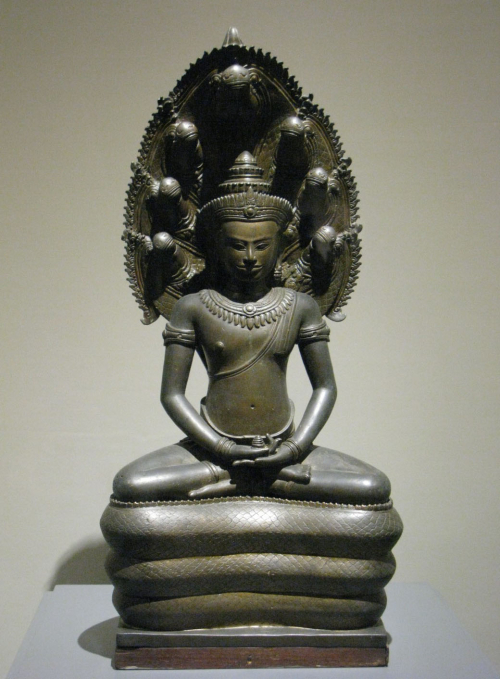
SculptureBuddha image Sheltered by a Naga
The Buddha image is sitting cross-legged with the hands in a meditating position. It is sitting on rolls of the Naga’s body and at the back is the hood of Naga spreading.The face of the sculpture is in square shape decorated with many things including pointed round shape earrings, a visor, and a cone tiara that is composed of layers of lotus petals which is one of the distinctive features of the Khmer Buddha image in the Bayon style. The image is also wearing neck accessories and bracelets. Although there are spaces between the body and the arms causing the feeling of being naked which is an outstanding feature of Lopburi Arts Buddha images However, it appears to have the edge of the slanted robe on the chest and the square robe on the left. There is a round cartridge placed in the right hand. There are 3 rolls of the naga’s body that is supporting the Buddha image. The top roll is the thickest and the widest then descending in size and the decorative patterns are like snake chips. There are 7 Naga’ s heads at the back of the Buddha image. They are in an outline that looks like Bodhi leaf. The head in the middle is the largest and the other 6 heads on the side are the same size. All of the smaller heads are facing the large head.
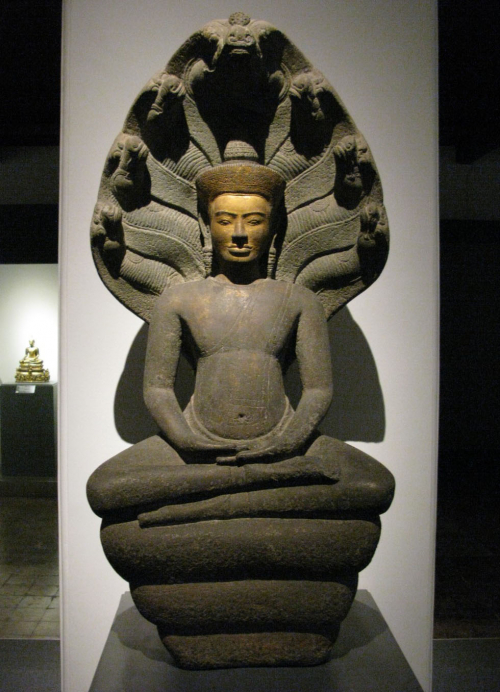
SculptureBuddha Image Sheltered by a Naga
The Buddha image is sitting cross-legged above the Naga with the hands in the position of meditation. The face is square and in a dark color. The eyes are widely open. There is a crown that is composed of a visor and a tiara in a cone shape. The image wears pointed round shape earrings.The upper part of the body is bare noticing from the holes between the flank and the arms. There is a deep line engraved in a form of a slanted robe that might have been done later. The lower part of the body is wearing a skirt-like lower garment. There are 7 Naga’ s heads at the back of the Buddha image. They are in an outline that looks like Bodhi leaf. The head in the middle is the largest and the 3 heads on each side are smaller. All of the smaller heads are facing the large head. There are 3 rolls of the Naga’s body that is supporting the Buddha image. The top roll is the thickest and the widest then descending in size forming a tube outline.
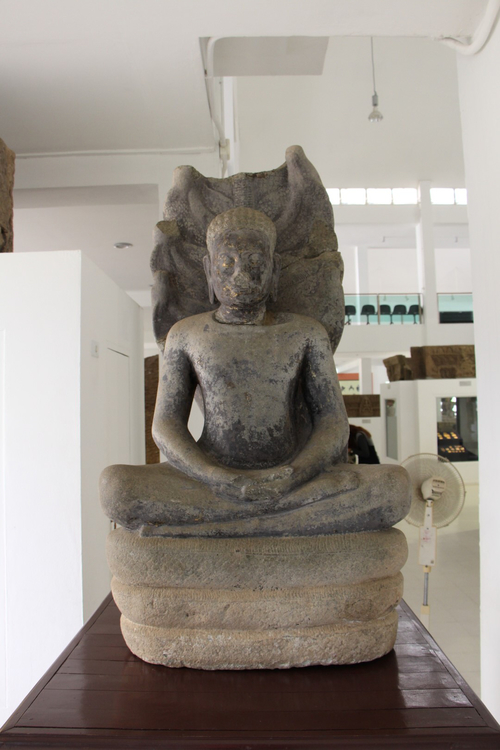
SculptureBuddha image Sheltered by a Naga
The Buddha image is sitting in a cross-legged position. The shin is as sharp as of the real person. The image wears a slanted yellow rope. The rope is very thin with no stripes. The face of the image is calm, the eyes are closed, the corner of the mouth slightly lifted, the hair curls in spiral, the frame of the face is a little convex. There are 3 layers of Naga supporting the image and in the back of the image, there are many Naga’s heads.
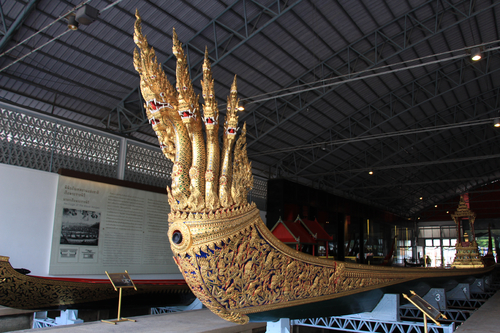
SculptureAnanta Nagaraja Royal Barge
The prow was crafted as Ananta Nagaraja or seven-headed nāga. In the middle part of the barge, a small pavilion is placed for carrying Katina cloth, enshrining important Buddha Images, and accommodating the kings. The exterior hull was painted green, while the interior was painted red.
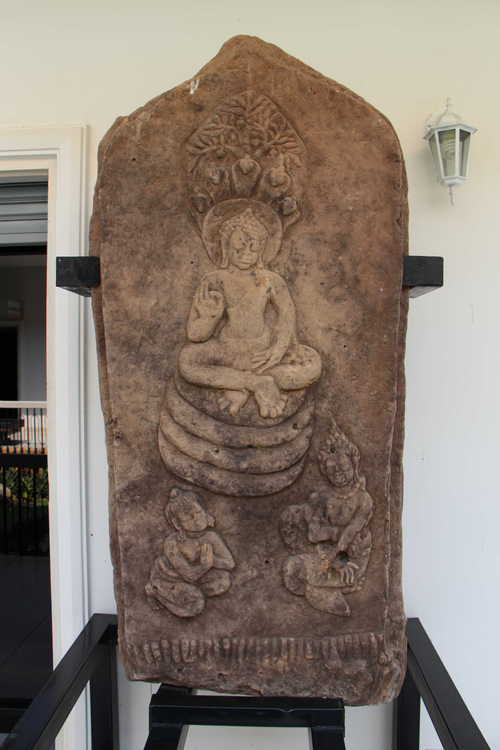
SculptureBoundary marker
The top boundary marker has a pointing edge and the bottom part is craved with lotus petals. At the front, the scene when the Lord Buddha was protected from the rain by Mujalin Naga is craved. On the marker, the Lord Buddha is seated loosely on a coil of Naga. The hands depict the attitude of giving sermon. There is a five-headed Naga covering his head. There is a Mujalin tree at the back. On the bottom left, there is a man wearing a lot or ornaments, assumed to be the human disguise of Mujalin. On the right, there is another man paying obeisance, assumed to be one of the followers.
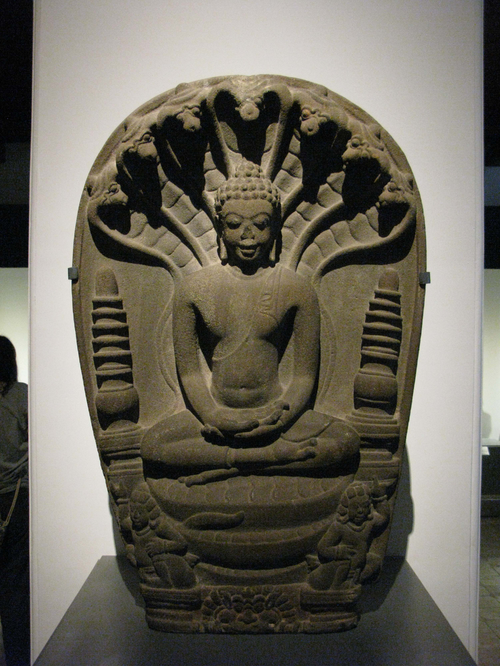
SculptureBuddha protected by the Naga
The high-relief Buddha Image under the naga is seated in meditation over the coiling up snake’s body. The Buddha is wearing a thin and plain monastic robe along his left arm while exposing his right shoulder with the hem of the uppergarment on his left shoulder. The Buddha is protected under the seven-headed naga. The face of the naga is a monkey lookalike, that is, a characteristic of nagas in the Dvaravati period. The Buddha is flanked by 2 cylindrical stupas, and 2 figures are sitting in front of the stupas. The base underneath the naga’s coiling up body is decorated with a lion head motif.
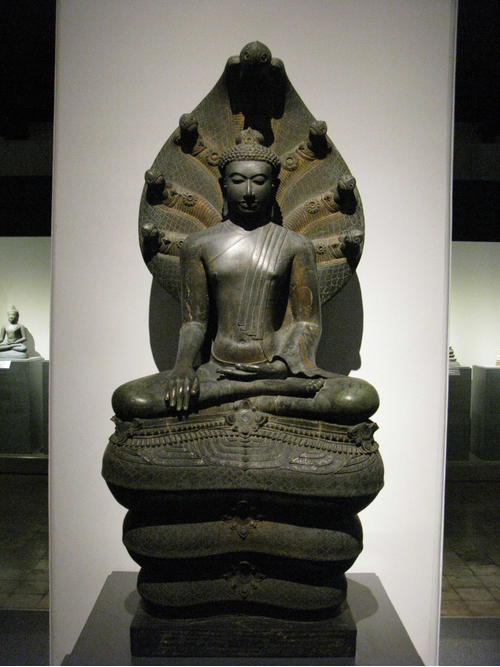
SculptureNaga-Protected Buddha
This bronze Naga-Protected Buddha can be separated into 3 parts; the body (Buddha), the Naga’s head, and the Naga Coil.The Buddha is seated in the lotus position with subduing Mara hand gesture which is unusual as most Naga-Protected Buddha would be craft in the meditation posture. This unique style is classified as the characteristic of the Chaiya School of Art. The hole on the forehead of the Image was likely made later. The Usaneesa is in the half circle shape, undecorated. There are triangular panels that originally had gems adorned in the front side. The seam of the robe runs pass through the left shoulder to the belly is in a square bars overlapping in several layers. The 7 heads of Naga are in triangular shape, similar to Bodhi leaf. The Middle head is the largest with 3 smaller heads that turn toward the main head on each sides. All of them were placed next to each other in the panel form comparable to the Naga Heads in Lavo or Khmer Art in Thailand during the Angkor Era like the ones at Angkor Thom and Bayon. The 3-layer Naga Coil is comparable to the Naga coil of Lavo or Khmer Art in Thailand during the Angkor Era as well especially the ones in Angkor Wat. The characteristic of this style is that each layers is not equal. It goes from the largest one on the top to the smallest one in the bottom in the reverse triangle shape. Moreover, on top of the coil is the lotus base for the Buddha Image.