Artwork Search
Arts in Southeast Asia Database


ArchitectureCandi Tikus
Trowulan was the capital of Majapahit dynasty. There are a number of monuments in this city, including Candi Tikus(the sacred pond) and several gateways. These monuments are always in brick, different from normal stone temple of the Eastern Javanese period

ArchitectureSplit Gateway at Pura Kehen
The split gateway, known as Candi Bentar, is typical to Balinese art. The gateway comprises the body and the superstructure, all of these members are split into two sides. Candi Bentar functions as the gateway as well as the gate for preventing the evil to enter the temple.
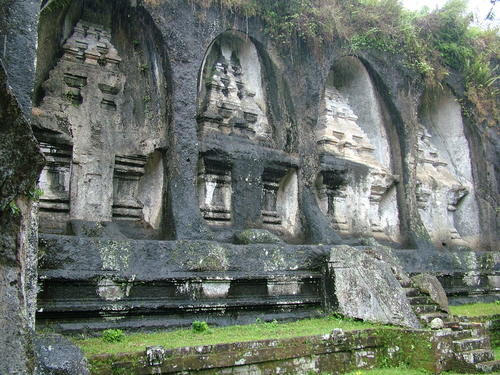
ArchitectureKunung Kawi
Candi Gunung Kawi is the series of nine rock-cut temples on the cliff adjacent to the river, considered to be the best example of the rock-cut temple in Bali. Furthermore, these temples are the good examples of the traces of Eastern Javanese Art in Bali. As the roofs are decorated with series of miniature temples which are normally absent in Balinese towers, the towers at Gunung Kawi are datable to Eastern Javanese Art. The location of these temples, by the river, also sanctifies the river.

SculptureAkashagarbha
Candi Mendut was built in Centra Java by Sai Lane dynasty in 14th century BE. It was built in Mahayana around the same period as Borobudur. Candi Mendut is in the same area as Candi Pawon and Borobudur.

SculptureNarrative derived from Panchatantra: Crane and Crab
Candi Mendut was built in Centra Java by Sai Lane dynasty in 14th century BE. It was built in Mahayana around the same period as Borobudur. Candi Mendut is in the same area as Candi Pawon and Borobudur.

SculptureHariti
Candi Mendut was built in Centra Java by Sai Lane dynasty in 14th century BE. It was built in Mahayana around the same period as Borobudur. Candi Mendut is in the same area as Candi Pawon and Borobudur.

SculptureMain Buddha Image at Candi Mendut
The Buddha image with a dropping leg shows a strong influence of Jalukya at Aelola cave and Pala art from the east India. The image has hair between eyebrows according to Pala art, but the robe only covers half of the body, which is similar to the Buddha image with dropping leg at Aelola and Ajanta. The Lord Buddha holds the robe while dropping his leg. Also, the edge of the robe falls down between his thights, which is similar to the art at Aelola cave. The throne is decorated with a dragon and elephants. This appear at Aelola in Pala art beforehand.

SculptureMain Buddha Image at Candi Mendut
At the side of a Buddha image in Candi Mendut, there are two Bhothisavaras.One is Avalokitesavara and the other is Vatcharapanee. Bhothisavaras at Cnadi Mendut have very similar costumes with Pala art including a three-banded crown, a tube-shaped crown and the wearing of Vasayatchayopraveet as well as Lalitasana seating posture on lotus pedals and the backrest of throne.