Artwork Search
Arts in Southeast Asia Database


ArchitecturePura Sada
Pura Sada was the former dynastic temple before the shifting to the new royal temple of Pura Taman Ayun in 1740. Interestingly, there are a number of unoccupied thrones in the temple precinct. Some scholars believe that these thrones symbolize the number of the persons who were in the boat during the funeral ceremony. This testifies that the temple was associated to the dead and the funeral cerwemony.

ArchitectureMeru at Pura Besakih
Meru is the name for the square tower with series of sloping thatched roofs, symbolizing the tower for the high-rankings. This kind of tower, therefore, is normally assigned for the significant gods. Meru normally locates inside the innermost courtyard of the temple. The thatched roof is normally perishable and always re-thatched, different form the brick-or-stone gateway which is quite permanent.

ArchitectureMeru at Pura Kehen
Meru is the name for the square tower with series of sloping thatched roofs, symbolizing the tower for the high-rankings. This kind of tower, therefore, is normally assigned for the significant gods. Meru normally locates inside the innermost courtyard of the temple. The thatched roof is normally perishable and always re-thatched, different form the brick-or-stone gateway which is quite permanent. At Pura Kehen, the Meru tower is supported on the back of the tortoise, the animal which was believed by the Hindus as the supporter of the cosmos’ centre.
ArchitectureGoa Gajah Cave
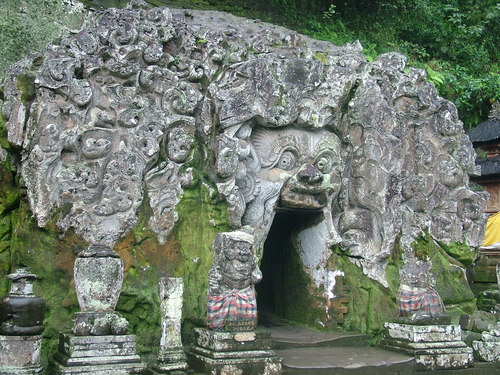
The most famous monument at Gua Gaja is the man-made cave. The entrance of the cave is decorated with the ferocious face of Kāla with protruding eyes for dispelling the evils, typical to Eastern-Javanese-and-Balinese art. Surrounding the face, there is the sculptural depiction of the wildwood, including the imitation of rocks and the depictions of wild animals The cave is designed as the T-shaped narrow cave with the seat meant for hermit.
ArchitectureGoa Gajah Fountain
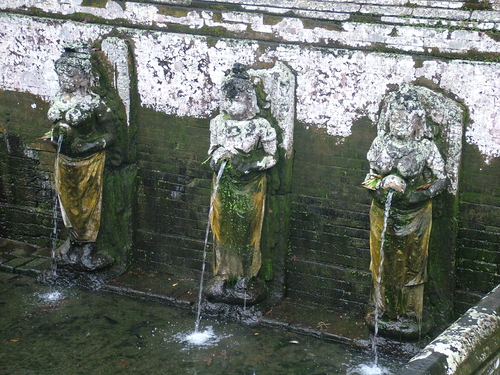
The sacred fountain had already been popular since Eastern Javanese period. The idea of constructing the fountain was inspired by the believed of the auspicious and superstitious power of the water, including the bestowal of the abundance and the power of sanctification. The separation of the ponds at Gua Gaja suggests the separation of male and female during the ablution. The statues of goddess holding pots as the fountain sculpture are assignable as the symbols of abundance.
ArchitectureKunung Kawi
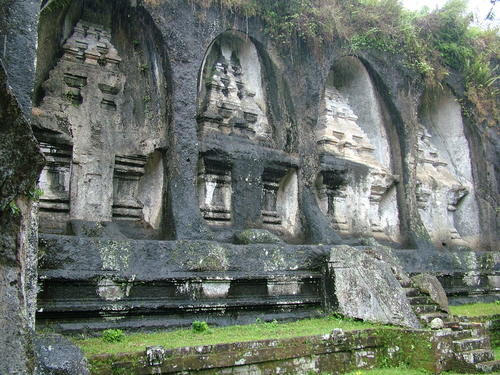
Candi Gunung Kawi is the series of nine rock-cut temples on the cliff adjacent to the river, considered to be the best example of the rock-cut temple in Bali. Furthermore, these temples are the good examples of the traces of Eastern Javanese Art in Bali. As the roofs are decorated with series of miniature temples which are normally absent in Balinese towers, the towers at Gunung Kawi are datable to Eastern Javanese Art. The location of these temples, by the river, also sanctifies the river.


SculptureAnantasayin Pediment from My Son E
These niches are very similar to “Kutu” or “Chandhasala” in Indian art. That is to say they are low arches decorated with dragons. However, a curving Naga pattern has been added into the Cham art, making the niches have both curving in and curving out pattern. In the middle, there is a picture of Vishanu Anatasayin. This shows that this prasat was built under the influence of Hinduism.

SculptureVishnu on Garuda
This Vishanu on Garuda shows the influence of Chava art that blended with the local Hua Lai art. The hat is decorated with three triangular decoration similar to Pala-Chava art. However, the mounth is rather thick, the eyes are protuding and there is a mustache on top of the mounth (the local characteristic). Garuda has a tip and “kanok” wings, which is a local characteristic.