Artwork Search
Arts in Southeast Asia Database


ArchitecturePo Rome
This temple is the last tower in traditional Cham art. Several details of the Cham architectural articulation are now omitted, including the reduction of the number of pilasters. Formerly, it was five in number but Po Rome architects put merely two pilasters, specifically at the corners. However, the spear-liked pointed arch and the lotus-bud-like miniature corner towers are of the same characters as Po Kluang Karai


ArchitectureShiva Temple: Candi Parambanan
Shiva temple is the loftiest temple in the complex. The cruciform plan with five sanctums indicates the continuation of the same plan from the Mahayanist temples which was now adjusted to Hinduism. The central sanctum is dedicated to Shiva, the south one to Agastaya, the west one to Ganesha and the north one to Mahishasuramardani. At the base exists several statues of the deities of eight directions. Stylistically, the temple is considered to be the most developed style in Javanese art. The body is divided into 2 tiers. The superstructure is complicate as it is in cruciform plan, similar to the body. The miniature temple decorated at the superstructure is notable as they are capped by the fluted Amalaka-liked Stupika which seems to be related to the north Idnian Amalaka.
SculptureKartikeya on Peacock
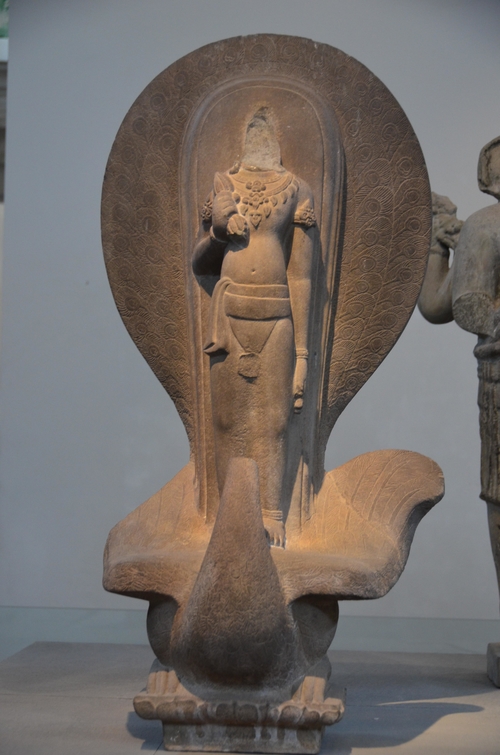
Kartekeya is the son of Shiva. This is the reason why he always shows his childishness. Besides, he rides on peacock and holds diamond, which was previously the weapon of Indra.

SculptureShiva
Human sculpture of Bin Din period has been better organised than the previous period. That is to say, all of the neckpieces are avove the front part of the hat. An important characteristic of Bin Din and the later period is the backrest. Most of the hands are attached to the backrest. The triangle cloth edge drops down at the front.
SculptureDancing Shiva from the pediment of Po Kluang Karai
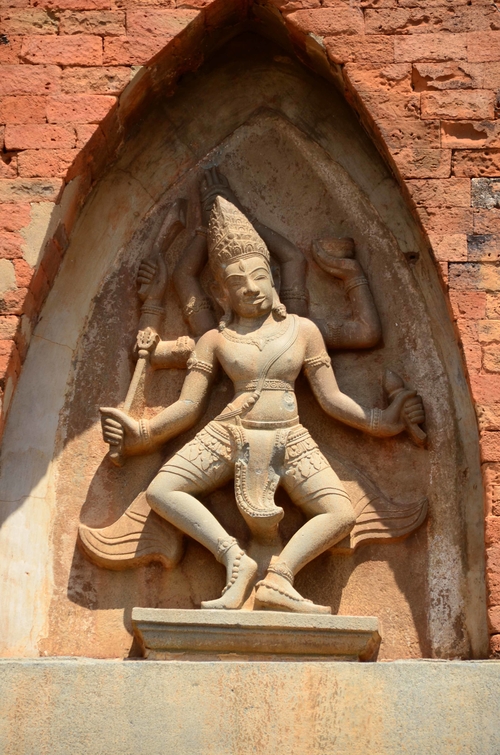
Although the temple is dated to the 13th century, the tympanum depicting the dancing Shiva is dated earlier as belonging to Binh Dinh style. This tympanum was re-used. The crown of Shiva, decorated with the series of tiny triangle elements forming the whole crown in triangular shape, is comparable to the normal style of Binh Dinh crown. The triangular cloth in the front of the lower garment is also the characteristic of the period.
SculptureSculpture of Later Period
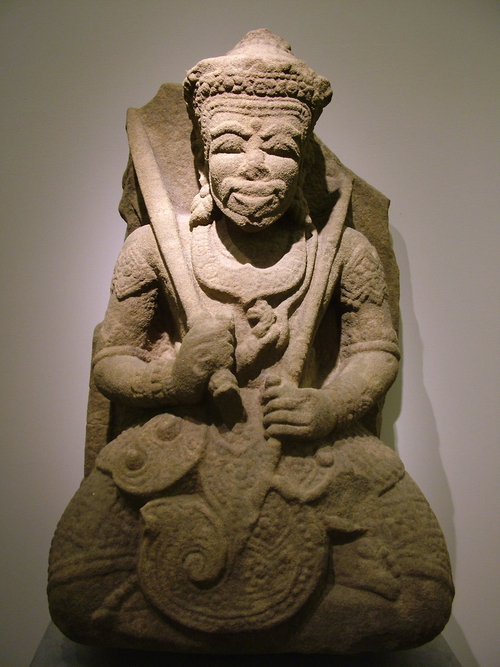
This sculpture is one of the best representations of the sculpture in the later period. Only half of the body remains. It sits in a crossed-legs position with the legs merging with the back. The face has some beard showing the Chinese and Vietnamese influence and it wears the cap.

SculptureShiva
This Shiva sculpture can be seen as a good example of costumes in Central Java art. He wears a sash and a bow-tied belt of Southern India art. However, the crown decoration is more similar to Pala art. It should be noted that costumes in the Central Java art are usually the mixture between Pala and Southern India arts.

SculptureHarihara
One important aspect of eastern Java sculpture is the back started to feature “Bua leaf” which is a unique feature of this period. Besides, sculptures were also decorated fully with ornaments and flowers. Jewellry earrings and “Yatchayopreweet” were decoaretd with pearls and flowers and so was the belt.