Artwork Search
Arts in Southeast Asia Database


SculptureGod Vishnu
The sculpture is in the standing posture on the base wearing the cylinder shape crown which is the distinct characteristic of the early style of Vishnu in Thailand and similar with Vishnu of Pallava Dynasty Art.The sculpture has 4 arms as follow the conventional Iconology of God Vishnu.The front right hand lies down to the belly level, hypothesized to held the clod before but has been broken off. The front left hand hold the mace but the mace part has been broken and only the dandle is left. The. The back hands are broken off. When compare to other Vishnu sculptures, it is hypothesized that the left hand would held Chakra and the right hand hold Shankha according to Vishnu iconology. This statue is of Pallava Art. The upper body is naked while the lower part wears Tothi or the thin panung. The piece of long cloth is tied around the hip through the thigh. The sculptor who crafted this statue might be worried about it being fragile, he made the front arms attached to the mace and the tothi. Moreover, the front pleat of the brocade is long down to the base which make the statue has 5 points to carry the weight; the 2 feet, the front pleat, the seam of body cloth and the mace.
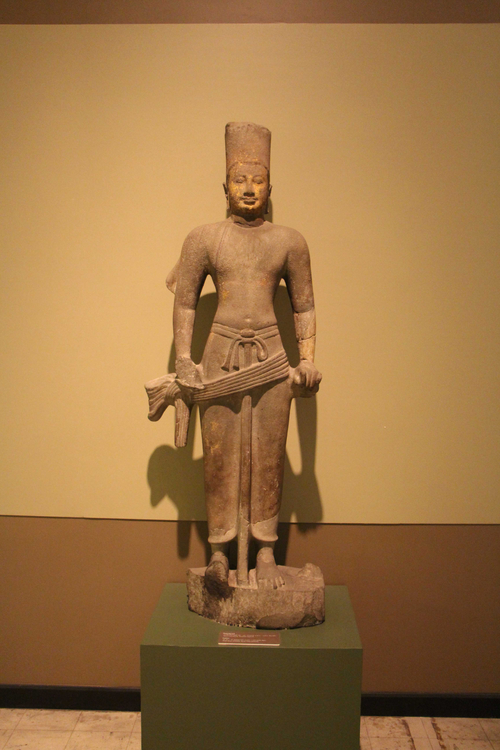
SculptureGod Vishnu
The sculpture is in the standing posture on the base wearing the cylinder shape crown which is the distinct characteristic of the early style of Vishnu in Thailand and similar with Vishnu of Pallava Dynasty Art.The sculpture has 4 arms as follow the conventional Iconology of God Vishnu.The front right hand lies down to the belly level, hypothesized to held the clod before but has been broken off. The front left hand hold the mace but the mace part has been broken and only the dandle is left. The. The back hands are broken off. When compare to other Vishnu sculptures, it is hypothesized that the left hand would held Chakra and the right hand hold Shankha according to Vishnu iconology. This statue is of Pallava Art. The upper body is naked while the lower part wears Tothi or the thin panung. The piece of long cloth is tied around the hip through the thigh. The sculptor who crafted this statue might be worried about it being fragile, he made the front arms attached to the mace and the tothi. Moreover, the front pleat of the brocade is long down to the base which make the statue has 4 points to carry the weight; the 2 feet, the front pleat and the mace.
SculptureGod Vishnu
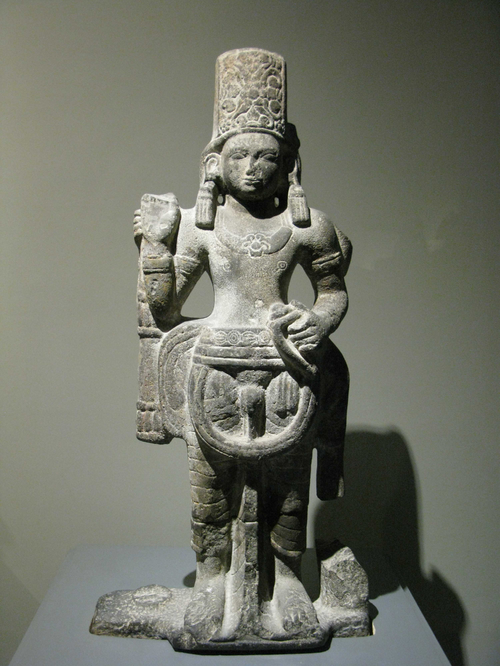
The sculpture is in the standing posture wears the cylinder shape crown which is the distinct characteristic of the early style of Vishnu in Thailand.The sculpture has 4 arms follow the conventional Iconology of God Vishnu. The front right hand is in the forgiving gesture, the back right one holds the mace, the front left hand holds Shankha (conch shell) at the hip level, the back left hand is lost but presumably to hold Chakra. The position of each hands with the carried objects are visible in the Northern Indian Art prior the 10th Buddhist Century. The upper body is naked while the lower part wears Tothi or the thin panung. The piece of long cloth is tied around the hip through the thigh. The characteristic is comparable to Southern Indian Art prior the 10th Buddhist Century.


ArchitectureMeru at Pura Ulun Danu
Pura Ulun Danu, located at Lake Bratan, was constructed by Mengwi dynasty in 1624 A.D. This is one of the most magnificent Balinese temples as the Meru tower is sent in the middle of the lake.


SculptureAnantasayin Pediment from My Son E
These niches are very similar to “Kutu” or “Chandhasala” in Indian art. That is to say they are low arches decorated with dragons. However, a curving Naga pattern has been added into the Cham art, making the niches have both curving in and curving out pattern. In the middle, there is a picture of Vishanu Anatasayin. This shows that this prasat was built under the influence of Hinduism.

SculptureVishnu on Garuda
This Vishanu on Garuda shows the influence of Chava art that blended with the local Hua Lai art. The hat is decorated with three triangular decoration similar to Pala-Chava art. However, the mounth is rather thick, the eyes are protuding and there is a mustache on top of the mounth (the local characteristic). Garuda has a tip and “kanok” wings, which is a local characteristic.

SculptureVishnu on Garuda
This Vishanu on Garuda clearly shows the local Dong Deung art. The hat is decorated with three triangular decoration similar to Pala-Chava art, but with a large lotus bud of Ding Deung style However, the lips are rather thick, the eyes are protuding and there is a mustache on top of the mounth (the local characteristic). Garuda has a tip and “kanok” wings, which is a local characteristic.

SculpturePediment depicting Vishnu
Vishanu always has four arms holding a discus, a conch shell, a club and earthe and is the king of the universe. It is possible that the pediment shows that this Prasat was built for Vishanu, which was far less that those of Shiva.