Artwork Search
Arts in Southeast Asia Database
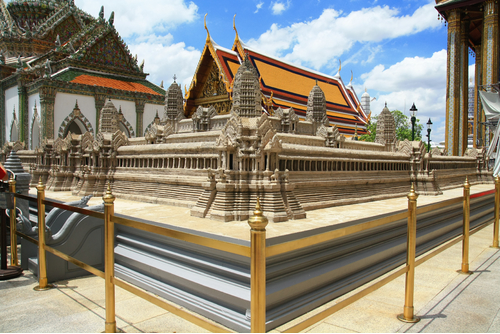

SculptureReplica of Angkor Wat
The replica of Angkor Wat was built in a square plan. The main tower, the highest building at the centre of the plan, was built on three descending levels in a cloistered enclosure order. Each cloister or gallery consists of columns and connecting roof. A gopura or entrance is in the middle of each side of the galleries, the 4 corners feature superimposed pediments. Since it is not an exact replication, the proportion and details of the replica are different from the original sanctuary: the tired roofs of the main tower and subordinate towers are those of pagodas in Thai arts.


ArchitectureAngkor Wat
The temple complex is surrounded by the one-kilometer moat. In the front there is the causeway leading to the main temple. The main temple rests on the triple stepped platforms, each of them is enclosed by the connected gallery. The galleries are punctuated with the gateway in the middle and the tower at the corners. The complex on the top of the platform comprises five towers. This temple is the culmination of the architectural accomplishment as the architects have combined the previous successes of two previous temples, Takeo and Baphoun. While the five set of towers on the top of the platform is the accomplishment of Takeo, the triple galleries are the accomplishment of Baphoun.
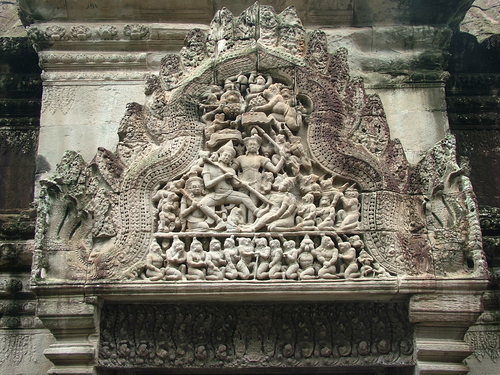
SculpturePediment carved of Ramayana, the Mokkasak
The pediment is in triangular shape with an arch. The arch curves in and out beautifully. The frame of the arch is decorated with multi-headed Naga following the pediment in the late Angkor period. In the middle, there is a stoprytelling scene from Ramayana: Mokkasak.
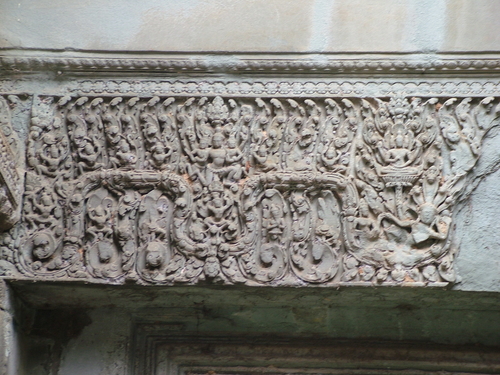
SculptureLintel carved of Vishnu Anantasayana
Lintels in Angkor Wat inherited the pattern from Bapuan art. The garland in the middle of the lintel curves down and the garland is divided into small parts. However, the difference is that there is a storytelling scene in the lintel.
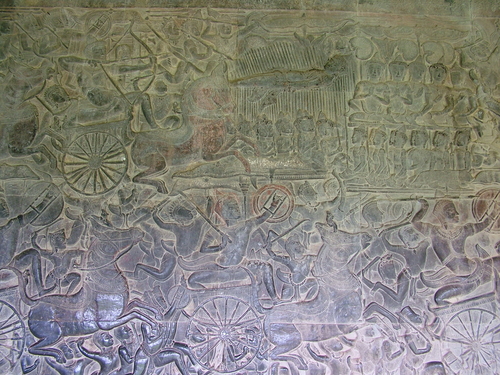
SculptureWall Carvings: Mahabharata - Bhishma death scene.
The western side of the lower gallery of Angkow Wat depicts the story from Mahabharata. The style of Angkor Wat art can be studied from the drapery of the figure in the narrative. The pointed crown with the diadem, the necklace with the row of pointed tassels, the short Sompot with the triangular piece of drapery at the side are the characters of Angkor Wat dressing.

SculptureApsara
Apsara is characterized by the square face decorated with diadem and the big earrings. The headgear is beautified by the triple flowers. The left hand holds flower bouquet. The strip of triangular cloth hangs from the right hand while another triangular strip of cloth emerges from the left and reaches the feet-level. The belt is characterized as the wide band decorated by the row of tassels. These are the typical characters of Apsara dress during Angkor Wat period.
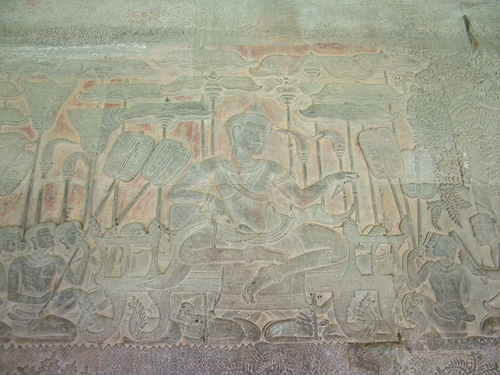
SculptureWall Carvings: Suryavarman II
The southern gallery bears the narrative of King Suryavarman II. The portrait of the king sits in Maharajalilasana posture in the centre as the most prominent figure. At the background are the regalia. The typical dress of Angkor Wat period is noticeable from the figure, including the point crown, diadem, necklace with the row of tassels, breast chain in X format, short lower garment and the triangular strip of garment at the side.

ArchitectureAngkor Wat
Angkor Wat is surrounded by the one-kilometer-long moat. The front is marked by the elongate walkway leading through the temple. The temple rests on the triple stepped platforms encircled by three rings of galleries. The gateways and the corner-temples are added in every elevation. On the top of the platform are five main towers. Angkor Wat is considered to be the culmination of Cambodian architecture, as the design of the temple combines the architectural success of Takeo (5 towers on the top of the platform) and Baphoun (galleries resting on platforms).