Artwork Search
Arts in Southeast Asia Database


SculptureHead of Buddha Image
The head of Buddha Image has a round face, broad forehead with connected eyebrows. The Buddha also has protuberant eyes looking down towards the floor; a huge nose; protruding lips; short and tight ringlet curls; and a Uṣṇīṣa shown as a cranial protuberance. There is a hole in the Uṣṇīṣa which possibly used to be decorated with an aureole made of gemstone or might be the space for enshrining Śarīra or relics of the Buddha.
SculptureDharmachakra
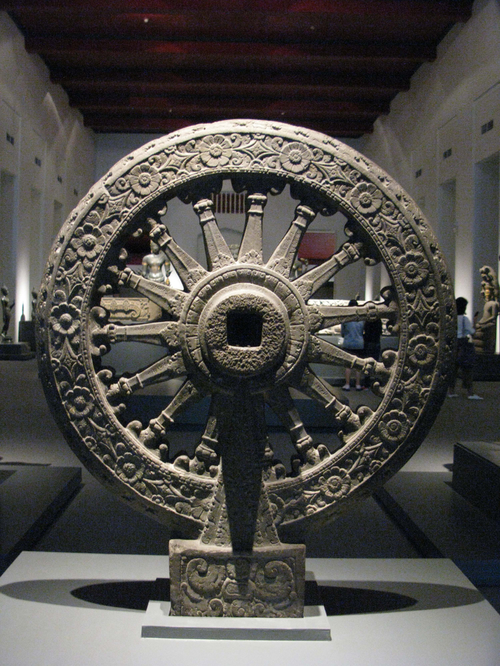
The Dharmacakra consists of 3 significant parts, that is, a hub in the middle, spokes the spaces between which were cut through and make it look thin, and the outer part of the Wheel which is a felloe was carved with round flower and lozenge patterns. The rim of the felloe was engraved with a decorative flame motif. The triangular lower part of the Wheel serves to bear its load and connects to a square base. Many parts of the Wheel bear Pali inscriptions using Pallava script which describe the Buddhist Doctrine, namely excerpts from Dhammacakkapavattana Sutta.
SculptureDharmachakra
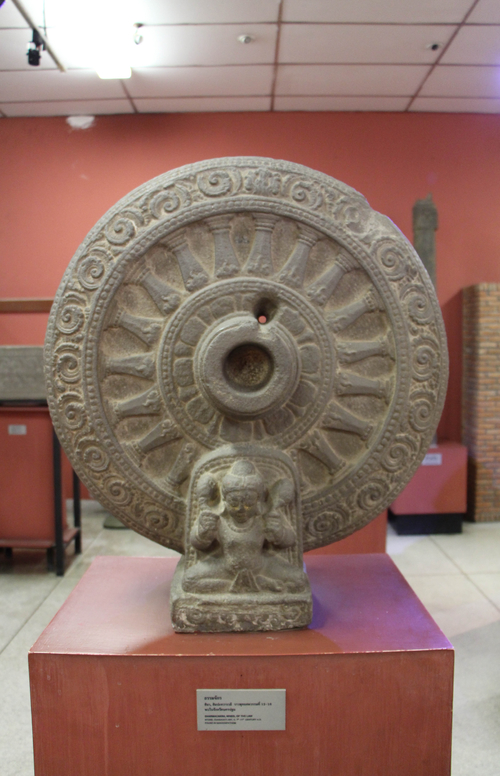
The Dharmacakra includes 3 main parts, namely a hub above which there is a through hole; spokes the spaces between which weren’t cut through and make the wheel look thick; and a felloe ornamented with a Kankhot or alternating lozenge motif. The lower part of the Wheel depicts an individual sitting cross-legged with a lotus in each hand which may represent Surya.
SculptureDharmachakra
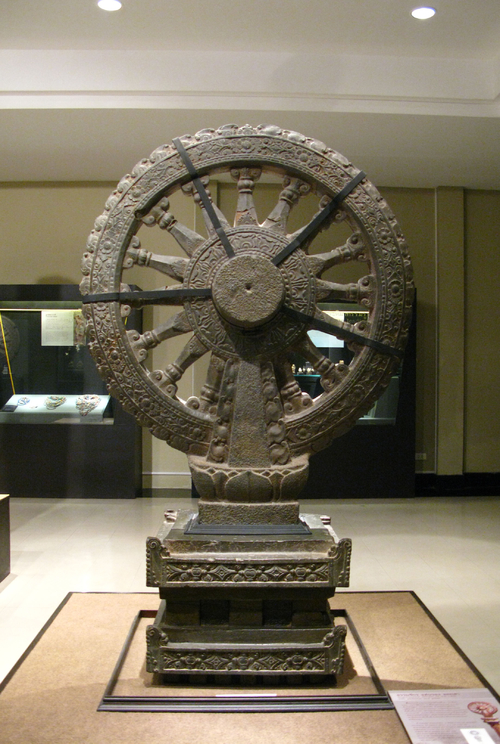
This emsemble of Dharmacakra is complete, as it includes 3 parts, namely an octagonal pillar, a square socle, and a Wheel of Law. The square socle helps hold the wheel firmly on the pillar.The round wheel of law consists of 3 main components as follows: a hub, spokes, and a felloe. The spaces between spokes were cut through, and they make the Wheel look thin. The outer part of the Wheel is the felloe carved with a pattern of round flowers and rhombi. The rim of the felloe was carved with a Thai motif called Kanok which resembles flames. The triangular bottom part of the wheel serves to bear its load, and the socle below decorated with a pattern of lotus petals comes with a tenon joint which fits a mortise hole underneath the wheel. In the lower part, the square connecting block is ornamented with a pattern of round flowers and rhombi; and the four corners of the socle depict a Makara motif. The block was cut through as a mortise hole which serves to fix the wheel to the Dharmacakrastambha or the pillar. The lowest part of the octagonal pillar is a square base carved with a Hamsa motif; and on top of it, the bottom of the pillar resembles lotus petals. The top of the pillar was engraved with a pattern of flower garlands and flower tassels. The upmost part of the pillar is a top tenon for insertion into a mortise beneath the square socle.
ArchitectureKhao Klang Nok
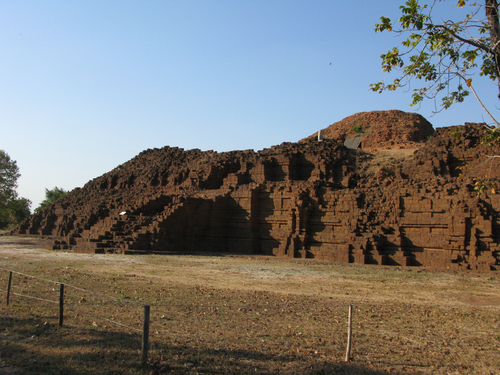
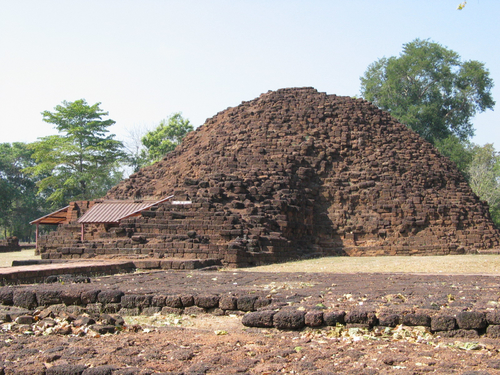
Khao Klang Nok is a laterite stupa without plastering and stucco decoration, while its anda was made by bricks. Its large pyramidal platforms are in side-and-edge-increased square plan, when each side has 3 edges and 2 edges at each corner. A staircase of each direction lies upon the principal edge of the side, which is bigger than its sided pair.Pyramidal wires one the platform’s wall show the significant of Dvaravati Art called “Buavalai” or “Kalasha”, which is similar to early Pala Art. Furthurmore, there are 8 vimans or replica prasats on attached to each wall side, which is related to early Chola Art. Upon the top verando stands a stupa made from Dvaravati bricks, which consist of lots of husk. However, the stupa is in bad condition which cannot show more details. The holes around the stupa might show that once there were pillars supporting roof frame which covered the stupa and the veranda.
ArchitectureKhao Klang Nai
Khao Klang Nai is a laterite stupa in an incease-corner rectangular plan and has an eastern staircase leading to upstairs veranda. The present condition of Khao Klang Nai is relatively dilapidated. Only large base with some shouldering-dwarf-shaped and floral-shaped stucco, especially on the southern part, can be seen, while other compounds and the top are nowhere to be found.


ArchitectureBuddha Image at Tham Chang
The characteristics of Buddha images in Dvaravati art of Central Laos, similar to those in Northeast Thailand, are the indigenous facial expression, the small hairy curls suggesting Khmer influence. Vitarka gesture is very popular during this period, as so the loose cross-legged sitting with one sole shown.

SculptureBuddha Image at Wat Manorom
Buddha Images in the beginning of Lanchang arts are very similar to the ones of Sukhothai arts. For example, oval face, big curl of hair, flame-like halo, low gazes, broad shoulders, the robe with the length until the navel.