Artwork Search
Arts in Southeast Asia Database
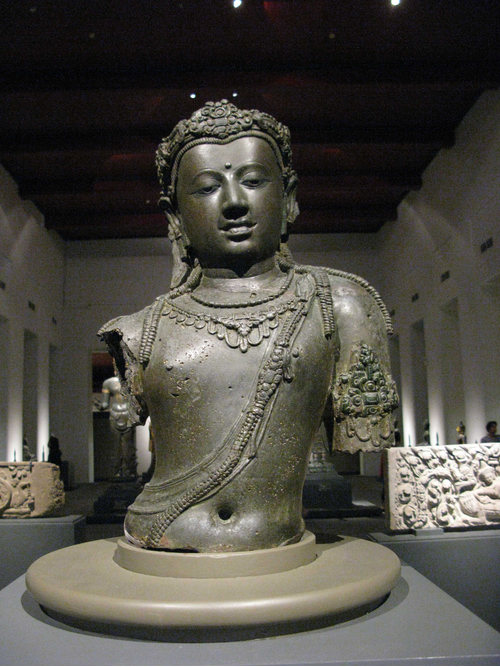

SculptureAvalokitesvara Bodhisattva
The sculpture is in the damaged condition. Only the head and upper body in ‘Tribhanga’ posture (standing body position or stance used in the traditional Indian sculpture, art and Indian classical dance forms) are left. The lower part of body is lost.The face is plump and well-crafted. The eyelids are half closed. The Unalome is visible at the forehead while head wears the triangle crown with jewelries. The hair bun on the top of the head is broken and lost, only the hair that is down to the shoulders left. The body wears many accessories such as the leather body bracelet with the chamois head on the left shoulder. This body bracelet is overlapped by a pearl body bracelet. Two necklaces, the top one is of pearls and the lower one is jewelries with flowers decorated. The jewels bracelet is also visible. Overall, this sculpture reflects the relationship between the Network of Mahayana Buddhist Kingdoms such as Pala Dynasty of India and Shailendra Dynasty of Java. However, the study by Assoc Prof Chet Tingsanchali points out the traits of the sculpture that do not exist in Java Art which means this sculpture might be crafted in Thailand.
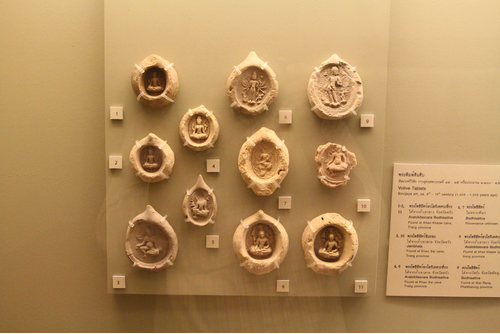
SculptureBuddha Amulets
These amulets were found in many area of Southern Thailand. These amulets are rounded. The upper part is slightly pointed. Some pieces are made with the bottom pointed with Bodhisattva or other holy figure images imprinted in the middle. For example, The 21-arm and 4-arm Avalokitesvara, or Kubera, Lord of Wealth and the god-king of the semi-divine Yakshas. These amulets are found in the territories of Mahayana Buddhist Kingdoms such as Pala Dynasty of India and Shailendra Dynasty of Java which made them the evidence of the relationship between the Mahayana Buddhist Kingdoms Network.
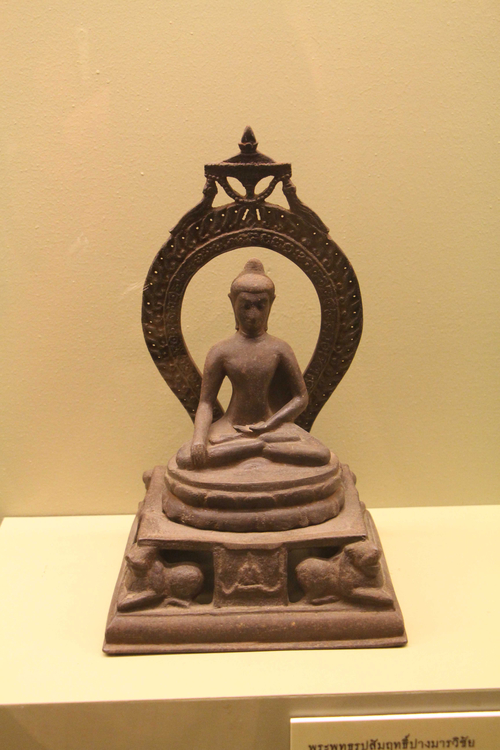
SculptureSubduing Mara Buddha (Mara Vijaya Posture)
The double lotus seated Buddha with the subduing Mara hand gesture on top of the double layers lotus throne with the singha at the corners. The round halo is on the back while the middle part is penetrated. The edges of halo are decorated by the flowers and the flames. The Chattra is above the Buddha.
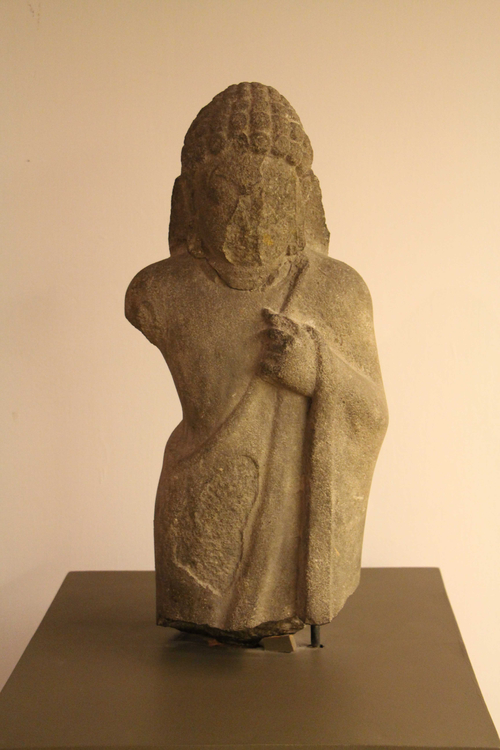
SculptureBuddha
The Buddha Image is in damaged condition. The face is partially damaged. The right hand and the body from the knee down ls lost. The sculpture is in the standing posture. The hair is in the spiral style of Buddhist Art. The Usanisa (the top part of the head that look like a crown, the symbolic iconological part of Buddhist Art for Lord Buddha likeness) is curved out a little bit similar to Amaravati Art which could be the model of the sculpture. The Buddha wears yellow robe oblique style. The seam of the robe lie down through to the left arm similar to the Amaravati. However, the robe has no pleat which is different. The right hand is stranglehold and raises to the chest with the palm facing the body.
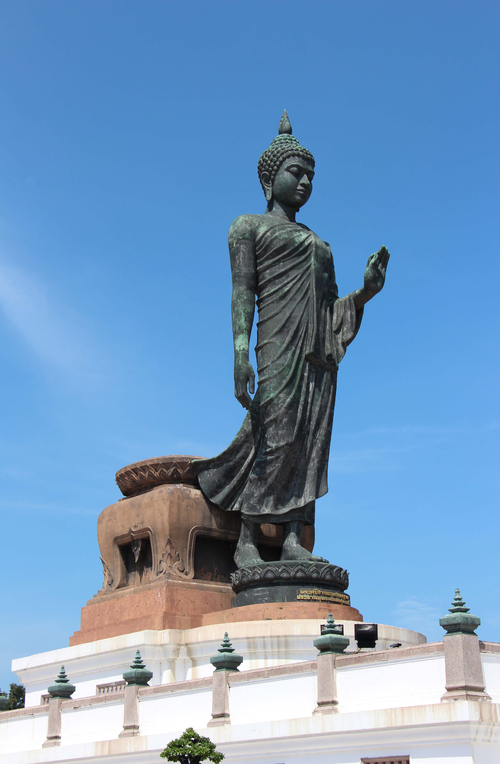
SculpturePhra Si Sakaya Dasabalayan Prathan Phutthamonthon Sudassana
It is a walking Buddha image on lotus base. The left hand is performing Vitarka Mudra. The face is oval-shaped rather round, like a real person. The hair is coiled into small spirals. There is the ushnisha under the flame halo. The ears are long. The image is wearing the robe across a shoulder with outer robe on the shoulder and the robe is wavy folded naturally. The edge of the robe is realistically attached to the rear throne.
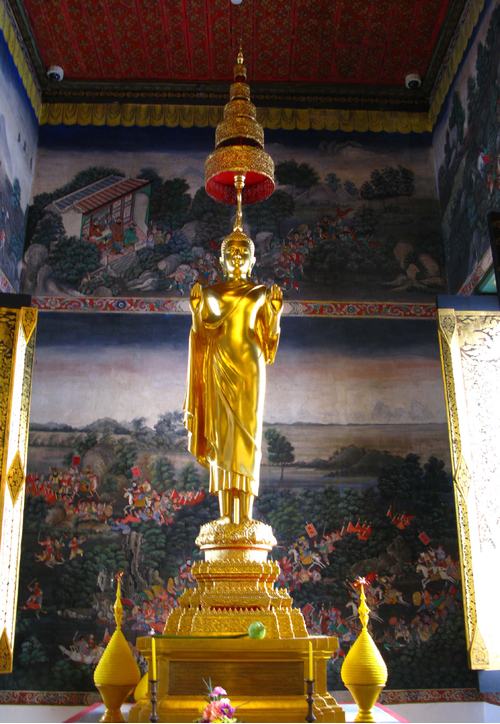
SculpturePhra Puttha Manusanak
It is the standing Buddha image on lotus lion-footed base. King Prajadhipok initiative of building the Buddha is also inscribed on the base. Both arms are elevated. The palms are facing outward and the fingers are extended upwards or it is called the attitude of stopping the rainstorm. The fingertips are not even in length. The robe is worn covering both shoulders. The robe is wavy folded naturally worn over Sabong which also can be detected from the streak underneath. The wavy folded style of robes represents the realistic concept, however other features of the Buddha are still the same such as the calm face, low-glancing eyes, long ears, small hair coils, and there is a low Ushnisha under a flame halo and decorated with five-tiered golden perforated Chatra
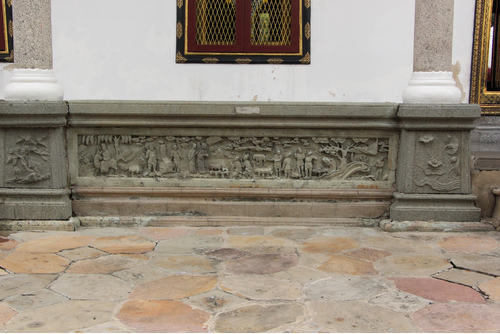
SculptureThe sculpture of Romance of the Three Kingdom
It is the stone sculpture in rectangular frame portraying parts of the story of the Romance of Three Kingdoms. The engraving shows the pictures of people wearing Chinese clothes. The scenery consists of trees, sky, vehicles, and animals which all these are the Chinese carving style.

SculpturePhra Si Ariya Mettrai
It is the Buddha image in royal attire. The robe is worn across the shoulder. The image is seated with the Siddhasana legs crossed which the right foot is placed above the left foot in the attitude of mediation. The face is quite round. The eyebrows are arched. The area between the eyelids line and the eyebrows is the sheets of eyelids. The eyes are quite small glancing low and not widely opened. The lips are small and also the hair coils. The body is slim. These are the Buddha image features in King Rama III period which could be compared to the Buddha image in royal attire during the same period of time in Wat Nang Nong.