Artwork Search
Arts in Southeast Asia Database


ArchitectureCandi Tikus
Trowulan was the capital of Majapahit dynasty. There are a number of monuments in this city, including Candi Tikus(the sacred pond) and several gateways. These monuments are always in brick, different from normal stone temple of the Eastern Javanese period

ArchitectureGapura Bajang Ratu
Gapura Bajang Ratu is of the most beautiful gateways in Majapahit period. Constructed in Brick which is the most popular material for construction at Trowulan, the style of the gateway is of the typical Eastern Javanese architecture. The door is decorated with the ferocious Kāla face gesturing the threatening gesture. The superstructure of the gateway is similar to the tower at Panataran, comprising the double bands punctuated by the cloister of 5 miniature towers. The contour is beautifully rendered in curvilinear shape. The tradition of constructing the gateway infornt of the temple complex in Eastern Javanese art anticipates the popularization of the same tradition in later Balinese art.

SculptureVishnu on Garuda from Belahan
Garuda in this period has a long and protuding mouth, shows a ferocious expressing, turns the face to the side and shows unsemestry movements. These characteristics all represent the essence of being “Eastern Java”.

SculptureLakshmi at Belahan
The wife wears curvy pattern costume and a lot of ornaments. Also, there is kanok pattern at the back. All of these represent the essense of being “Eastern Java”.

SculptureGaruda being slaved by Serpents
Candi Kidal is the place where ashes of king Anusabadhi of Singasari dynasty were buried. He died in 1248 and because the death and the rituals had to always be sepeated by 12 years, this religious place was built in 1260. There are narratives showing Garuda stealing holy water to save his mother. The holy water is the water of eternity. This relates to “Tevaraja” principle in that it helps the dead gain eternity.
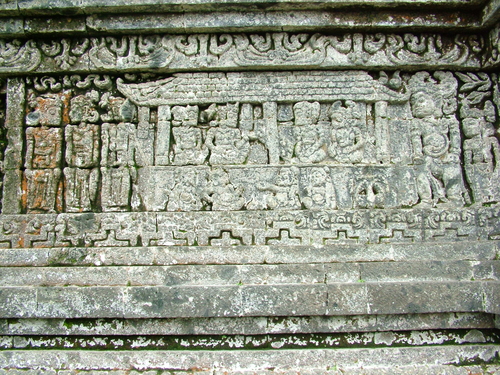
SculptureNarrative “Pandavas bit with Kauravas”
The narratrives in Eastern Java art usually depict human sculpture similar to Java shadow play. The sculpture only shows on side of the face and never face the audience directly. It wears local crown which is different from that in India. The space is filled with flower and cloud patterns. The building itself is of the local style. All of these localities show unique characteristics of “Eastern Java art”.
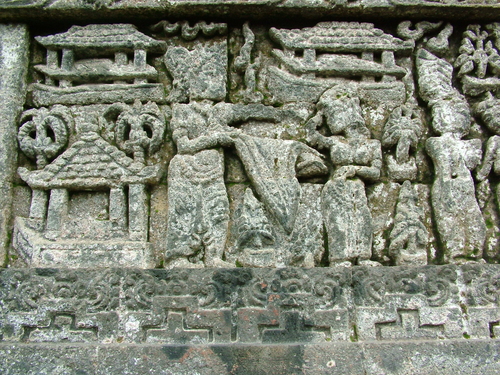
SculptureNarrative “Draupati’s Disrobing ”
The narratrives in Eastern Java art usually depict human sculpture similar to Java shadow play. The sculpture only shows on side of the face and never face the audience directly. It wears local crown which is different from that in India. The space is filled with flower and cloud patterns. The building itself is of the local style. All of these localities show unique characteristics of “Eastern Java art”.
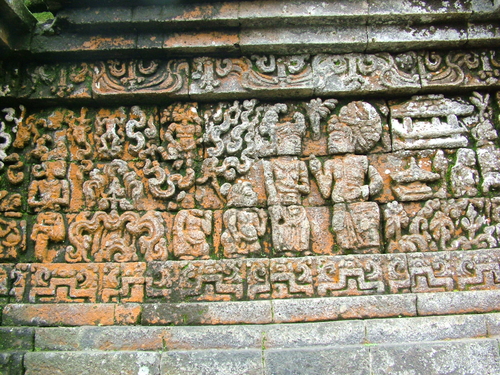
SculptureNarrative “The penance of Arjuna”
The narratrives in Eastern Java art usually depict human sculpture similar to Java shadow play. The sculpture only shows on side of the face and never face the audience directly. It wears local crown which is different from that in India. The space is filled with flower and cloud patterns. The building itself is of the local style. All of these localities show unique characteristics of “Eastern Java art”.