Artwork Search
Arts in Southeast Asia Database


SculptureAnimals from Thap Mam
Lion from Thap Mam indicates lots of Chinese characters, including the raising of the paws and the face that explicitly revealing the combination between the lion and the Chinese dragon. The Chinese beard and the dragon-liked mouth indicate the Chinese and Vietnamese artistic influence. During this period, Vietnam played the important political role in the region.

SculptureAnimals from Thap Mam
The lion from Thap Mam represents a strong influence of Bayon art from Khmer on Bin Din art. This is because the posture of the lion here is similar to the animals holding the base of the grand palace of Angor city. Also, due to tne invasion from King Chayavaramn VII, the khmer culture influenced sculpture in this period. The triangle cloth at the front is also considered the influence from Khmer culture.

SculptureAnimals from Thap Mam
Lion form Thap Mam exhibits lots of Chinese influences, including the Chinese beard and the paw raising posture. However, because of the political power of King Jayavarman VII of Cambodia, this lion was also influenced by Khmer art

SculptureDancing Shiva from the pediment of Po Kluang Karai
Although the temple is dated to the 13th century, the tympanum depicting the dancing Shiva is dated earlier as belonging to Binh Dinh style. This tympanum was re-used. The crown of Shiva, decorated with the series of tiny triangle elements forming the whole crown in triangular shape, is comparable to the normal style of Binh Dinh crown. The triangular cloth in the front of the lower garment is also the characteristic of the period.

SculptureSculpture of Later Period
This sculpture is one of the best representations of the sculpture in the later period. Only half of the body remains. It sits in a crossed-legs position with the legs merging with the back. The face has some beard showing the Chinese and Vietnamese influence and it wears the cap.
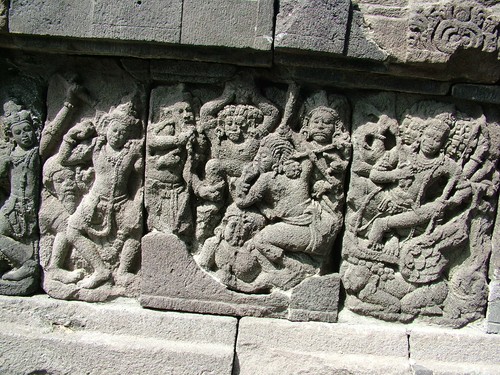

SculptureRamayana Narrative at Candi Prambanan
Unlike Borobudur, the narrative at Candi Parambanan is characterized by the background filled with motif and vegetation. The devoid of space in Parambanan narrative is noticeable and this is precursor towards the same trend in Eastern Javanese art. The volume of each figure is however still shaped and the face of these figures is still front-facing which is still traceable to Indian art.
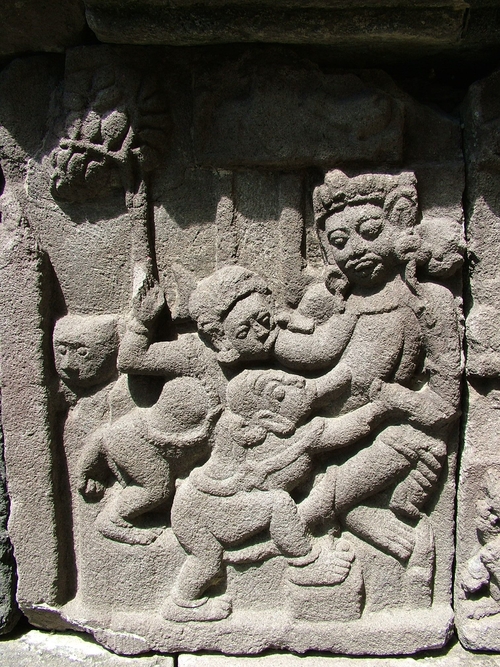
SculptureKrishna Narrative at Candi Prambanan
Unlike Borobudur, the narrative at Candi Parambanan is characterized by the background filled with motif and vegetation. The devoid of space in Parambanan narrative is noticeable and this is precursor towards the same trend in Eastern Javanese art. The volume of each figure is however still shaped and the face of these figures is still front-facing which is still traceable to Indian art.