Artwork Search
Arts in Southeast Asia Database
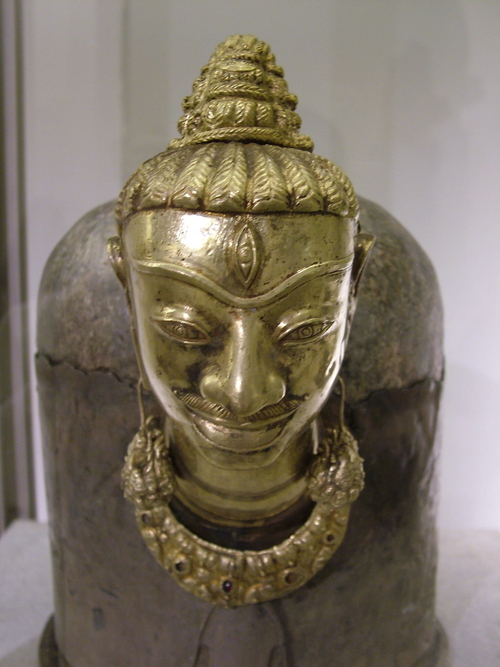

SculptureMukhalinga Cover
This linga shows a strong charcteristic of Dong Deung art especially the face. It has thick mounth, large nose and protuding eyes. The eyebrows are connected and there is a mustache. This is very different from the Indian-Chava appearing in My Son E1 and A1. Sometimes, linga might be covered by valuable metal,making it more holy. The metal covered might be made from copper, silver or gold.

SculptureBase with dancer and musician
Because the Indian-Chava influence started to feature again in My Son A1, sculpture in My Son A1 art is very gentle. The eyes are not protuding and there is no mustache. The lips are thin like Indian-Chava. The curving wearing cloth was also popular in Indian-Chava beforehand.

SculptureKartikeya on Peacock
Kartekeya is the son of Shiva. This is the reason why he always shows his childishness. Besides, he rides on peacock and holds diamond, which was previously the weapon of Indra.

SculpturePediment depicting Vishnu
Vishanu always has four arms holding a discus, a conch shell, a club and earthe and is the king of the universe. It is possible that the pediment shows that this Prasat was built for Vishanu, which was far less that those of Shiva.

SculpturePediment depicting Garuda and Naga
Vishanu is the guardian of the universe. He has two mouths: Garuda and Naga. Both appear on this pediment. Garuda is the mouth when he travels to palces, whereas Naga is his bed when he sleeps on the milk sea.

SculptureLion with both paws raising from Tra Kieu
Most of animal figures found at Tra Kieu are normally in dynamic movement, typical to this period. The lion figure of this period is also in the moving posture. The lion with the goat’s horn is called Vyala in Indian art.

SculptureShiva
Human sculpture of Bin Din period has been better organised than the previous period. That is to say, all of the neckpieces are avove the front part of the hat. An important characteristic of Bin Din and the later period is the backrest. Most of the hands are attached to the backrest. The triangle cloth edge drops down at the front.

SculpturePediment narrates Mahishasuramardani at Po Nagar
Po Nagar enshrines Pakawati icon, a disguise of Uma, is the goddess of the southern Champa. The Prasat was built in dedication to Pakawati in Hua Lai period, but was destroyed by Khmer in the 15th century BE. The new Prasat was built again in the early Bin Din Period, which is the current Po Nagar.