Artwork Search
Arts in Southeast Asia Database
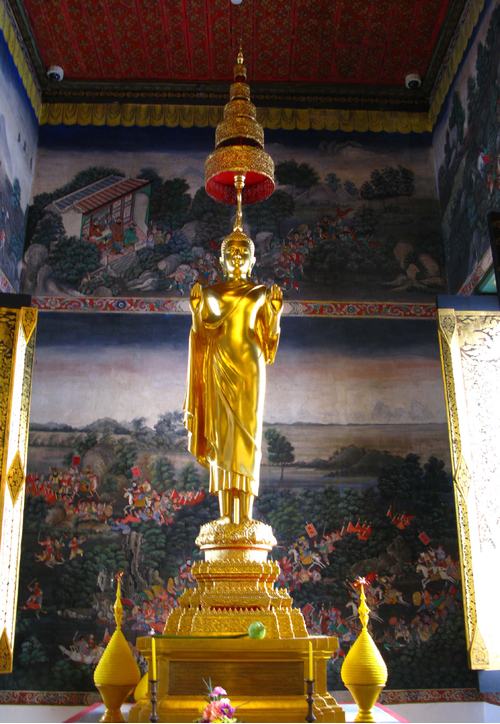

SculpturePhra Puttha Manusanak
It is the standing Buddha image on lotus lion-footed base. King Prajadhipok initiative of building the Buddha is also inscribed on the base. Both arms are elevated. The palms are facing outward and the fingers are extended upwards or it is called the attitude of stopping the rainstorm. The fingertips are not even in length. The robe is worn covering both shoulders. The robe is wavy folded naturally worn over Sabong which also can be detected from the streak underneath. The wavy folded style of robes represents the realistic concept, however other features of the Buddha are still the same such as the calm face, low-glancing eyes, long ears, small hair coils, and there is a low Ushnisha under a flame halo and decorated with five-tiered golden perforated Chatra
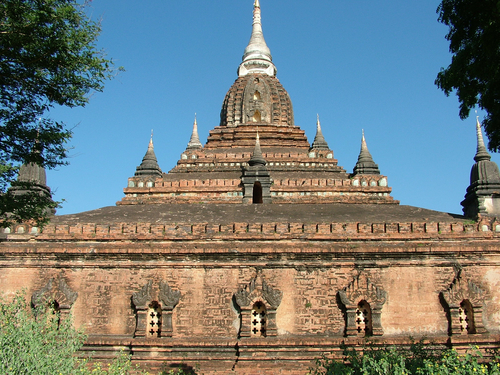

ArchitectureNagayon
The dim interior seems to be the most popular concept for the early Pagan art. That is why the lattice window is so popular during this period. The series of sloping roofs on the transition zone between the body and the spire are also the typical character of the early Pagan period. However, some characters of this temple anticipates the late Pagan art, including the elongate leafs decorating the tympanum. The series of niches decorating vertically at the central portion of the Śikhara is typical to the reign of King Kyanzittha.
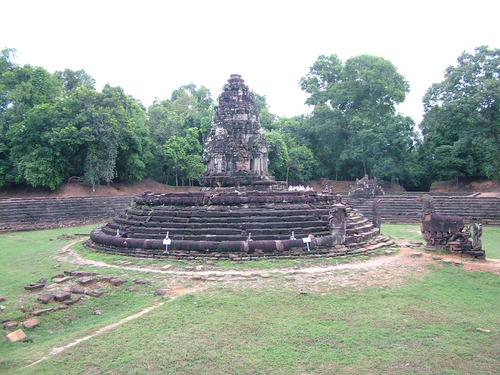

ArchitecturePrasat Neak Pean
Jayavarman VII had the reservoir entitled “Jayataḍāga” to be excavated in front of the complex of Rāajayaśrī (Prasat Preah Khan). In the middle of the lake there exists Prasat Neak Phan, the representation of the mythical Anottāta Lake, the holy lake in Buddhism.


ArchitectureTower with serpent: Candi Panataran
The most striking tower in the middle courtyard of the complex is the tower surrounded by the body of the serpent. The elongate body of the serpent is supported by several deities with the cylindrical crown and the typical Eastern Javanese dress. One of their hands hold the ceremonial bell while the another holds the body of the serpent. Th original function of this tower is unknown. However the serpent is connectible to the legend of the churning of the milky ocean and the function of this tower is possibly associated with the sacred water consecration.


SculpturePediment depicting Vishnu
Vishanu always has four arms holding a discus, a conch shell, a club and earthe and is the king of the universe. It is possible that the pediment shows that this Prasat was built for Vishanu, which was far less that those of Shiva.

SculpturePediment depicting Garuda and Naga
Vishanu is the guardian of the universe. He has two mouths: Garuda and Naga. Both appear on this pediment. Garuda is the mouth when he travels to palces, whereas Naga is his bed when he sleeps on the milk sea.

SculptureGaruda being slaved by Serpents
Candi Kidal is the place where ashes of king Anusabadhi of Singasari dynasty were buried. He died in 1248 and because the death and the rituals had to always be sepeated by 12 years, this religious place was built in 1260. There are narratives showing Garuda stealing holy water to save his mother. The holy water is the water of eternity. This relates to “Tevaraja” principle in that it helps the dead gain eternity.

SculptureNaga
The Naga Sculptures often found on the banisters or stariways depicted in the many headed form especially 7 headed Naga. The naga bores heavy influence from pre 16th Buddhist Century Khmer Art. The heads of Naga are bald without the headgears.