Artwork Search
Arts in Southeast Asia Database


ArchitectureGapura Bajang Ratu
Gapura Bajang Ratu is of the most beautiful gateways in Majapahit period. Constructed in Brick which is the most popular material for construction at Trowulan, the style of the gateway is of the typical Eastern Javanese architecture. The door is decorated with the ferocious Kāla face gesturing the threatening gesture. The superstructure of the gateway is similar to the tower at Panataran, comprising the double bands punctuated by the cloister of 5 miniature towers. The contour is beautifully rendered in curvilinear shape. The tradition of constructing the gateway infornt of the temple complex in Eastern Javanese art anticipates the popularization of the same tradition in later Balinese art.
ArchitectureMeru at Pura Ulun Danu
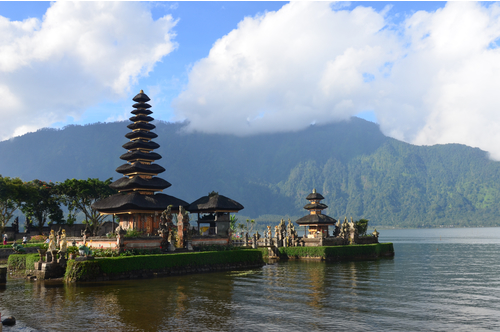
Pura Ulun Danu, located at Lake Bratan, was constructed by Mengwi dynasty in 1624 A.D. This is one of the most magnificent Balinese temples as the Meru tower is sent in the middle of the lake.
ArchitectureStepped bases at Pura Kehen
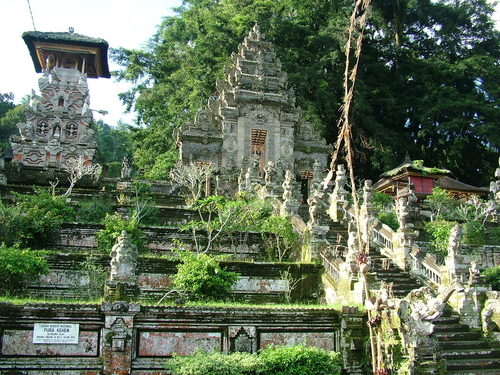
Balinese temple complex is dividable into 3 courtyards. The outer courtyard locates at the foot of the hill, symbolizing the netherworld. The middle courtyard symbolizes the human world and the innermost one the heaven, the abode of gods. Every courtyard is divided by the steps decorated with series of sculptures. The gateway punctuating the step symbolizes the door of each cosmic step.

ArchitectureGateway (Gopura) at Pura Kehen
Gopura is the gateway with Prāsāda superstructure which divides spaces in the temple complex, symbolizing the division of hierarchical steps of the cosmos. This door is iconographically conceived as the door preventing the evil to enter to the temple. Architecturally, Balinese gateway is divided into 3 portions, the central door and the side portions. Sometime, the side portions provide doors, hence triple doors. The ferocious Kāla face with threaten gestures, symbolising the prevention of evil, located above the door is typical to Eastern Javanese and Balinese art. Although the superstructure follows the south Indian architectural articulation, the sculpture of several weird animals and the Chinese-style-liked motif are incorporated to the spire.

ArchitectureSplit Gateway at Pura Kehen
The split gateway, known as Candi Bentar, is typical to Balinese art. The gateway comprises the body and the superstructure, all of these members are split into two sides. Candi Bentar functions as the gateway as well as the gate for preventing the evil to enter the temple.

ArchitectureMeru at Pura Taman Ayun
Pura Taman Ayun is the most famous temple for the rows of Meru towers. The height s of these towers are different and these tower are beautifully arranged in the order from the highest to the lowest spire, providing the most spectacular view of Balinese architectural landscape. These towers are dedicated to several mountains in Bali, including Gunung Batur, Gunung Batukau and Gunung Agung. The superimposing tiers of the Meru roof symbolize not only the high-ranking status of the pavilion but also the mountain.

ArchitecturePura Sada
Pura Sada was the former dynastic temple before the shifting to the new royal temple of Pura Taman Ayun in 1740. Interestingly, there are a number of unoccupied thrones in the temple precinct. Some scholars believe that these thrones symbolize the number of the persons who were in the boat during the funeral ceremony. This testifies that the temple was associated to the dead and the funeral cerwemony.
ArchitectureMeru at Pura Besakih
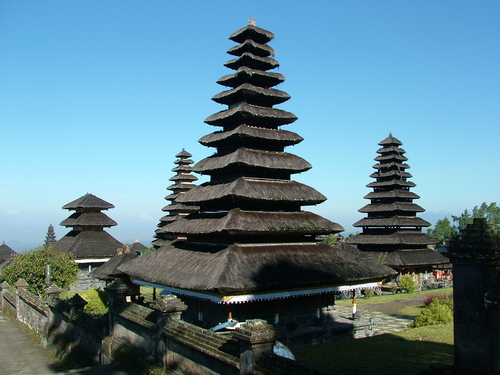
Meru is the name for the square tower with series of sloping thatched roofs, symbolizing the tower for the high-rankings. This kind of tower, therefore, is normally assigned for the significant gods. Meru normally locates inside the innermost courtyard of the temple. The thatched roof is normally perishable and always re-thatched, different form the brick-or-stone gateway which is quite permanent.