Artwork Search
Arts in Southeast Asia Database
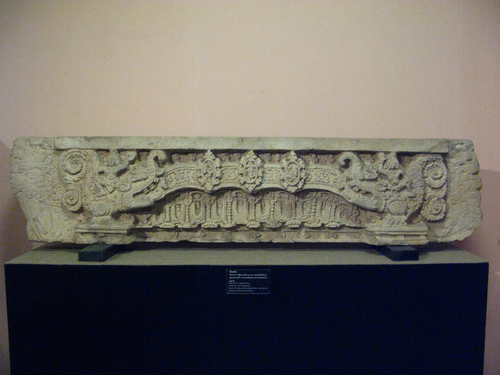

SculptureThe lintel from the north of Prasat Khao Noi
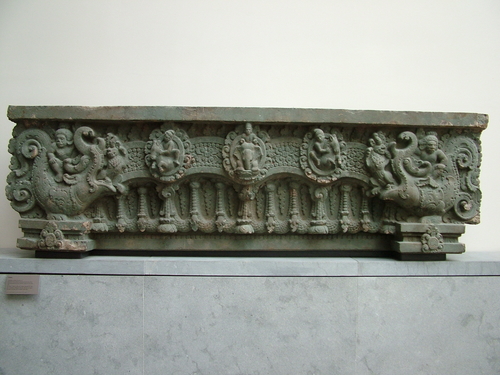
It is a rectangular-shaped lintel. The middle is engraved with 4 consecutive curved circles. The confluence of each arc is decorated with an oval pattern. Inside the oval pattern is decorated with an image of an angel on a vehicle. Under the curved lines are engraved patterns of garlands and a bunch of flowers. Next to both curved ends is a dragon facing inward with Its mouth open as if it is blowing out an arc of fire. There is an image of a person sitting above the dragon and the dragon is supported by a square base.
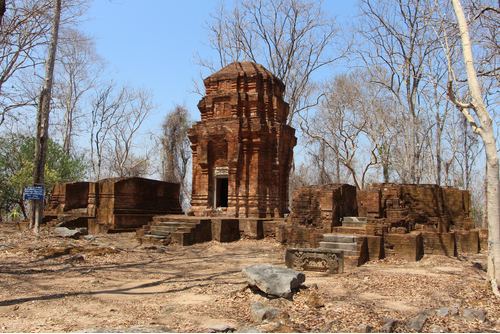
ArchitecturePrasat Khao Noi
The layout of Prasat Khao Noi consists of 3 brick buildings located in the north-south line. The northern and the southern ones have already collapsed, only the central one remains intact. The northern and the central prasats are on the same base but the northern prasat was extended outward. The southern prasat is on a base with the same height but slightly apart with only a connection by a brick base on the back. It can be seen that the construction of these 3 buildings are not in alignment which is similar to the construction of the prasats in Mueang Phra Nakhon of Khmer, which is not very organized.The north side of the prasat has a rectangular layout. There is only one entrance and one exit on the east side. The doors on the other sides are false doors. The entrance was extended so the diagram of the building is deep. The room’s diagram is rectangular with a curved hole on each side.The central prasat is a brickwork in a square plan extended with twelve wooden corners. There is only one entrance and one exit on the east side. The doors on the other sides are false doors. Inside is a room with different length on each side. The prasat on the southern side is a rectangular building on a brick base with the building made up of walls. There is a porch on the east entrance and the diagram inside the building is rectangular as well.
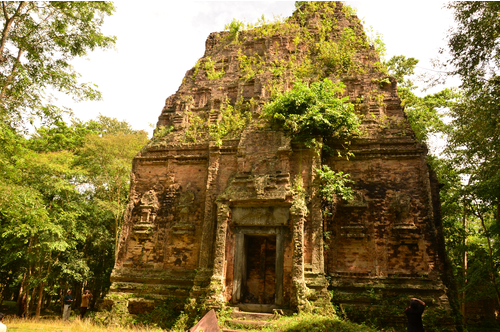

ArchitectureSombor Preikuk S1
Pre-Angkorian temple is characterized by the brick temple decorated with carving. The body of the temple is normally punctuated by series of pilasters at the corners as well as at the middle of the wall. Sombor Preikuk is decorated by six pilasters dividing the wall into five offsets. The central offset is ornamented by the miniature bas-relief temple while the side offsets are decorated by the so-called flying temples. The superstructure follows the South Indian architectural tradition, comprising the miniature superimposing tiers decorated with the miniature temples.
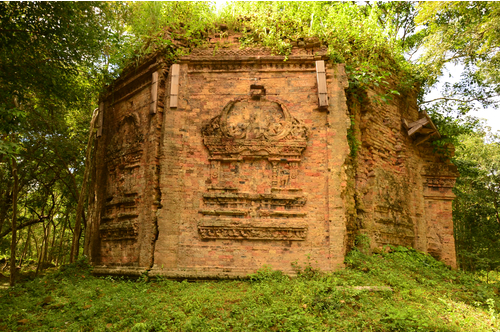
ArchitectureOctagonal temple: Sombor Preikuk
Some of Sombor Preikuk temples are of octagonal plan which is one of the most striking characteristics of Pre-Angkorian period. These octagonal temples are normally decorated with pilasters at each corner and the so-called flying bas-relief temple in each offset. The superstructure comprises series of sloping roofs punctuated by Kudu arches indicating the North Indian affiliation.
SculptureLintel
Lintel is an architectural element normally installed at the top of the door. Lintel of Sombor Preikuk period is characterized by the couple of inward-facing Makara disgorging four arches punctuated by three medallions. Makara normally stand on the base and is ridden by a person. Inside the medallions exists the figure. Below the arches exists the stings of garlands and the flowery tassels.

SculptureWall Carved: Prasat at Prasat Sombopraikuk
The Prasat is built from bricks located within the square plan. There is the pillar attached to each corner of the Prasat as well as the Ruean Tat (Middle Part of the Prasat). There is only one entrance with three others are seen but clogged. The roof are made in the replica pattern of Ruen Tat stacked up in the style of Vimana of Suthern Indian Art. The Prasat is located on a flat ground with no stacking base.