Artwork Search
Arts in Southeast Asia Database
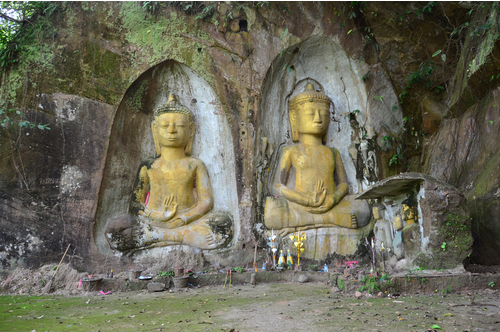

ArchitectureBuddha Image at Tham Chang
The characteristics of Buddha images in Dvaravati art of Central Laos, similar to those in Northeast Thailand, are the indigenous facial expression, the small hairy curls suggesting Khmer influence. Vitarka gesture is very popular during this period, as so the loose cross-legged sitting with one sole shown.
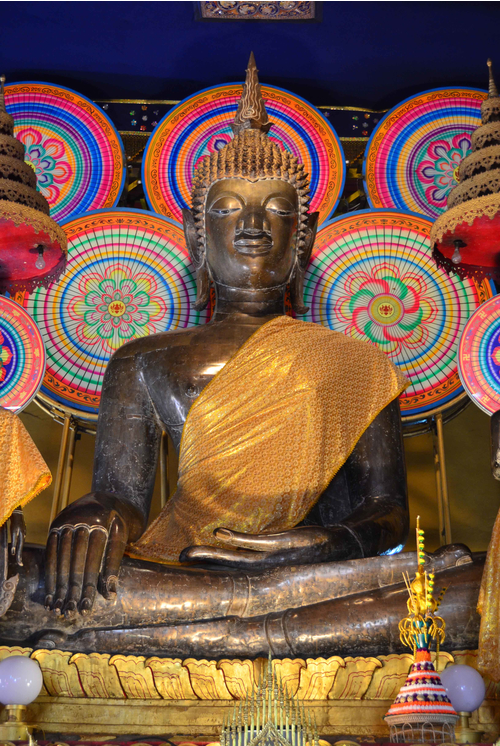
SculpturePra Chao Ong Tue
This Buddha image bears the characteristic of King Xai Xettha styles. The Sukhothai and Lanna influence is noticeable from the oval face and the flame on the top of the chignon. The Buddha wears the one-shoulder-covered robe, sitting in Maravijaya gesture on the lotus ring. The influences from Sukhothai, Ayutthaya and Lanna art are quite obvious as there were the close connection between Laos andThailand during the reign of Xai Xettha.

SculptureBronze Base of the Buddha Image
In 22-24 centuries BE., Buddha Images in Lanchang were usually built with high bases with elaborated lotus wire. The base is made of bronze. It is composed of lion base and the foot of the lion is an arc that is continuously connected. This characteristic is similar to the one of Mid-Ayutthaya art. Next to the base appears the overturned lotus and the wood with the pattern of Look gaew ok gai. Next is the upturned lotus connected with the overturned one to soften the upper layer of wood and to show the curve of the base. The curve is the important aesthetics of lotus wires in Lanchang art.
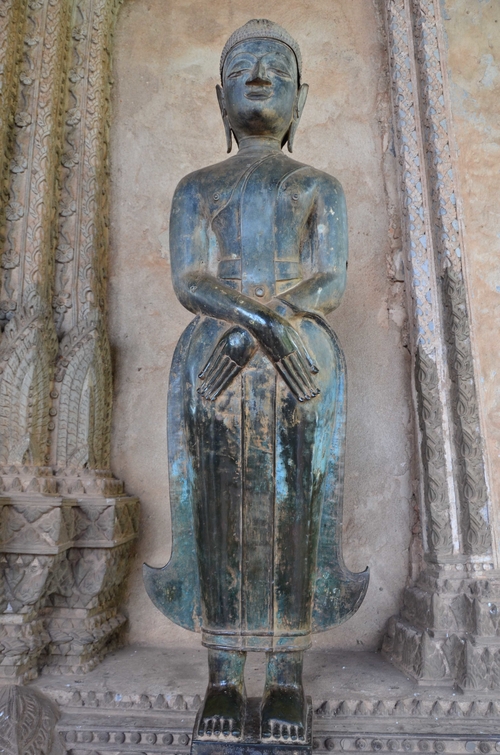
SculptureBronze Buddha Image
In 22-24 centuries BE, there are several remarkable feature of Buddha Image in Lanchang arts. For example, the traditional style face, small hair with hairline, large heads but narrow shoulders. The body is tall and thin. The robe is smooth with no stripes and there is the edge of the robe in the front according to Ayutthaya style. However, the edge of the robe is tilted which is the special characteristic of Lanchang.
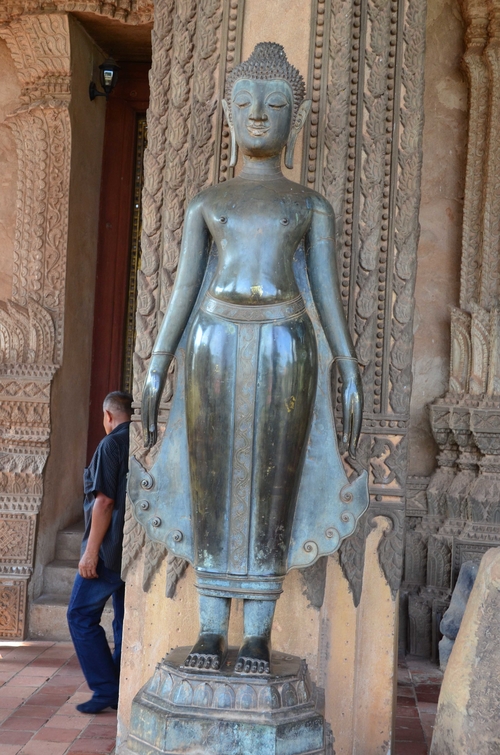
SculptureBronze Buddha Image
In 22-24 centuries BE., there are several remarkable feature of Buddha Image in Lanchang arts. For example, the traditional style face, small hair with hairline, large heads but narrow shoulders. The body is tall and thin. The robe is smooth with no stripes and there is the edge of the robe in the front according to Ayutthaya style. However, the edge of the robe is tilted which is the special characteristic of Lanchang. What interesting about this Buddha Image is that the edge of the robe is in spiral style which is the same as some Buddha Images in Vientiane.
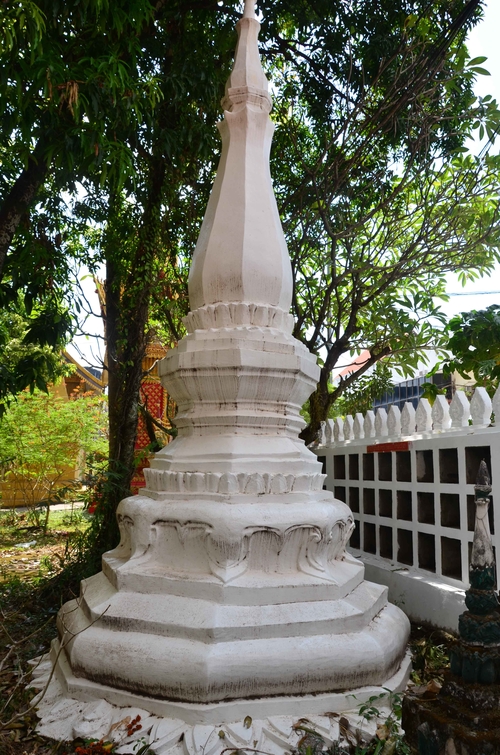
ArchitectureStupa: Wat Peng
Stua at Wat Peng is a stupa in an octagonal plan. The important feature is the angled lotus bell-shaped element, which is the unique feature of Lan Chang. The base is Bua Khao Prom in the form of lion legs. This shows the relationship with the lion base in the middle Ayuthaya and is very similar to the same part at Wat ong Tue, Tha Bor Subdistrict, Nong Khai.

ArchitectureStupa: Wat Nak Yai
Stupa at Wat Nak Yai is the most beautiful Prasat-type in Vientiane area. It is very similar to Lanna art. The chamber is redented with 20 corners. The niches on the four sides enshrine the standing Buddha images. Above the chamber is a base supoorting the redented bell-shaped element with 12 corners. and the top part is the angled lotus. This stupa might have been built from the reign of king Chai Chetthathirat to the reign of king Suriyawongsathammikaraj. This was the period when Lan Chang art was still closely related to Lanna and Ayutthaya arts.
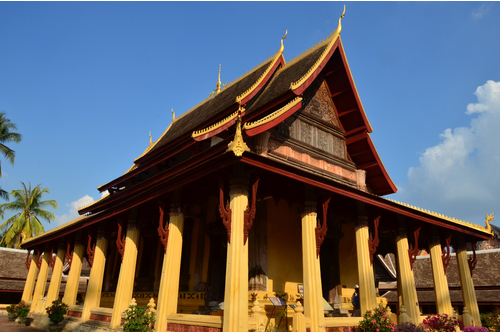
ArchitectureSim: Wat Sisaket
Sim at Wat Srisaket is a Vientiane sim that has high roofs on the sides. This is different from low roofs of Luang Phra Bang and Chiang Kwang. There are surrounding Palai, which is very similar to Ubosot in Rattanakosin art. The door and window are of Mondop shape, which is similar to ubosot at Wat Phra Sri Sasadaram in Bangkok. However, the multi-tiered roof is similar to Lan Chang. The colorless tiles, the gabel apex and the Prasat on the top of the roof are all unique characteristics of Lan Chang.