Artwork Search
Arts in Southeast Asia Database
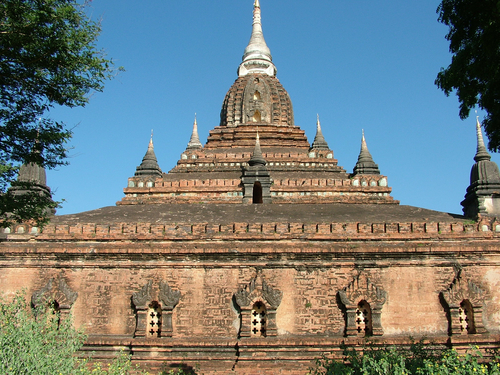

ArchitectureNagayon
The dim interior seems to be the most popular concept for the early Pagan art. That is why the lattice window is so popular during this period. The series of sloping roofs on the transition zone between the body and the spire are also the typical character of the early Pagan period. However, some characters of this temple anticipates the late Pagan art, including the elongate leafs decorating the tympanum. The series of niches decorating vertically at the central portion of the Śikhara is typical to the reign of King Kyanzittha.


ArchitecturePo Nagar
Po Nagar tower is assigned to the transition period between the periods of My son A1 and Binh Dinh. Whereas the five-set fluted pilaster is the characteristic of My Son A1 period, the spear-liked pointed arch Is of the later Binh Dinh style.

ArchitectureLocation of Po Nagar
Po Nagar locates on the bank of the river, adjacent to the sea, which is the important landmark. As the goddess is associated with the sea as well as the flatness of the Yonī, this temple is chosen to be by the sea-river.

SculpturePediment depicting Vishnu
Vishanu always has four arms holding a discus, a conch shell, a club and earthe and is the king of the universe. It is possible that the pediment shows that this Prasat was built for Vishanu, which was far less that those of Shiva.

SculpturePediment depicting Garuda and Naga
Vishanu is the guardian of the universe. He has two mouths: Garuda and Naga. Both appear on this pediment. Garuda is the mouth when he travels to palces, whereas Naga is his bed when he sleeps on the milk sea.

SculpturePediment narrates Mahishasuramardani at Po Nagar
Po Nagar enshrines Pakawati icon, a disguise of Uma, is the goddess of the southern Champa. The Prasat was built in dedication to Pakawati in Hua Lai period, but was destroyed by Khmer in the 15th century BE. The new Prasat was built again in the early Bin Din Period, which is the current Po Nagar.


SculptureNaga
The Naga Sculptures often found on the banisters or stariways depicted in the many headed form especially 7 headed Naga. The naga bores heavy influence from pre 16th Buddhist Century Khmer Art. The heads of Naga are bald without the headgears.
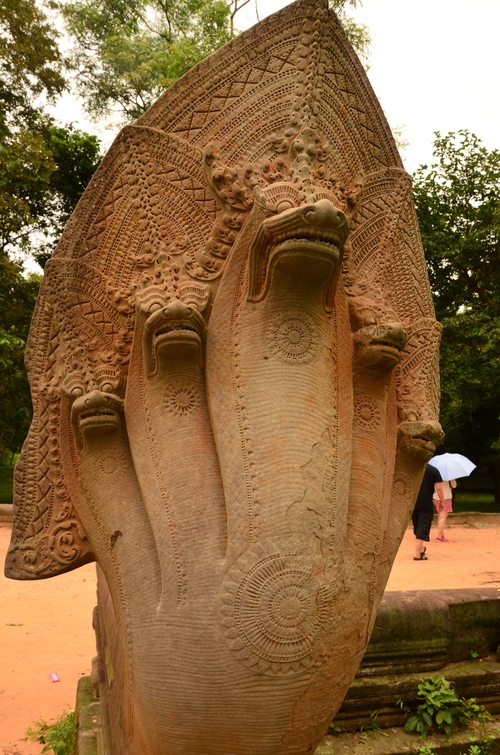
SculptureHead of Naga
Naga is generally found in Khmer art. It is usually used as a component of a balustrade or walkway. The Naga has 5 heads. All of the heads wear cap and share the same halo, which is the characteristic of Angkor Wat art.