Artwork Search
Arts in Southeast Asia Database
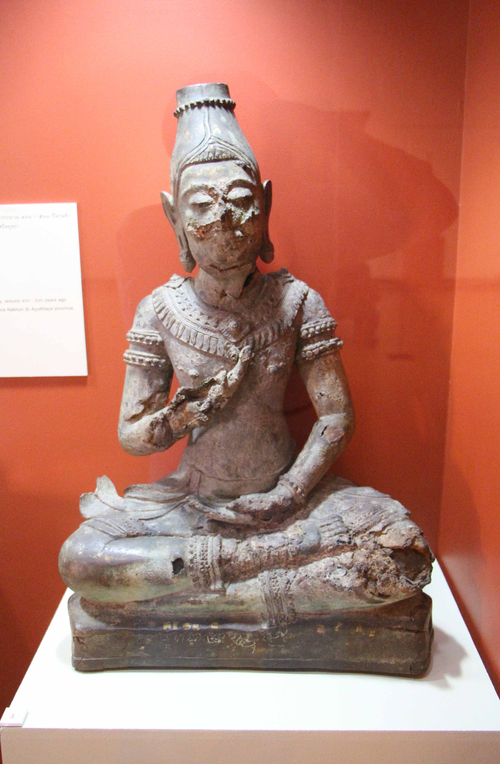

SculptureBodhisattva
The Bodhisattva is sitting on an inscribed base. The right hand is at the chest level. The left hand is placed above the lap. The hair is long and it is curled. The Bodhisattva wears some jewelry such as filter neck, bracelet.
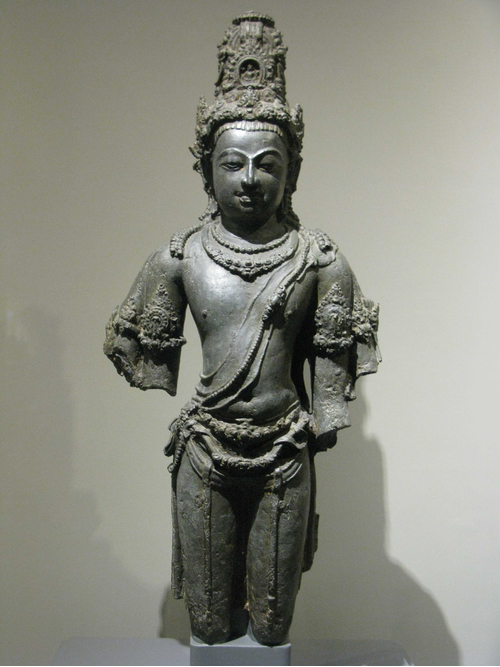
SculptureAvalokitesvara Bodhisattva
The Avalokitesvara Bodhisattva is in the standing posture with 8 arms but all the arms has only the upper part left. The lower body part from the knees down are gone.he face is plump and well-crafted. The eyelids are half closed. The head wears the triangle crown with jewelries. The hair bun is in the cylinder shape with the image of Amitabha Buddha. The hair is curvy and lies down to the shoulders left. The body wears many accessories such as the leather body bracelet with the chamois head on the left shoulder. This body bracelet is overlapped by a pearl body bracelet. Two necklaces, the top one is of pearls and the lower one is jewelries with flowers decorated. The jewels bracelet is also visible. Overall, this sculpture reflects the relationship between the Network of Mahayana Buddhist Kingdoms such as Pala Dynasty of India and Shailendra Dynasty of Java. However, the study by Assoc Prof Chet Tingsanchali points out the traits of the sculpture that do not exist in Java Art which means this sculpture might be crafted in Thailand.
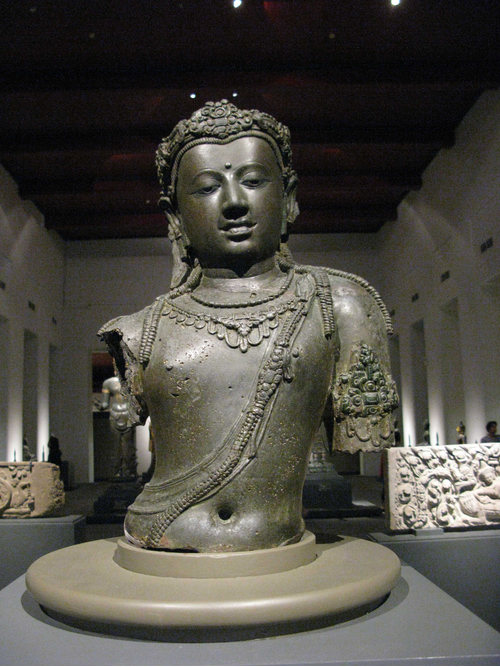
SculptureAvalokitesvara Bodhisattva
The sculpture is in the damaged condition. Only the head and upper body in ‘Tribhanga’ posture (standing body position or stance used in the traditional Indian sculpture, art and Indian classical dance forms) are left. The lower part of body is lost.The face is plump and well-crafted. The eyelids are half closed. The Unalome is visible at the forehead while head wears the triangle crown with jewelries. The hair bun on the top of the head is broken and lost, only the hair that is down to the shoulders left. The body wears many accessories such as the leather body bracelet with the chamois head on the left shoulder. This body bracelet is overlapped by a pearl body bracelet. Two necklaces, the top one is of pearls and the lower one is jewelries with flowers decorated. The jewels bracelet is also visible. Overall, this sculpture reflects the relationship between the Network of Mahayana Buddhist Kingdoms such as Pala Dynasty of India and Shailendra Dynasty of Java. However, the study by Assoc Prof Chet Tingsanchali points out the traits of the sculpture that do not exist in Java Art which means this sculpture might be crafted in Thailand.
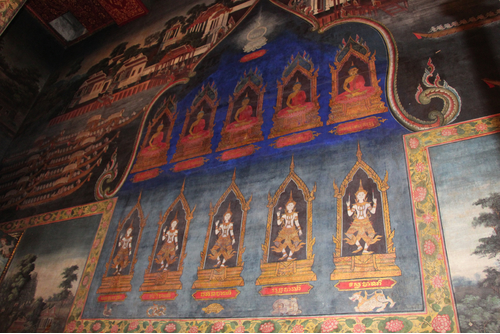
ArchitecturePainting of the Mahayana Buddha and Bodhisattva
The composition of this painting is written on a dark blue background with a curved and spiked frame. There are five Buddha sitting in rows inside the frame. Each Buddha wears dark color almost red, oblique and no streak robe. There is a small strip Samghati, from the left shoulder to the belly. The face and body are gold-plated. Above the head, there is a gold-plated flame halo with no urna which is an important symbol of royal intention Buddha images of King Rama IV. All Buddha are dhyana mudra (also called the samadhi mudra) on lotus base that support by singha base inside the glass curved arch. At the end of arch looks like hawk face beside. The middle crest is a Kranok pattern similar to the straight head naga. Top of the arch decorate by Bodhi tree, surround with frame Kranok pattern. This is the style of royal intention Buddha images arch of King Rama IV too. Under the base of each Buddha has a golden Khom alphabet on the red background.Above five Buddhas, there is a shining urna over the lotus. The center of urna has Khom alphabet. Under the lotus has Khom alphabet on red background. ฺBelow Buddhas are five persons who dress like an angel. Everyone wears jewelry that is gilded : crown with ears decorate, necklace, breast chain, bracelet. Wear striped paint cloth with two layers seam, golden anklet and shoes. Stand on the platform with cloth inside the arch which is similar to Buddhas arch without bodhi. Under each platform has golden Khom alphabet on red background, along with chicken, naga, turtle, cow and lion.All these paintings are related to the Mahayana belief. Because the alphabets that appear under each Buddha are : “Vairochana” “Akshobhya” “Ratnasambhava” “Amitabha” และ “Amogasiddhi” in order from left to right. This name corresponds to the Khom alphabets under the urna and above the paintings of the Buddha which read “Dhyani Buddhas” The Khom alphabets that are under the paintings of five person who dresses like angels are : “Samantabhadra” “Vajrapani” “Ratnapani” “Pattamapani” and “Vishvapani”. So, it corresponds to the paintings of each Dhyani Buddhas that have Bodhisattva below. And believe that animals below of each Bodhisattva are the symbol of the five Buddhas who enlighten in the earth. The urna that appears on top, there is three Khom alphabets inside which read : A U Ma or Ohm. It is the worship words of God in accordance with the belief in ancient Brahman. It is interesting that it was written above the text and images of Dhyani Buddhas, which is a subject in Buddhism.


ArchitectureAbeyadana
The dim interior seems to be the most popular concept for the early Pagan art. That is why the lattice window is so popular during this period. The window-niche is beautified with the short leafs on the top of the pediment, characteristic of the period of Early Pagan. The superstructure comprises the series of sloping roofs, typical to the early period of Pagan art, and the Pāla style stupa as the pinnacle. The Pālal styled stupa is characterized by the multi-angled square Harmikā and the Chatravali decorated with the tiny triangle. Abeyadana is the fine example of the Ku or temple of the early Pagan art.

ArchitecturePrasat Neak Pean
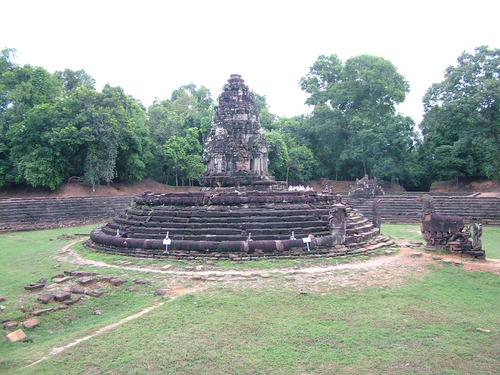
Jayavarman VII had the reservoir entitled “Jayataḍāga” to be excavated in front of the complex of Rāajayaśrī (Prasat Preah Khan). In the middle of the lake there exists Prasat Neak Phan, the representation of the mythical Anottāta Lake, the holy lake in Buddhism.
PaintingMural in Abeyadana
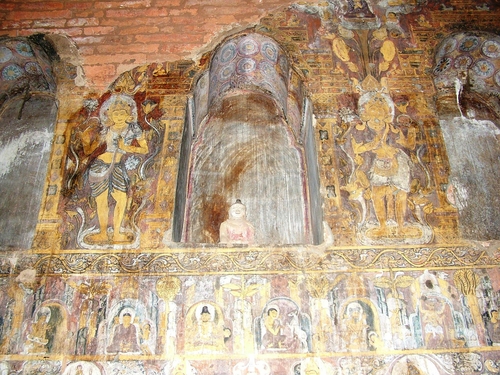
Pala artistic influence can be noticed from the red tone that occupies the painting. The niches for enshrining Buddha images that cloister at the wall of the temple are flanked by Mahayana Bodhisattvas. The dress and regalia of these figure are very similar to those of Pala sculpture, including the diadem with three pointed leafs, the S-shaped Yajnopavita and the folded lower garment.

PaintingManjusri : Mural in Abeyadana
The visible influence of Pala Art is the use of hot tone colors such as red, yellow, black, and gold while the cool tone colors such as green is rarely seen. The clockwise walkway inside leaves some traces of Buddha Images that used to be installed there. The frames that used to be the Buddha Image spots are flanked by the painting of Mahayana’s Bodhisattva dressed similar to the Pala Style of Art such as wearing high crown (Jada headgear), wearing the ‘S’ shape sashes, and wearing striated brocades.