Artwork Search
Arts in Southeast Asia Database
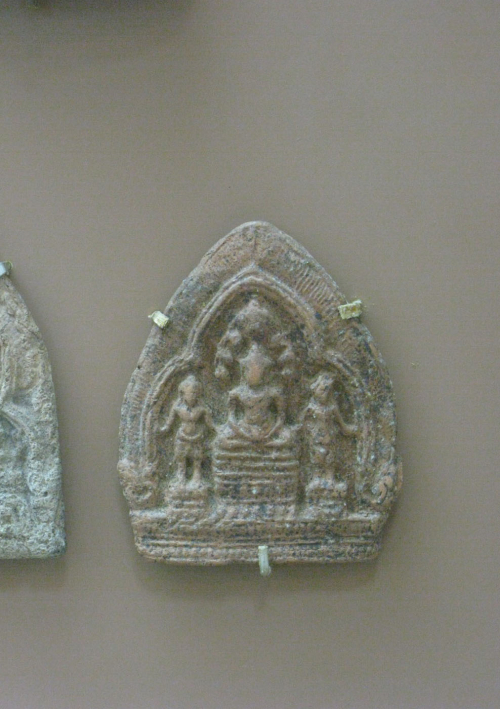

SculpturePottery votive tablet
It is a votive tablet that looks like a triangle shape. In the middle is a Buddha image Sheltered by a Naga. The right side is believed to be Avalokiteshvara Bodhisattva and the left side is Prachya Paramita. There is a curved frame surrounds the three sculptures and it is supported by a lotus base.
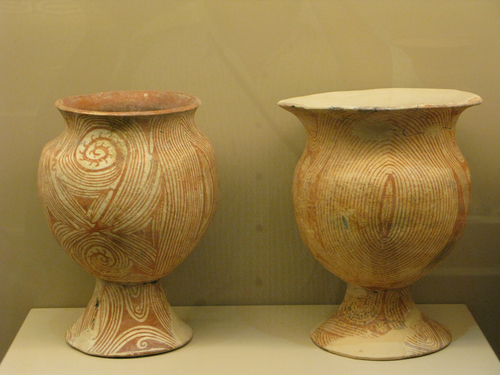
SculptureBan Chiang Pottery
It is a pottery in the tomb found from excavations of Ban Chiang Archaeological Site. It can be classified as follows:1.Early periods, at least between 4,300-3,000 years old.Phase 1 There are prominent types of potteries which are black-dark gray potteries with a low base. The upper half of the container is often decorated with curved lines with pressed dots and short lines. The lower half of the container is often decorated with handprint rope which is the pattern resulting from pressing the pottery surface with a rope. Phase 2 New type of pottery began to appear. It was a large pottery used to hold the bodies of children before being buried. There was also an ordinary-sized pottery with most of the surface outside of the container decorated with curved lines and that makes it seems like it was the container with more lines decorated than the one of the early periods.Phrase 3 Appeared potteries with the straight side wall or almost straight resulting in having a beaker-shaped container. There was also a short, round-necked pot with a straight mouth. It was decorated with handprinted rope on the entire container. Phase 4 Appeared round bottom pottery. The shoulder area of the pottery was decorated with curved lines mixed with red painting. While the part under the shoulder area was decorated with handprinted rope. This pottery was called “Om Kaew" because it was the main pottery type found in Ban Om Kaew, which was not far from Ban Chiang, during the prehistoric period.2.Middle periods, at least between 3,000-2,000 years old. The outer surface area of the pottery is white with clear sharp or curve angles in most of the shoulder areas. There are both round and pointed bottoms. Some of the potteries were decorated with stripes mixed with color painted near the mouth of the container and during the end of the middle period, the mouth of this type of pottery were decorated with red paint.3.Late periods: between 2,300-1,800 years agoThe early times of the Late periods: found potteries with red color painted on a soft color surface.The middle time of the Late periods: started to use potteries with red color painted on a red surface. The late times of the Late periods: started to use potteries painted with red color then wax. The pattern that appears on the potteries can be classified as follows:1. Geometrical motifs2. Free symmetry pattern3. Asymmetrical balanced pattern groupsThe popular patterns in the late periods were to color on the soft clay coating with circle or oval patterns, spiral patterns, spiral towards the center patterns, spiral towards the center, then looping out, and the S and Z patterns.The pattern of the container shows meticulousness of the potters. They created the potteries for the dead according to tradition and belief about death. The basic idea of the pattern creator in the community is culturally mutual but there were varieties of patterns appearing at the same time. In the initial stages, the patterns were simple and later, when the potters had more expertise, the patterns gradually became more and more complex.
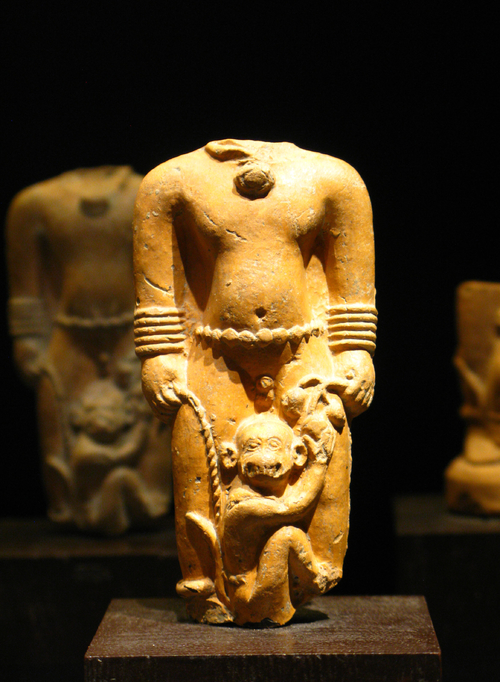
SculptureA clay offering doll depicting a human leading a monkey.
A small clay doll without the head. It depicts a naked man wearing necklace, belt and a bracelet. The right hand holds a chain that ties the monkey who sits between the two legs and the left hand holds fruit.
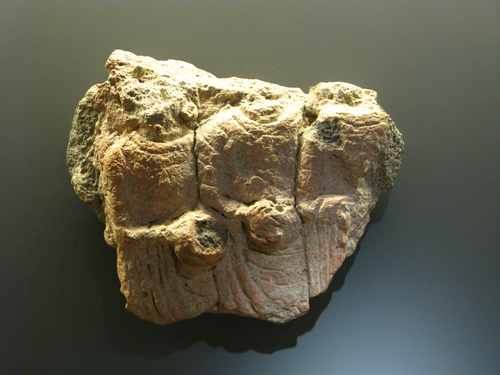
SculptureMonks holding alms bowls
This terra-cotta bas-relief used to decorate a stupa, but it is in badly damaged condition. The sculpture illustrates 3 Buddhist monks standing in a row, and each monk is wearing a monastic robe the shawl of which is covering their shoulders and arms and is holding an alms bowl at navel height.


SculptureJataka Narrative in Terracotta: Mahajanaka
Piet Liek Chedi is a bell-shaped chedi of the early Puklam period, influenced by Pala art. The base of the chedi contains 550 naratives scene in terracotta. These scenes are made of terracotta, but have not been enameled in green, which is different from Chavechikong. This shows that these scences may be dated in the pre-Pukam and the early Pukam period.

SculptureJataka Narrative in Terracotta: Sama
Piet Liek Chedi is a bell-shaped chedi of the early Puklam period, influenced by Pala art. The base of the chedi contains 550 naratives scene in terracotta. These scenes are made of terracotta, but have not been enameled in green, which is different from Chavechikong. This shows that these scences may be dated in the pre-Pukam and the early Pukam period.

SculptureTerracotta Plaques at Ananda
At the outer base of Ananda chedi, there is a green-enameled terracotta piece, which is popular in Burmese art. These stories are used to decorate the plain area inthe middle of a lotus base. This is also a popular characteristic of Pukam art.

SculptureTerracotta Plaques at Ananda
At the outer base of Ananda chedi, there is a green-enameled terracotta piece, which is popular in Burmese art. These stories are used to decorate the plain area inthe middle of a lotus base. This is also a popular characteristic of Pukam art.