Artwork Search
Arts in Southeast Asia Database
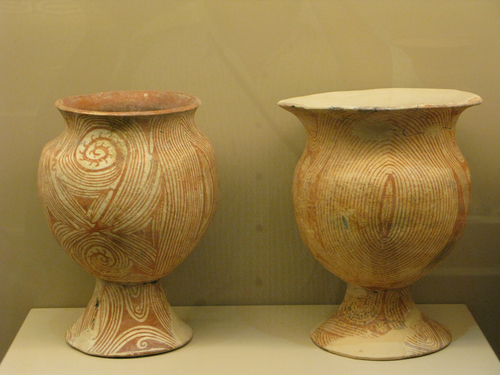

SculptureBan Chiang Pottery
It is a pottery in the tomb found from excavations of Ban Chiang Archaeological Site. It can be classified as follows:1.Early periods, at least between 4,300-3,000 years old.Phase 1 There are prominent types of potteries which are black-dark gray potteries with a low base. The upper half of the container is often decorated with curved lines with pressed dots and short lines. The lower half of the container is often decorated with handprint rope which is the pattern resulting from pressing the pottery surface with a rope. Phase 2 New type of pottery began to appear. It was a large pottery used to hold the bodies of children before being buried. There was also an ordinary-sized pottery with most of the surface outside of the container decorated with curved lines and that makes it seems like it was the container with more lines decorated than the one of the early periods.Phrase 3 Appeared potteries with the straight side wall or almost straight resulting in having a beaker-shaped container. There was also a short, round-necked pot with a straight mouth. It was decorated with handprinted rope on the entire container. Phase 4 Appeared round bottom pottery. The shoulder area of the pottery was decorated with curved lines mixed with red painting. While the part under the shoulder area was decorated with handprinted rope. This pottery was called “Om Kaew" because it was the main pottery type found in Ban Om Kaew, which was not far from Ban Chiang, during the prehistoric period.2.Middle periods, at least between 3,000-2,000 years old. The outer surface area of the pottery is white with clear sharp or curve angles in most of the shoulder areas. There are both round and pointed bottoms. Some of the potteries were decorated with stripes mixed with color painted near the mouth of the container and during the end of the middle period, the mouth of this type of pottery were decorated with red paint.3.Late periods: between 2,300-1,800 years agoThe early times of the Late periods: found potteries with red color painted on a soft color surface.The middle time of the Late periods: started to use potteries with red color painted on a red surface. The late times of the Late periods: started to use potteries painted with red color then wax. The pattern that appears on the potteries can be classified as follows:1. Geometrical motifs2. Free symmetry pattern3. Asymmetrical balanced pattern groupsThe popular patterns in the late periods were to color on the soft clay coating with circle or oval patterns, spiral patterns, spiral towards the center patterns, spiral towards the center, then looping out, and the S and Z patterns.The pattern of the container shows meticulousness of the potters. They created the potteries for the dead according to tradition and belief about death. The basic idea of the pattern creator in the community is culturally mutual but there were varieties of patterns appearing at the same time. In the initial stages, the patterns were simple and later, when the potters had more expertise, the patterns gradually became more and more complex.

PaintingPha Taem Prehistoric Color Painting
It can be divided into 4 groups according to the name and the position of the cliff, they are Pha Kham, Pha Taem, Pha Mon Noi, and Pha Mon. They are all facing the east.1. Pha KhamIt shows a painting of 4 large fishes approximately 0.35 - 1.00 meters long written in a red x-ray style to see the internal structure. In addition, there is a painting of an elephant which is much smaller than a fish (about 13 cm) and a painting of a quadruped.2. Pha TaemThere are paintings all along the cliff. They are 180 meters long and about 4 - 5 meters above the ground. There are more than 300 color paintings at Pha Taem. There are paintings created by the rain gouging into the rock creating some lines patterns; some are straight, some are arranged along a straight line, some oblique, some horizontal. They are from 5 - 15 centimeters in height. The remaining section is only about 80 centimeters long and they are possibly some iconic images. Most of the color paintings in this area are written in red, only some are in black and white divided into small sizes of human paintings and only 10 of them were found.Paintings of animals such as elephants, fish, turtles or snapping turtle, dog, cow, chicken or bird etc. are often painted as large as the real thing, especially elephant and fish whose size is up to 4 meters long and about 3 meters high. There are about 30 animal paintings found and both human and animal paintings are often in motion.Object paintings. This could be a fishing tool called a "Toom" and a crossbow or bow that a person is holding.Geometrical motifs. The motifs are in twisted, wavy or zigzag lines that can refer to “water” or a fish trap. They are also in herringbone, geometric, parallel lines that looks like ricefields, etc.Human hands. There are more than 200 hands, both of children and adults. The colors are red, black, and white. All types of paintings are always drawn together, especially the hands that appear in every painting.Most of the paintings are silhouette. Others are outlines and stick men. The human hand paintings are stencils, imprints, and outlines.3. Pha Mon NoiThis section shows a painting of a person about 1.6 meters tall holding a bow aimed at a four-legged animal, possibly a pregnant cow with the body size of 6.4 meters long. Next to that is a painting of a person about 1.2 meters tall chasing a horned four-legged animal which might be a deer that invaded the ricefields. surrounding this group of paintings are paintings of about 20 hands, both left hands and right hands created by putting the paint on the palm then scraping off some of the paint on the fingers and palms and then imprinting the hand on the wall. Next is a painting of three four-legged animals with bloated bellies and it looks like they are pregnant as well. There is a drawing that is similar to the net of an animal trap and also paintings of connected parallel lines. There are, in addition, 15 human hands paintings arranged in long wavy lines. They are similar to the ones of the first group. Paintings of people and animals were painted in red silhouette. It is noteworthy that all types of paintings at Pha Taem and Pha Mon Noi are related. Whether it is a picture of a person and a cow with hands, fish and hands, ‘Toom’ with hands, geometrical motifs of ricefields, people, and deer with hands, or a painting of a person hunting a cow or a deer.4. Pha MonIn this section, there are paintings of people and animals written in red silhouette.In this first group, there is only a painting of a single person and 11 four-legged animals, possibly elephants, cows, dogs and pigs, or sheep or goats, walking in the same direction. (Except for one animal, possibly a dog that is facing the herd)In the second group, there are paintings of about 10 people drawn in silhouette and stickmen. They all look quite realistic, even their calves are aneurysms. An interesting painting of the Pha Mon is the painting of a person wearing a half-calf length skirt standing with arms akimbo, not sure whether it is a woman or a man. This painting is larger than other paintings. Moreover, they are paintings of the right hands of adults, 2 paintings in stencil, 2 imprinted paintings, and 2 imprinted paintings of children hands. It can be noticed that there are always paintings of hands appearing in all 4 groups of paintings. This could refer to a cooperation in doing an activity such as fishing. cultivating, raising animals, or hunting. This shows that the illustrators might be in agricultural society and they may share common belief in fertility.
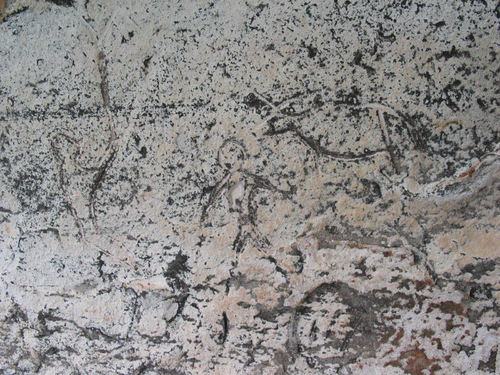
PaintingTumpalai Phu Pha Yon
The various engraved drawings can be classified as follows:1. Human figures. There are 21 engraved drawings of people, including both realistic and semi-realistic portraits. There are 9 realistic drawings, 2 of children and 7 of adults, that show the similarity between the real person and the drawing, for instance, the drawing of a person with an emphasis on only the outlines; the description of organs such as ears, eyes, mouth, nose, fingers, toes are not shown. The semi-realistic drawing is the drawing that characterizes the person in proportion but will be inaccurate from reality, for instance, the human head is in a square shape or the muscles of the limbs are not focused. However, other important parts such as ears, eyes, mouth, nose, fingers and toes aren’t completely shown. There are 12 drawings of this type. 2. Human hands. There is only one drawing of a right hand with the palm open. There are six fingers on the hand.3.Animals figures There are 21 drawings, 8 of fish, 4 of birds, 2 of dogs, 1 of a squirrel or a chipmunk, 1 of a buffalo, 4 of buffaloes or cows, 1 of a frog or a small green frog. 4. Geometrical motifs There are a lot of drawings with straight lines, curve lines or lines with different patterns, square, triangle, cross, arrowhead, rhombic triangle, single line, arranged lines, and crossed lines and sometimes the shape cannot be identified. 5.Appliance For example, a picture that resembles a plow, farming tools that show only the head area called “Moldboard plow” or “Phal” at the rear. There are also drawings of a shovel with a handle and a fan for blowing away the withered grain. 6.Building There are 2 drawings that look like a house. It is a house with a gable roof. One drawing is of a house with a dog inside and another drawing is of a house with a crossed roof similar to the roof of Kalae house or the roof of a hut in a farm in northeast of Thailand and it looks like there is a person inside the house.