Artwork Search
Arts in Southeast Asia Database


SculptureJataka Narrative in Terracotta: Mahajanaka
Piet Liek Chedi is a bell-shaped chedi of the early Puklam period, influenced by Pala art. The base of the chedi contains 550 naratives scene in terracotta. These scenes are made of terracotta, but have not been enameled in green, which is different from Chavechikong. This shows that these scences may be dated in the pre-Pukam and the early Pukam period.

SculptureJataka Narrative in Terracotta: Sama
Piet Liek Chedi is a bell-shaped chedi of the early Puklam period, influenced by Pala art. The base of the chedi contains 550 naratives scene in terracotta. These scenes are made of terracotta, but have not been enameled in green, which is different from Chavechikong. This shows that these scences may be dated in the pre-Pukam and the early Pukam period.
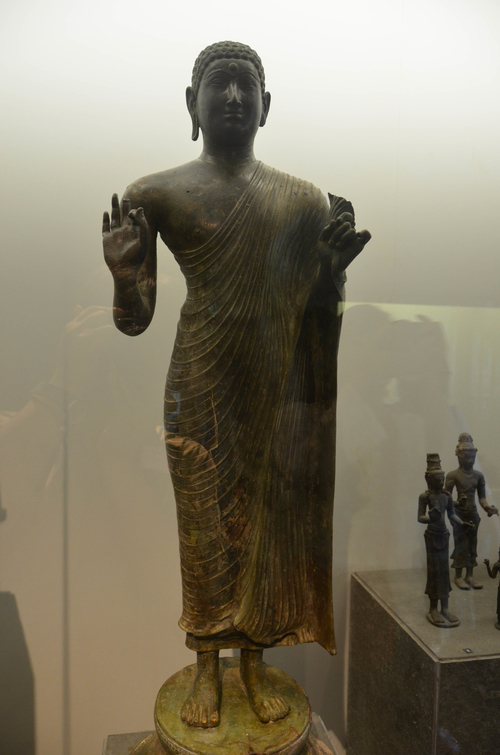

SculptureBuddha Image from Dong Duong
The characters of this Buddha image are of the normal Amaravati or Sri Lankan art. Low Ushanisha, the curly hairs, one-shoulder-covered robe with the left rim raising towards the left hand in the shape of triangle are some of the characters of Amaravati or Sri Lankan Buddha images. The right hand is in Vitarka Mudra while the left holds the tip of the garment in symmetrical manner, which also affiliate to Sith Indian or Sri Lankan art.
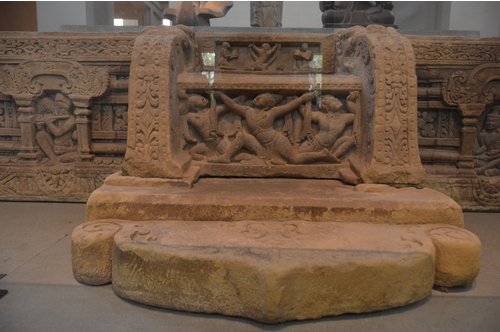
SculptureStone Base from My Son E: Details
The entrance stair was influenced heavily from India such as the picture of a giant lifting the base, the handrail with the lions, decorated with flower pattern, and the bracket. The decoration of lions at the handrail and the flower pattern remind us of the same patterns at Achanta cave and Lanka art in Anuratthapura, which was in the same period or a little earlier. This shows the relationship between Cham kingdom and India and Lanka

SculptureStone Base from My Son E: Details
There are niches on both sides of the linga base. These niches are very similar to “Kutu” or “Chandhasala” in Indian art. That is to say they are low arches decorated with dragons. However, a curving Naga pattern has been added into the Cham art, making the niches have both curving in and curving out pattern.


SculptureHari-Hara
This free-standing sculpture is characterized by the division of Shiva and Vishu iconography. Jatamakuta and Trishula of Shiva are in the right whereas Kiritamakuta and disc of Vishu at the left. The long dhoti indicates Indian affiliation but the tiger head at the right side of the dhoti is the iconographical character of Shiva.

SculptureBuddha Sculpture
The Standing Buddha Image with The Abhaya Mudra or Standing Repelling Posture. and walking images. The gesture can be made with the right hand, the left hand or both hands. The hand is held upwards, palm facing outward, the fingers together, the arm bent at the elbow. The Fleshy protuberance on the crown of the head is in the spiral without unalom ( hair between eyebrows). The eyes look low. The robe is very thin and look like it is wet. It is fully covered the whole body without stripe in the Indian’s Gupta art of Sarnath School. The right arm raised up in the Vitarka Mudra (teaching gesture) Position while the left arm that is missing, is assumed to originally hold the seam of the robe in the pattern of Gupta Art. The Buddha Image is firmly upstanding.