Artwork Search
Arts in Southeast Asia Database


SculptureHari-Hara
This free-standing sculpture is characterized by the division of Shiva and Vishu iconography. Jatamakuta and Trishula of Shiva are in the right whereas Kiritamakuta and disc of Vishu at the left. The long dhoti indicates Indian affiliation but the tiger head at the right side of the dhoti is the iconographical character of Shiva.
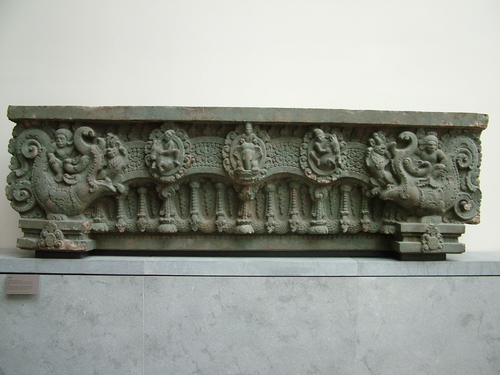
SculptureLintel
Lintel is an architectural element normally installed at the top of the door. Lintel of Sombor Preikuk period is characterized by the couple of inward-facing Makara disgorging four arches punctuated by three medallions. Makara normally stand on the base and is ridden by a person. Inside the medallions exists the figure. Below the arches exists the stings of garlands and the flowery tassels.

SculptureWall Carved: Prasat at Prasat Sombopraikuk
The Prasat is built from bricks located within the square plan. There is the pillar attached to each corner of the Prasat as well as the Ruean Tat (Middle Part of the Prasat). There is only one entrance with three others are seen but clogged. The roof are made in the replica pattern of Ruen Tat stacked up in the style of Vimana of Suthern Indian Art. The Prasat is located on a flat ground with no stacking base.
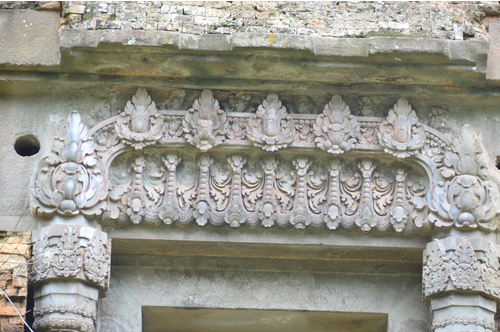
SculptureLintel
Lintel is a piece of architecture found in Khmer art. It is always mounted on the entrance door frame. The Lintel in the picture belongs to the Prei Kmeng Art which leads to Kampong Phra Art. It is characterized by the curved line which is drawn in a single straight line in the center of the lintel with the picture of tokens appear in the center of the curve line. This style belong to the Prei Kmeng Art. However, the tokens have been transformed into a leaf pattern which is identical with the pattern at both ends of the Lintel. This leaf pattern is later found its fame in the Kampon Phra Art.
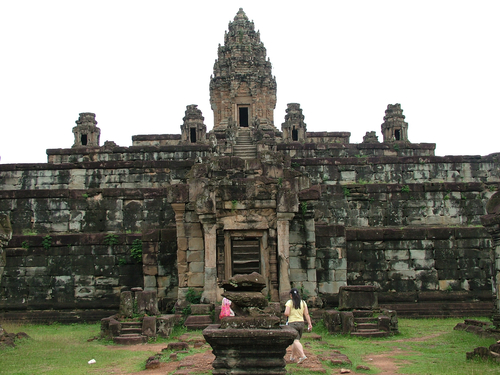
ArchitecturePrasat Bakong
Prasat Bakong comprises the sole main tower on the top of the stepped pyramidal base surrounded by the series of small temples. In the front, there are the gateways leading towards the staircases. The base is surrounded by series of the bigger brick temples which located on the ground and scattered in several directions (not visible in the photo). Prasat Bakong is the example of the earliest stepped pyramidal based temple as the temple is without the complexity and the base supports only one temple on the top. The complexity of the temple would be increased in the later period.
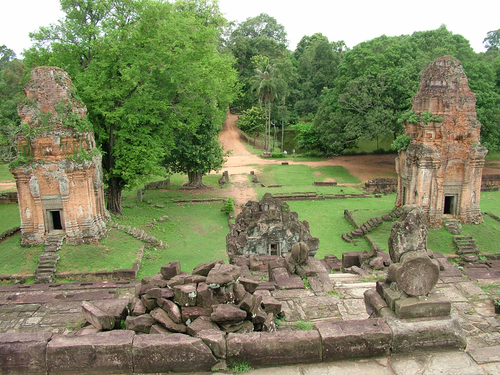
ArchitectureSubsidiary Towers of Prasat Bakong
The subsidiary temples of Prasat Bakong are made of brick and decorated with stucco. These temples scatter in every directions of Prasat Bakong. There are eight in number. ( 2 temples in each direction as being seen in the photo)
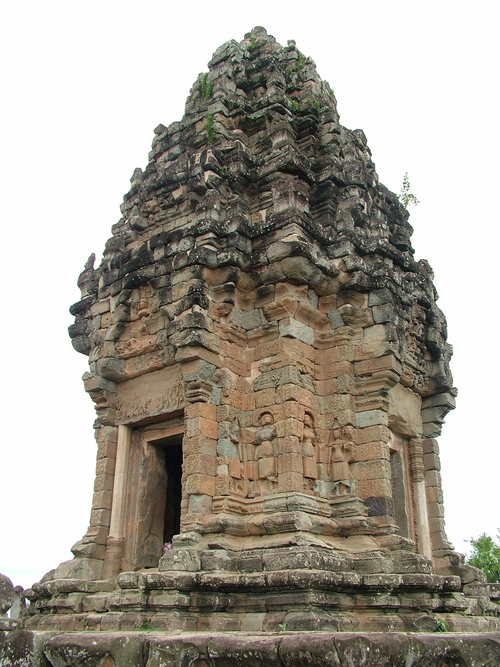
ArchitectureMain Tower; Prasat Bakong
While the subsidiary temples are made of brick, the main tower is surprisingly constructed of sandstone and decorated with the later-period Angkor Wat-styled motif. This differs from the normal date of Prasat Bakong which is assigned to Prah Ko style. Possibly, the main tower was constructed later during the period of Angkor Wat for replacing the original brick temple which is possible to be dilapidated during that period. The characters of Angkor Wat style of temple are the redent body and the decoration of Apsara (female deities) at the corner of the temple as well as the decoration of the antefixes at the superstructure.
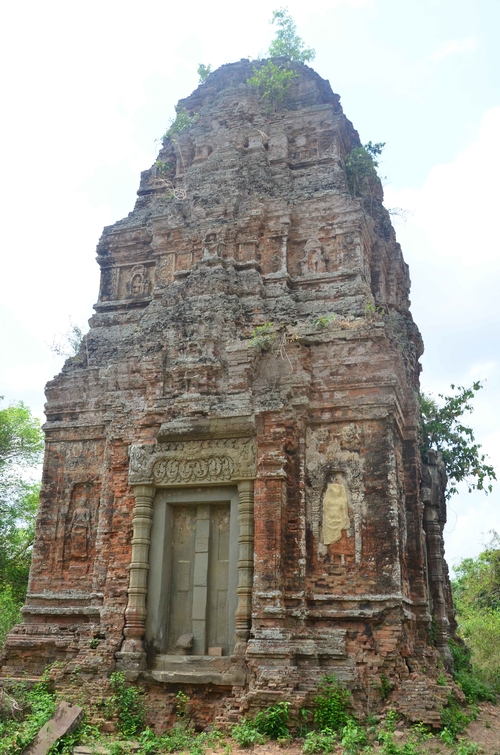
ArchitecturePrasat Trapang Pong
The temple is made of brick and decorated with stucco, typical to Preah Ko style. The body is decorated with the images of female deities which are similar to the pattern at Prasat Preah Ko and Prasat Lolei . The lintel and the colonnette are however made of stone. The lintel is dominated with the Kala face disgorging the garlands ended with Makaras, testifying the Javanese connection. The superstructure composes of the miniature multi-tiered roofs indicating South Indian connection whereas the central portion of the temple is articulated with the multi-angled pattern which is similar to those in Pre-Angkorian period. The combination of the styles is expected in this period as Preah Ko period is the transition between the Pre-Angkorian and Angkorian art.