Artwork Search
Arts in Southeast Asia Database


SculptureGaruda being slaved by Serpents
Candi Kidal is the place where ashes of king Anusabadhi of Singasari dynasty were buried. He died in 1248 and because the death and the rituals had to always be sepeated by 12 years, this religious place was built in 1260. There are narratives showing Garuda stealing holy water to save his mother. The holy water is the water of eternity. This relates to “Tevaraja” principle in that it helps the dead gain eternity.

SculptureGuardian Sculpture
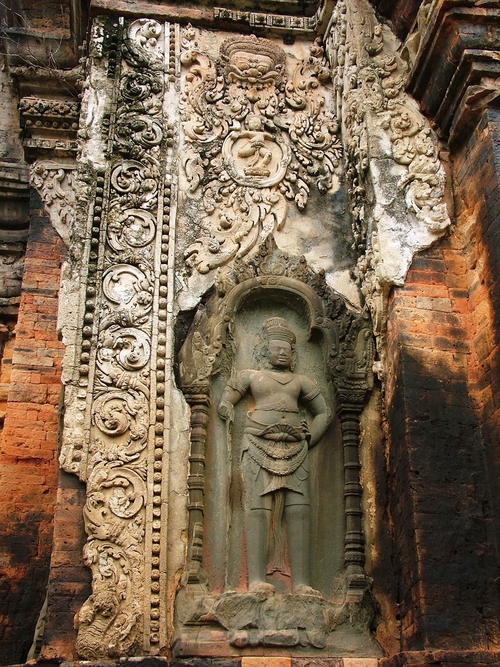
Guardian Sculpture is carved with full-costume, wearing headwear with cylinder hair style as the trait of the sculptures of Angkor Era. The Guardian wears a curved belt and strap (belly belt), the over the trunks brocade with frilly dress. The selvage is in the fish tail pattern in the front while the side lies unnaturally which is the trait of Angkor Art.

SculptureLintel
Lintel is an architectural element normally installed at the top of the door. Preah Ko lentel. as being under the influence of Javanese and Kulen art, is characterized by the Kala face in the middle of the upper part of the lintel. At the both ends of the lintels are the outward-facing Makaras inspired by Javanese Kala-Makara niche. However, more variation of the style is noticeable in Preah Ko period. Above and below the garland exist the vegetation leafs as continuing form Kulen style. There are also figures inserted throughout the vegetative motifs anticipating Koh Ker style of lintel. The lotus band at the bottom of the lintel, however, anticipates Pre Rup style of lintel.

SculptureNaga
The Naga Sculptures often found on the banisters or stariways depicted in the many headed form especially 7 headed Naga. The naga bores heavy influence from pre 16th Buddhist Century Khmer Art. The heads of Naga are bald without the headgears.
ArchitectureAngkor Wat
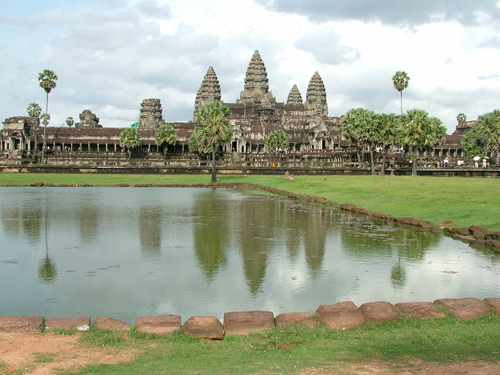
Angkor Wat is surrounded by the one-kilometer-long moat. The front is marked by the elongate walkway leading through the temple. The temple rests on the triple stepped platforms encircled by three rings of galleries. The gateways and the corner-temples are added in every elevation. On the top of the platform are five main towers. Angkor Wat is considered to be the culmination of Cambodian architecture, as the design of the temple combines the architectural success of Takeo (5 towers on the top of the platform) and Baphoun (galleries resting on platforms).
SculptureMain Tower: Angkor Wat
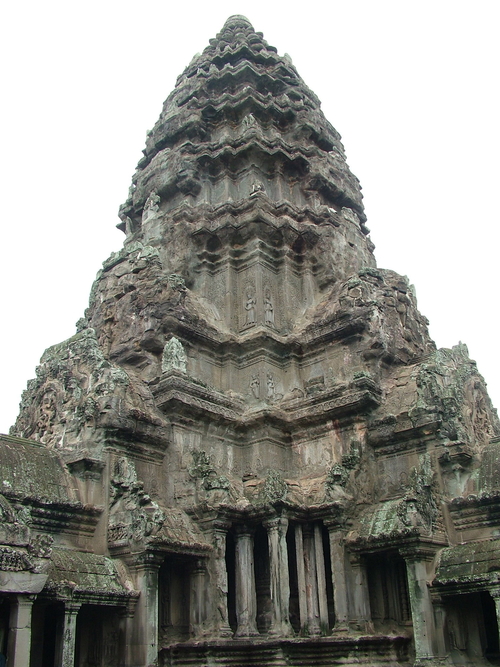
The central tower of Angkor Wat is of the normal character of the 12-century Cambodian temple. The temple is made of sandstone and added by the enterable doors cum porches. In case of Angkor Wat, the porches connect to the galleries of the four directions which turn the plan of the main temple into cruciform plan. The body of the temple is multi-angled. The superstructure is decorated with antefixes turning the stepped-contour roof into the corn-liked shape one. The antefixes have been used for the superstructures of the contemporaneous temples, like Phimai and Banteay Samre .