Artwork Search
Arts in Southeast Asia Database
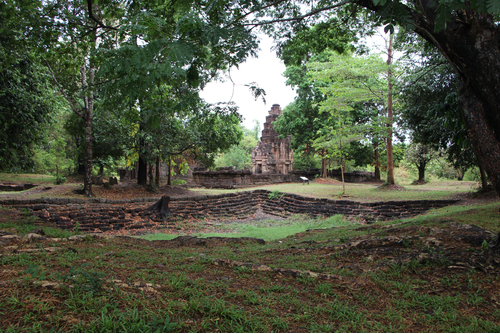

ArchitecturePrasat Ta Muan Tot
Prasat Ta Muan Tot is a chapel “Arogayasala”. It was built to treat diseases during the reign of King Jayavarman VII during the 18th century B.E. The architectural elements of the Arogayasala are the same everywhere. There will be one principle prasat made of laterite and sandstone. It is a square diagram with recessed corners. The top part was carved with sandstone in the lotus petals pattern. There is only one entrance and exit, the other 3 sides are false doors. The entrance was made as a long room with a porch in the front. The roof was made of sandstone and laterite. There is a Banalai in a rectangular diagram built from sandstone and laterite on the east of the principle prasat. There is one entrance and exit. The eastern area is surrounded by an inner wall and under a laterite arch door that is divided into 3 booths. A stone inscription, built around the 18th century B.E., inscribed in Khmer letters, Sanskrit language was found around the booths and it is currently at Wachirayan Book Hall, Bangkok. The inscription mentioned Phra Phaisachayaguru, the Bodhisattva who granted people a healty life. It also stated that King Jayavarman VII donated materials and equipment and arranged staff to stay in the hospital as well. The north-eastern side of the prasat appears a pond.