Artwork Search
Arts in Southeast Asia Database
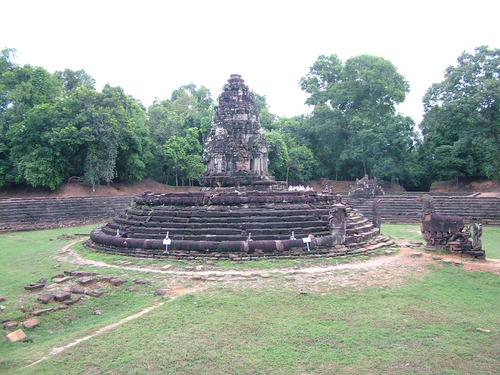

ArchitecturePrasat Neak Pean
Jayavarman VII had the reservoir entitled “Jayataḍāga” to be excavated in front of the complex of Rāajayaśrī (Prasat Preah Khan). In the middle of the lake there exists Prasat Neak Phan, the representation of the mythical Anottāta Lake, the holy lake in Buddhism.
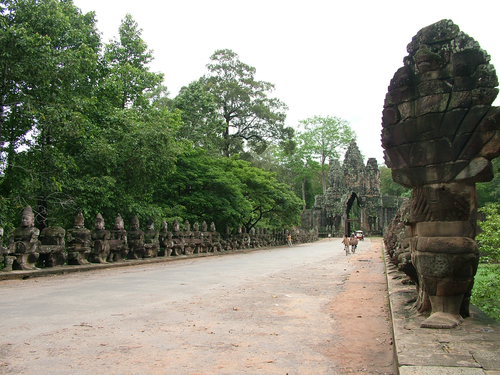
ArchitectureSouthern Gate of Angkor Thom
The Gateway of Angkor Thom composes of 2 elements, the tower decorated with the gigantic four human faces and the bridge crossing the city moat. The balustrade is associated with the story of the churning of the milky ocean in accordance with Hindu mythology. This iconography is associated with the auspiciousness for the people who would be blessed to be the immortals. Concerning the gigantic four human face at the tower is possible to be the faces of the lords of the cardinal directions.

ArchitecturePrasat Banteay Kdei
Dated toi Bayon period, Prasat Banteay Kdei was erected by King Jayavarman Vii . The temple comprises a number of towers connected by the cruciform galleries, typical to this period. The plan of the temple is conceived as a diagram, reminiscent of Mandala diagram in Mahayana Buddhism.


ArchitectureThap Doi
Thap Doi is the example of Khmer-influenced temple in Cham art. The Khmer influence is noticeable from the insertion of stone into the brick wall and the decoration of several antefixes on the superstructure. These antefixes shape the contour of the superstructure as the curvilinear lotus-bud-liked spire, similar to Angkor Wat and Bayon art. The cornered Garuda is also typical to Khmer art indicating the Cambodian affiliation while Jayavarman VII seized the political role in Champa. This temple therefore is datable to late Binh Dinh art.

ArchitectureSuperstructure: Thap Doi
Thap Doi is the example of Khmer-influenced temple in Cham art. The Khmer influence is noticeable from the insertion of stone into the brick wall and the decoration of several antefixes on the superstructure. These antefixes shape the contour of the superstructure as the curvilinear lotus-bud-liked spire, similar to Angkor Wat and Bayon art. The cornered Garuda is also typical to Khmer art indicating the Cambodian affiliation while Jayavarman VII seized the political role in Champa. This temple therefore is datable to late Binh Dinh art.

SculptureLintel
Lintel is an architectural part that is found in Khmer art. It is always placed on top of the entrance gate. Lintel in Phra Kho period has Kala following the influence of Java art. However, A distinctive feature of this lintel is the decoration of the quarter part of the garland with “ an animal face biting the garland”. This is the model for the quarter Uba in Banteau Srei and Bapuan arts.

SculpturePediment Carved of Umamaheswara
The triangular Pediment is straighten up vertically. Above it, is an arch in a wavy pattern. The beautiful wavy style on the arch is systematic. The the both ends of the arch are the multi-headed nagas as in the pattern of architecture of the late Angkor Period. The center part of the Pediment depicted the story of Umamaheswara.