Artwork Search
Arts in Southeast Asia Database


ArchitectureSim
This Sim is a large Sim with a high base that leans forward. There is a porch at the front and the pediment is decorated with curving wooded pieces. There is just one tier of roof and the decoration is of Rattanakosin art. However, there is still Naga in the decoration and the edge of the roof is decorated with gable apex or Sattaburiphan.
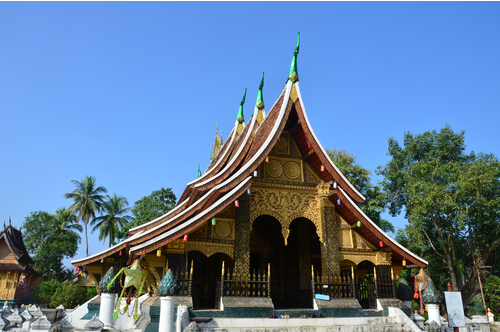

ArchitectureSim: Wat Xiang Thong
Sim (the ordination hall) of Wat Xiang Thong is the most significant example of the pavilion in Luang Prabang school. The most important characters are the multi-angled plan providing several doors scattering at every corner of the body. The pediment edge is of curvilinear contour reaching the ground level. The tympanum is divided in to several small square panels (Ma Tang Mai tympanum system). Below the frieze is the double-arched fillets which is the character that share both in Laotian and Lanna art. The style of the pavilion in Laun Prabang school is closely similar to tha of Lann art in Northern Thailand.

ArchitectureCho Fa: Wat Xiang Thong
Sim at Wat Xian Thong is the most complete sim in Lan Chang art of Luang Phra Bang school of art. At the ridge of the roof, there is a gable apex or the copy of Meru mouth. This symbilises that sim is the center of the universe surrounded by 7 Suttaboribhan mountains of different heights. At the edge, there is a universal mountain and at the bottom, there is fish ti represent the ocean. Such representation of Meru always appears in paintings both in Myanmese and Thai arts. This may be the model of the gable apex in Lan Chang art.
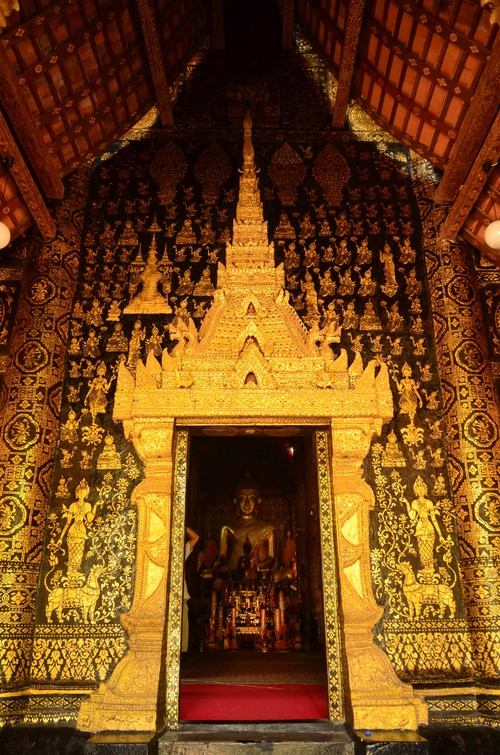
ArchitectureSim’s Gateway : Wat Xiang Thong
Sim at Wat Xian Thong is the most complete sim in Lan Chang art of Luang Phra Bang school of art. The interior decoration is very beautiful, being decorated with Kham pattern. At the front wall, there is a picture of gods paying respect to a chedi, which may be Chulamanee on the heaven. The sim’s gateway has the characteristics of Lan Chang that share many characteristics with Lanna art including the gate pole is decorated in three parts: high arch tiles, low arch tiles and the flower. The top of the Prasat is a tier of a large sloping roof topped with many tiers of lotus flower shape elements.

ArchitectureSim : Wat Kili
wSim at Wat kili is the most complete example of Chiang Kwang sim in Luang Phra Bang. The sims of Chiang Kwang school of art at Khoun city were all destroyed during the war. This makes it only possible to study the Chiang Kwang school of art in Luang Phra Bang. The sim of Chiang Kwang school of art is very similar to that of Luang Phra Bang in terms of the pediment that has a curvy frame falling down almost to the ground and the “Ma Tang Mai’, a special feature of Lanna art. However, the most diiferent feature is that the pediment of Luang Phra Bang schoolof art has brid-winged partitions, the pediment of Chiang Kwang school of art does not have it at all.

ArchitectureSim : Wat Pak Khan
Sim at Wat Pak Khan is the most complete sim in Lan Chang art of Thai Leu school of art. It has wide supporting posts and the height of the roof at the front is equivalent with the height at the side. Thia Leu sim was popular in Sip Song Punna, which is now in Yunan state in the south of China. The appearance of Thai Leu sim in Luang Phra Bang shows the migratioin of Thai Leu people from Sip Song Punna to find settlements in Luang Phra Bang.

ArchitectureSim : Wat Mai
Sim at Wat Mai has a distinctive roof tiering system. The building is in a rectangular plan that alnost resembles a square one. The top tier is a “Loi” type of tier on top of the main roof. Below is the bird-winged roofs that covers the Palai. Each tier has high supporting poles. At the front, there is “Hor Kwang”, which is a special feature of this sim.


PaintingPrevious Buddhas and Their Great Departures
Paintings in the early Kongbong are similar to those of Nyongyan. The distinctive feature is the use of hot-shading color with green color. There is no landscape. x The drawings are simple similar to drawing cartoons in the present time. Each picture is seperated by connected curves called “Sintao”. Empty space is filled with flora patterns. Sometimes pictures are drawn in long strips similar to pictures on ancient palm leave manuscripts. However, a high crown of Thai style shows that these paintings were painted after Ayutthaya was taken for the second time.