Artwork Search
Arts in Southeast Asia Database
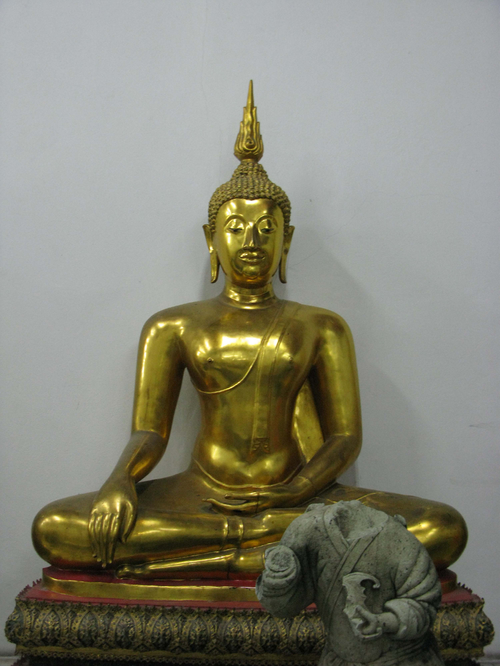

SculptureThe attitude of subduing Mara
The Buddha image is in the attitude of subduing Mara siting simple cross-legged on the plain base. It has the oval-shaped face. The hair curls are not small, yet not big. The aureole is flame-liked and quite short. It has arched eyebrows. The eyes are partially open gazing low and the outer corners of the eyes are uplifted. It has a hook nose with curvy lips like a wave. The body is well-proportioned. The outer robe is long reaching the navel and its edge is folded like the centipede fangs. The fingers are not equal in length and the index finger is a little bit lifted. The image has Thai alphabet during Rattanakosin period specifying “Sankhalok”, written in Rama I period which means this Buddha image was respectfully engaged from Sawankhalok or Si Satchanalai during the respectful invitation event from Sukhothai.
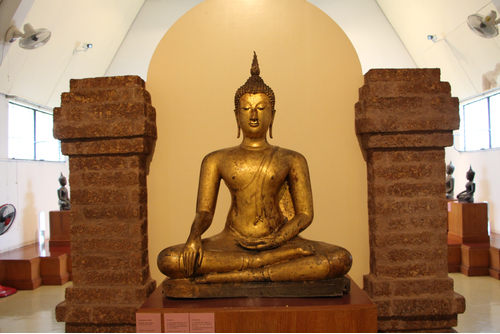
SculptureThe attitude of subduing Mara
The image is seated in a basic cross-legged gesture on the plain base while the hands are doing the attitude of subduing Mara. The significant features that classify the image under the General Group are the oval face, the curved eyebrows, the low gazing eyes, the aquiline nose, the well-proportioned lips, the big hair curls like a whorl, high swelling Usanisa, the flame-liked halo, wearing cross-body robe with no crease, and the long small outer robe reaching the navel which the edge is folded known as the centipede fangs. There is the name of its creator and the desire in building it.
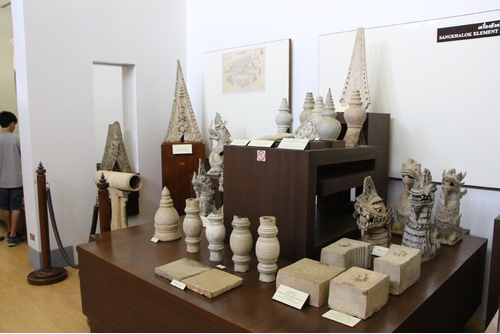
SculptureSangkhalok
There are a lot of architectural decoration parts, the important ones are Makara, decorated the finial of a gable and it would develop to be Hang Hong (finials on the outer corners of the lower roof sections), the ridge that would become Cho Fa (gable finials), Barali (finials evenly spaced on the roof-ridge) for roof ridge decoration, purlins , banisters, and floor tiles.
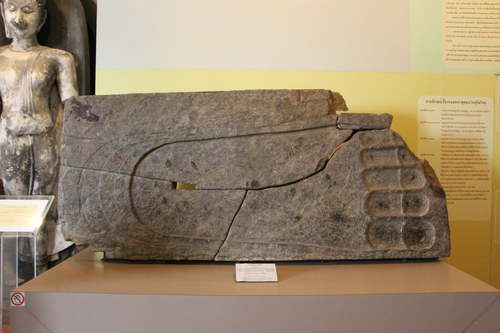
SculptureThe footprint of the Buddha
The footprint is engraved on a rectangular stone. Some parts of the stone are damaged. There are actually four overlapped footprints detected by the lines on the sides and heel. The footprint that was used for pattern studying is the smallest one as other three have only the lines on the sides and heel. The toe fingers on the smallest footprint are not equal in length. Each finger has a whorl motif decorated. In the middle of the sole, there is Chakra symbol which are decorated with the 108 propitious motifs. Two points on the area connected to the toe fingers are decorated with whorl motifs , while the heel is decorated with lotus petal motif.
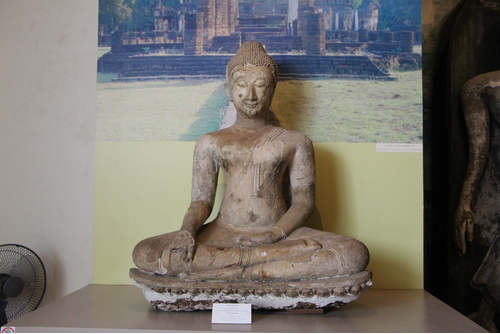
SculptureThe attitude of subduing Mara
The stucco Buddha image is sitting simple cross-legged on the lotus base. The hand is in the attitude of subduing Mara. The image has a round face, yet rather oval which could indicate the time during the change from the round face in early Sukhothai Buddha images to the oval face the Major Group. The eyebrows are arched. The eyes are gazing down. It also has a pointed nose, well-proportioned lips and small finer hair curls. The robe is worn across the body without drapery folds. The outer robe is worn on the left shoulder. It has a special feature that makes it different from other images in the Major Group which is that the whole outer robe is folded while other images in the Major Group will be folded only the edge.
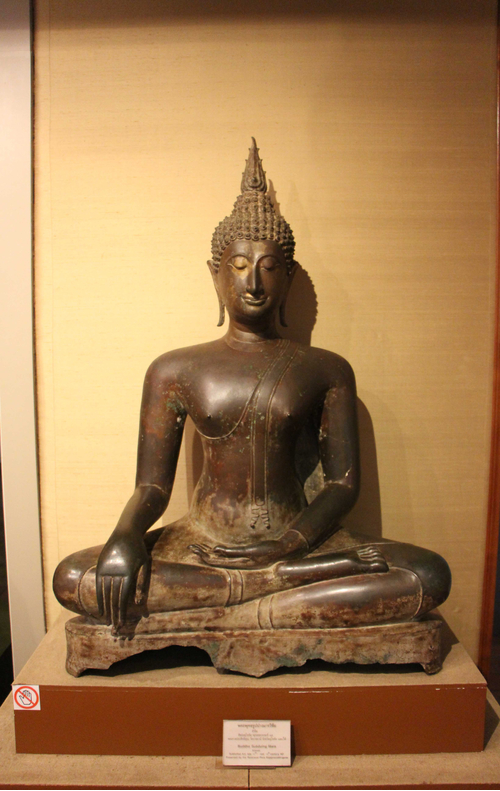
SculptureThe attitude of subduing Mara
The Buddha image is in meditation posture sitting simple cross-legged on the plain base. The hands are performing the attitude of subduing Mara which is the remarkable feature of Sukhothai Buddha images under the Major Group and the features are including the oval face, the arched eyebrows, the low gazing eyes, the aquiline nose, the well-proportioned lips, the big spiral-liked hair curls, the high Usnisa, flame-liked aureole, wearing cross-body robe with no crease, the long small outer robe strip with the edge reaching the navel, and the folded edge known as centipede fangs.
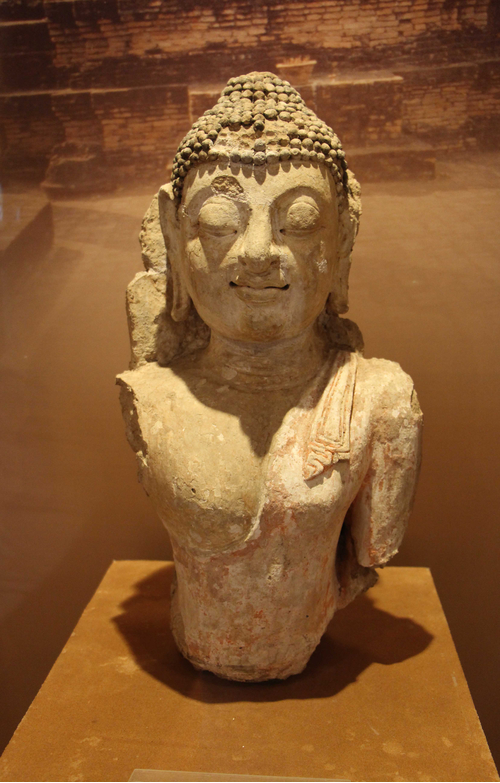
SculptureBuddha image
The Buddha image is damaged in many parts that it cannot be detected of which manner and attitude it was originally made. As it is a high relief sculpture, it is believed that the image was used to decorate a religious place attached to the wall. It has a round face with arched eyebrows and pointed nose. The eyes are gazing down. The lips are fairly well-proportioned, though curvy-shaped like a wave. The hair is tightly curled into finer small curls. Usanisa (cranial bump) is swelling high. The halo on top of the head is damaged and missing. The image has prominent chest with the robe worn across the body, no drapery folds. The outer robe is small and short only above the breast. The edged is folded in many layers and this is known as centipede fangs.
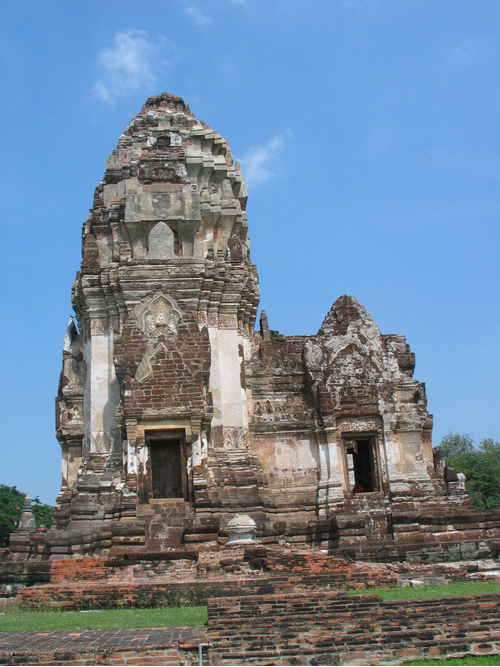
ArchitecturePrang Phra Si Rattana Mahathat Lopburi
Phra Si Rattana Mahathat Lopburi was erected on the Phai thi base and oriented toward the east. Initially the main prang was flanked by two smaller prangs to the north and the south which were destroyed. Prang Phra Si Rattana Mahathat Lopburi was main