Artwork Search
Arts in Southeast Asia Database

SculptureLintel
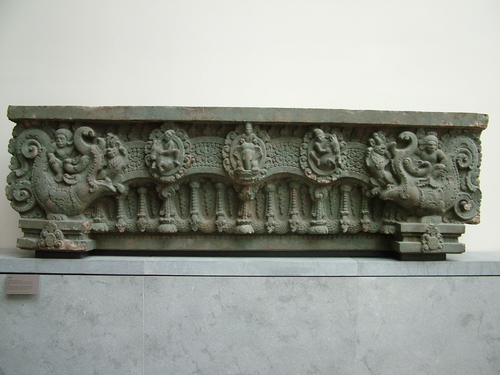
Lintel is an architectural element normally installed at the top of the door. Lintel of Sombor Preikuk period is characterized by the couple of inward-facing Makara disgorging four arches punctuated by three medallions. Makara normally stand on the base and is ridden by a person. Inside the medallions exists the figure. Below the arches exists the stings of garlands and the flowery tassels.

SculptureWall Carved: Prasat at Prasat Sombopraikuk
The Prasat is built from bricks located within the square plan. There is the pillar attached to each corner of the Prasat as well as the Ruean Tat (Middle Part of the Prasat). There is only one entrance with three others are seen but clogged. The roof are made in the replica pattern of Ruen Tat stacked up in the style of Vimana of Suthern Indian Art. The Prasat is located on a flat ground with no stacking base.
SculptureLintel
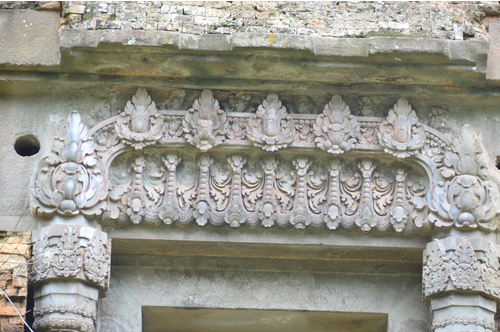
Lintel is a piece of architecture found in Khmer art. It is always mounted on the entrance door frame. The Lintel in the picture belongs to the Prei Kmeng Art which leads to Kampong Phra Art. It is characterized by the curved line which is drawn in a single straight line in the center of the lintel with the picture of tokens appear in the center of the curve line. This style belong to the Prei Kmeng Art. However, the tokens have been transformed into a leaf pattern which is identical with the pattern at both ends of the Lintel. This leaf pattern is later found its fame in the Kampon Phra Art.
SculptureMain Tower: Prasat Banteay Srei
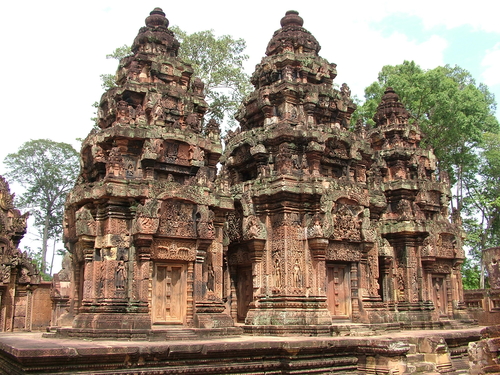
Banteay Srei is the triple temples rested on the flat platform. The central tower is dedicated to Shiva. Although there is no inscription mentioning to whom the subsidiary ones were dedicated, they are possible to be dedicated to Uma and Ganga, two consorts of Shiva, as the attendants carving on these temple are only female. These towers are made of sandstone, typical to the Late Angkorian period. However the older fashion is still visible, such as the three-sided false doors and the miniature temples that are decorated at the corner of the superstructure.


SculptureMinaret: Masjid Kampong Hulu
The minaret of Masjid Kampong Hulu seems special and interesting because the minaret duplicates the shape of lighthouse. The octagonal tower is in tapering shape unlike the minaret of Masjid Kampong Kling, which is in the shape of Chinese pagoda. Moreover, using lighthouse as the minaret shows the adapted western style that can be found In Southeast Asia. Another example is the minaret of Masjid Melayu in Penang.

SculptureDrawing depicting Kyauktawgyi
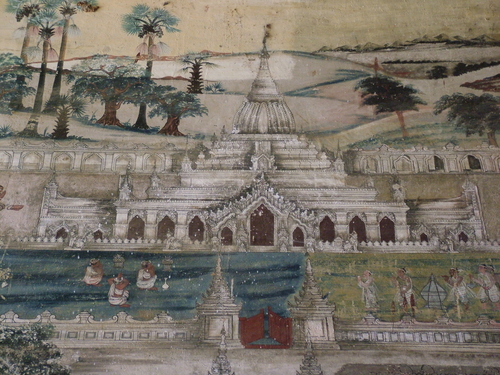
During the period of Amarapura and Mandalay art, the western-influenced realism played an important role in Burmese murals. The picture of Kyauktawkyi was therefore drawn here ford depicting the city of Amarapura itself. The volume of the temple and the landscape at the background are accurate in accordance with the perspective.


SculptureMirrored Tree at the backside of Sim Wat Xiang Thong
The mirrored mosaic decoration on the outer wall seems to be very popular during in the Luang Prabang school of art during the 20th century A.D. Lots of pavilions at Wat Xiang Thong bear this kind of decoration. The mirrored mosaic is more durable than the mural and also gives the effect of glittering than the mural. So, this technique becomes very popular during this period.

SculptureJulamanee: Golden Painting at the inner wall of Sim Wat Xiang Thong
In Lan Chang Art of Luang Phra Bang school around 25 century BE., the golden painting was very popular. It was mostly decorated inside the building. At the front of Chiang Khong temple, there is a picture of gods honouring the very beautiful Chedi Julamanee.