Artwork Search
Arts in Southeast Asia Database


ArchitectureHtilominlo
The double-storeyed temple of Htilominlo seems to be the copy of Sulamani temple which had been constructed during the previous reign. This temple follows the normal convention, comprising the gigantic core at the lower storey to support the temple at the upper storey. The temple is capped by the Śikhara spire which is not different from Sulamani. The double-storeyed temple is typical to late Pagan art. It was firstly introduced In the reign of Alaungsitthu and became very popular during the reigns of Narapatisitthu and Nantaungmaya.

ArchitectureMahabodhi
As this temple is the imitation of the great temple at Bodhgaya, the plan is also laid in accordance with the prototype. The plan of Mahabodhi was designed in the two-chambered scheme with the front room for the Buddha image and the rear one for the Bodhi tree. The body of the temple is designed in the form of Jagatī platform supporting quincunx Śikhara temples which is called in Indian term as Pañcāyatana scheme. The Śikhasra spire is designed with trapezoid contour, similar to Bodhgaya’s Śikhara in Indian art. This uniqueness attests the attempt of the replication of Bodhagaya temple in India. The spire of Mahabodhi at Pagan, therefore is totally different from the normal curvilinear-contoured Śikhara in other Pagan temple.
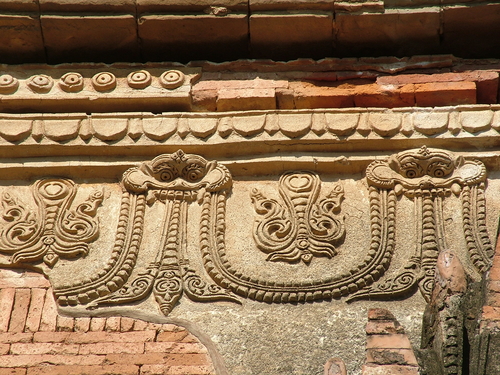
SculptureKala faces disgorging garlands
At the top of the chamber of Chedi in Pukam is always decorated with Kara releasing garlands-Uba. Such patterns appeared in Pala before becoming very popular in Pukam art. They also show the will to always have the chamber deocated with fresh flowers.
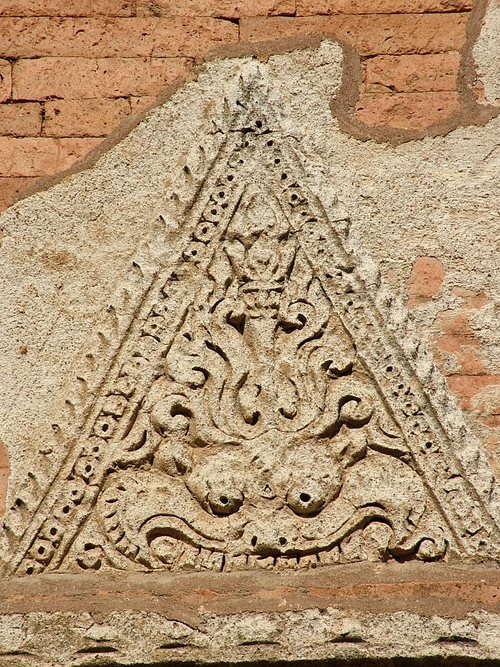
SculptureTriangular motif with Kala face
The columns of the chamber are always decoarted with the “lower arch frame”, which is a part of the three patterns on the columns: The top arch frame – the flowers- the lower arch frame. All of the patterns are in the rectangular frame that is full of flower or Kanok patterns. Sometimes, there are Kara releasing flowers as well.