Artwork Search
Arts in Southeast Asia Database


SculptureLintel carved of Kurma
This sculpture is a part of the lintel of the scene when Vishnu disguised into a turtle to bear the mountain in stirring the milk sea. There are gods and demons on two sides standing in rows with thier hands touching the Naga. Above this is a row of swan and gods sitting with one knee up and put their hands together. In the middle, there is a mountain that the turtle bears. At the column, there is a Vishanu sculpture embracing the mountain. At the top, there is Bhraman. People in the carvings wear funnel-shaped-top crown caps, necklects with tufts, bracelets, short cloth and the end of the cloth has two fish tails on top of each other. Such characteristics are the features of Angkor Wat art.
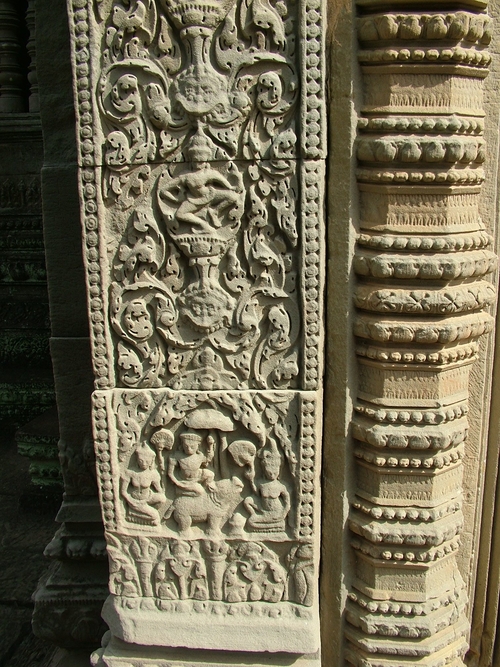
SculptureWall pole and Door columns
The door columns are of octagonal shape and were inherited from the early Angkor Wat period. There are small triangular leaves put together in the shape of serration. So, there are more than one leaf per side of a column. The wall pole is fully decorated with coiling and flower patterns. Also, there is storytelling scence on the pole such as the picture of Shiva.
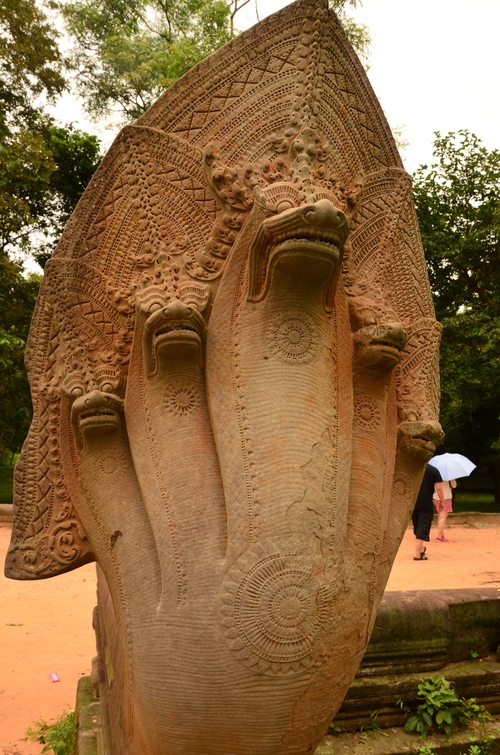
SculptureHead of Naga
Naga is generally found in Khmer art. It is usually used as a component of a balustrade or walkway. The Naga has 5 heads. All of the heads wear cap and share the same halo, which is the characteristic of Angkor Wat art.

ArchitectureAngkor Wat
Angkor Wat is surrounded by the one-kilometer-long moat. The front is marked by the elongate walkway leading through the temple. The temple rests on the triple stepped platforms encircled by three rings of galleries. The gateways and the corner-temples are added in every elevation. On the top of the platform are five main towers. Angkor Wat is considered to be the culmination of Cambodian architecture, as the design of the temple combines the architectural success of Takeo (5 towers on the top of the platform) and Baphoun (galleries resting on platforms).

SculptureMain Tower: Angkor Wat
The central tower of Angkor Wat is of the normal character of the 12-century Cambodian temple. The temple is made of sandstone and added by the enterable doors cum porches. In case of Angkor Wat, the porches connect to the galleries of the four directions which turn the plan of the main temple into cruciform plan. The body of the temple is multi-angled. The superstructure is decorated with antefixes turning the stepped-contour roof into the corn-liked shape one. The antefixes have been used for the superstructures of the contemporaneous temples, like Phimai and Banteay Samre .